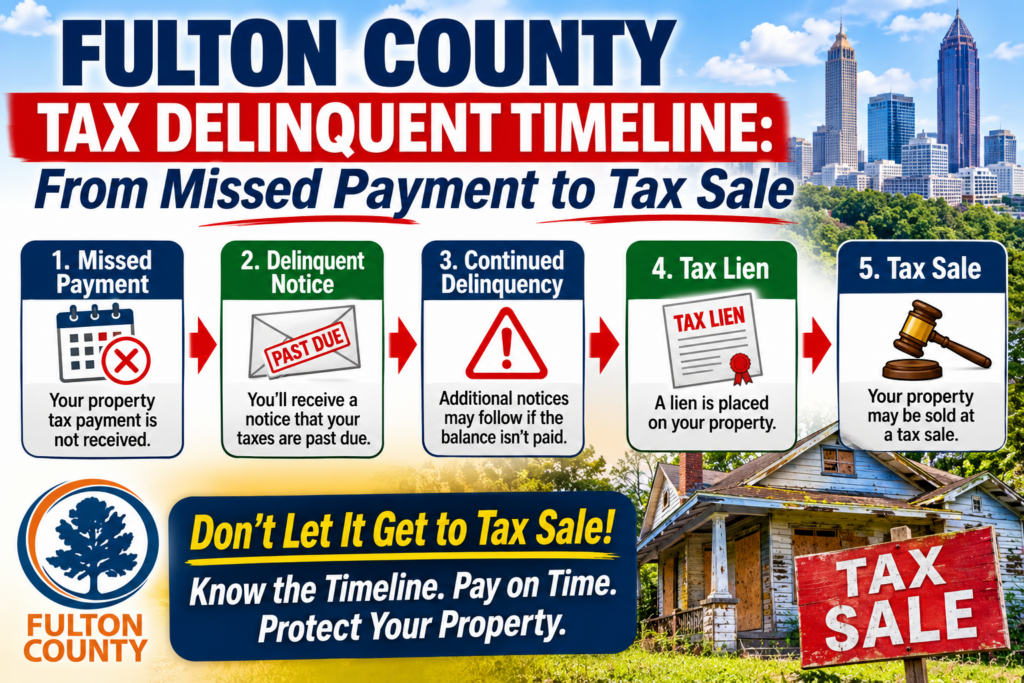
If you’re behind on Fulton County property taxes, the first thing to know is that being late does not necessarily mean your property will be sold right away. Delinquent taxes move through a series of stages, with notices along the way. But it’s also not something to set aside. Interest can build, a tax lien can be recorded, and the property can eventually be scheduled for a tax sale.
The exact timeline is different for every account. It depends on the tax year, which notices were sent and when, what collection steps the county has taken, and whether the property has been selected and advertised for sale.
This guide walks through the typical stages, from a missed payment to what can happen after a sale, and explains when to stop and verify your status directly with the county.
Quick answer: There is no single guaranteed number of months between a missed Fulton County tax payment and a tax sale. The practical timeline depends on the tax year, account status, notices, collection actions, and whether a property is selected and advertised for sale. Check your exact balance and any notices immediately.
The Fulton County Tax Delinquent Timeline at a Glance
Here’s the general sequence. Not every property moves through every stage, and the time between stages varies by account and tax year.
| Stage | What usually happens | What the owner should do now |
| 1. Property-tax bill and due date | Bill issued to the owner of record; due dates vary by year. | Confirm this year’s due date and your mailing address. |
| 2. Payment becomes late | Unpaid amounts become delinquent after the due date. | Check the balance; pay what you can. |
| 3. Interest and penalties accumulate | Interest begins to accrue; penalties may be added at intervals. | Ask for a current figure; interest continues on unpaid amounts. |
| 4. Notice before a Fi.Fa. | The Tax Commissioner sends written notice that taxes are outstanding. | Contact the office before the notice period ends. |
| 5. Fi.Fa. is issued | A tax execution (lien) may be issued and recorded against the owner and property. | Verify the Fi.Fa. amount and what is needed to satisfy and release it. |
| 6. Selected, scheduled, and advertised | The property may be levied, scheduled for a sale, and advertised in advance. | Check the sale list and seek advice promptly. |
| 7. Fulton County tax levy sale | The Sheriff conducts tax sales, generally the first Tuesday of the month. | Contact the county and an attorney right away. |
| 8. After a tax sale | The purchaser receives a Sheriff’s tax deed conveying defeasible title. | Don’t assume nothing can be done; verify quickly. |
| 9. Redemption and excess funds | Redemption rights and any excess-funds claims are fact-specific. | Get property-specific legal advice promptly; deadlines may apply. |
When Fulton County Property Taxes Become Due
The Fulton County Tax Commissioner bills and collects property taxes for Fulton County, the school systems, and several cities. A bill is issued to the owner of record, and the Tax Commissioner’s office notes that bills are normally mailed in the third quarter of the year.
Due dates are not fixed from year to year. According to the Fulton County Tax Commissioner’s property-tax FAQ, due dates may vary, and owners should check the Important Dates listed on the office’s website for the current year. Confirm which due date applies to your parcel.
What you can do now: Confirm this year’s due date on the Fulton County Tax Commissioner’s website. If you haven’t received a bill, contact the office to request one. Make sure your mailing address on file is current.
What Changes After the Due Date
Once the due date passes, any unpaid amount is delinquent. At this point, nothing dramatic happens overnight, but the account is now subject to interest and penalties, and the collection process has begun.
One detail surprises many owners: not receiving a bill doesn’t change the obligation. The Tax Commissioner’s FAQ states that failure to receive a tax bill does not relieve the owner of the responsibility to pay by the due date, and that interest and penalty are not waived for that reason.
Timing matters too. The office honors postmarks only for current-year bills; delinquent payments must be received and processed before further legal action.
What you can do now: Look up your current balance through the Tax Commissioner’s official site or by calling the office. Note the parcel and account numbers so every payment is tied to the right property.
Interest, Penalties, and Partial Payments
After the due date, interest begins to accrue on the unpaid principal. The Tax Commissioner’s FAQ also describes a penalty that can be added at set intervals after each due date, up to a maximum. Rely on the county’s current figures, since rates and rules can change.
If you can’t pay the full amount, partial payments may still help. Fulton County’s FAQ says the office accepts partial payments until a bill is paid in full. However, interest continues to accrue on the unpaid principal balance, so a partial payment reduces the balance but doesn’t stop the clock on what remains.
What you can do now: Request a current payoff figure in writing and ask whether it includes interest through a specific date and any execution costs. Keep receipts for any partial payments.
What a Fi.Fa. Means for a Fulton County Property Owner
A Fi.Fa., short for fieri facias, is a tax execution. In practical terms, it’s a lien that documents the delinquent tax debt against the owner and the property, and it’s a key step that can eventually allow a tax sale.
Before a Fi.Fa. is issued, there is a notice step. According to the Tax Commissioner’s FAQ, after the last day to pay, the office notifies the taxpayer in writing that the taxes are outstanding and that an execution will be issued unless the taxes are paid within 30 days. After that 30-day notice period has passed, the Tax Commissioner may issue the Fi.Fa. against the owner and the property.
A recorded Fi.Fa. can show up in title searches and may affect a sale, refinance, or estate settlement. It is not a tax sale and doesn’t mean you’ve lost the property, but the account has moved into a more serious stage.
What you can do now: If you’ve received a 30-day notice, contact the Tax Commissioner before the period ends. If a Fi.Fa. has already been issued, ask for the exact amount needed to satisfy it and how you’ll receive confirmation of the release.
How a Property Reaches the Tax-Sale Advertisement Stage
A property must be selected for collection action, and Fulton County’s tax materials describe additional steps such as a levy and further notices before a sale. Exact timing varies by parcel.
Once a property is scheduled, it is advertised. The Fulton County Sheriff’s tax-sales page states that a courtesy listing of properties appears in the Wednesday edition of the South Fulton Neighbor newspaper for four weeks before the Tuesday sale date. Each advertisement shows the owner’s name, a description of the property, and the amount of tax due. The Sheriff’s Office also posts sale lists on its website.
If your property appears in an advertisement or on a sale list, the timeline has become short. Treat a listing as a sign to act right away.
What you can do now: Check the current Sheriff’s sale list for your parcel number and address, not just your name. Call the Tax Commissioner to confirm the status and payoff. If a sale is scheduled, contact a qualified Georgia real-estate attorney or legal-aid provider promptly.
What Happens on Fulton County Tax-Sale Day
Fulton County tax levy sales are conducted by the Sheriff’s Office. According to the Sheriff, sales are generally held on the first Tuesday of each month between 10 a.m. and 4 p.m. on the courthouse steps at 136 Pryor Street SW in Atlanta. If the first Tuesday is a legal holiday, the sale moves to the next business day.
This article focuses on the owner’s timeline rather than auction mechanics. For more detail on the sale itself, see our guide to how the Fulton County tax-sale process works.
What you can do now: If your property is on the upcoming list, contact the Tax Commissioner and the Sheriff’s Office to confirm its status and what payment, if any, would be accepted before the sale. Speak with an attorney immediately about your options.
What Happens After a Fulton County Tax Sale
A tax sale does not automatically give the buyer immediate, clear ownership. The Fulton County Sheriff’s Office reminds purchasers that a Sheriff’s tax deed conveys only defeasible title. To obtain fee-simple title, the purchaser must foreclose or bar the right to redeem, or allow title to ripen by prescription under Georgia law.
In plain terms, that means there is typically a period after the sale during which the former owner and certain other interested parties may have a right of redemption, and the buyer must take further legal steps before full ownership is secure. The deadlines, amounts, and procedures depend on the specific property and facts, so they should be verified promptly with an attorney.
If a property sells for more than the taxes and costs owed, there may be excess funds. The Sheriff’s Office states that if excess funds are generated, a notice is sent to the same interested parties notified during the levy and sale. Anyone offering to recover these funds for a fee should be evaluated carefully.
What you can do now: If your property has already been sold, contact a qualified Georgia real-estate attorney or legal-aid provider right away about redemption. Keep every notice you receive, and confirm any excess-funds information directly with the Sheriff’s Office.
How to Check Where Your Property Stands Right Now
Wherever you are in the timeline, these steps help you replace guesswork with facts:
- Locate the parcel and official tax account. Use a prior bill, deed, or the county’s property search.
- Check the balance through official Fulton County channels. Avoid relying on third-party sites or mailers.
- Read every notice and compare the parcel number and address. Note any stated deadlines.
- Confirm whether a tax-sale date or advertisement applies. Check the Sheriff’s current sale list and ask the Tax Commissioner directly.
- Request a current payoff figure, if applicable. Ask for it in writing, with the date it’s good through.
- Seek qualified legal advice quickly when needed. This is especially important if there’s a scheduled sale, title issue, probate matter, co-owner disagreement, or post-sale question.
Can You Sell a Property Before a Fulton County Tax Sale?
For some owners, a voluntary sale may be one option, particularly if you don’t want to keep the property, title can be cleared, the payoff can be confirmed, and there’s enough time to close before a scheduled sale. A closing attorney or title company would review the title and determine what must be paid.
It isn’t possible or appropriate in every situation. Title problems, probate questions, multiple owners, or a sale date that is too close can all get in the way. A sale should never be treated as a substitute for legal advice or as a guaranteed way to stop a tax sale. Paying the balance, arranging partial payments, or seeking legal help may be better fits for many owners.
If the property is vacant land, inherited land, or an unwanted parcel and keeping it no longer makes sense, Atlanta Land Buyers can review the property and explain whether a direct sale appears feasible. There is no obligation to accept an offer.
You can read more about options for selling tax-delinquent land in Atlanta, or request a no-pressure property review.
Special Situations That Can Change the Timeline
Inherited Property and Probate
If the owner of record has died, the person dealing with the taxes may not yet have legal authority to act for the estate. Probate questions can slow down a payoff or a sale, so start early. For background, see selling inherited land in Atlanta.
Multiple Heirs or Co-Owners
When several people share ownership, decisions about paying, selling, or responding to notices may require agreement or signatures from more than one person. Disagreement can use up time that a tax timeline doesn’t provide.
Out-of-State Owners Who May Miss Mailed Notices
Notices go to the mailing address on file. If that address is old, an owner may not learn about a delinquency until late in the process. Checking your account periodically helps. Here is how we work with out-of-state landowners if that applies to you.
Vacant Land With No Mortgage Escrow
Vacant land usually has no mortgage, which means no lender is paying taxes through escrow or watching for a lapse. Delinquencies on vacant parcels can go unnoticed for longer.
Code Liens, HOA Balances, Judgments, or Other Title Issues
A parcel may also carry other recorded claims, such as code-enforcement liens, HOA balances, or judgments. These can affect a payoff or closing in addition to the tax debt.
Unclear Access, Mobile Homes, Structures, or Boundary Questions
Access questions, a mobile home or abandoned structure, or uncertain boundaries don’t change the tax timeline, but they can slow down any option, including a sale.
Frequently Asked Questions
How long can property taxes be delinquent in Fulton County before a tax sale?
There is no single, guaranteed timeframe. After the due date, the Tax Commissioner sends a written notice, and a Fi.Fa. may be issued once the 30-day notice period has passed. From there, a property may or may not be selected, levied, and advertised for sale, depending on the account and county action. The only reliable way to know exactly where yours stands is to check directly with the Tax Commissioner.
Can I make partial payments on delinquent Fulton County property taxes?
According to the Tax Commissioner’s FAQ, the office accepts partial payments until a bill is paid in full. However, interest continues to accrue on the unpaid principal balance, so a partial payment reduces what you owe without stopping interest on the remainder. If a sale has been scheduled, a partial payment may not be enough to remove the property from the list. Ask the office directly what amount would be required in your situation.
How do I know if my Fulton County property is scheduled for tax sale?
Check the Fulton County Sheriff’s tax-sales page, which posts current sale lists, and look for your parcel number and address. The Sheriff also notes that a courtesy listing appears in the South Fulton Neighbor newspaper for four weeks before each sale. Because lists can change, call the Tax Commissioner to confirm your status and payoff. If your property is listed, contact a qualified attorney or legal-aid provider right away for help.
What is a Fi.Fa. in Georgia?
A Fi.Fa., short for fieri facias, is a tax execution, which functions as a lien documenting delinquent property taxes against the owner and the property. In Fulton County, the Tax Commissioner sends a written notice first; if the taxes are not paid within 30 days, a Fi.Fa. may be issued. It can eventually lead to a tax sale, but it does not by itself mean the property has been sold.
Can I sell a property before a Fulton County tax sale?
Sometimes, but not always. A voluntary sale may be possible if title can be cleared, the payoff is confirmed, all required owners can sign, and there is enough time to close before a scheduled sale. Probate issues, title defects, co-owner disagreements, or a very close sale date can make it impractical. A sale is not a guaranteed way to stop a tax sale, so confirm your status with the county and consider legal advice first.
What happens if I did not receive my Fulton County tax bill?
The obligation still applies. The Tax Commissioner’s FAQ states that failure to receive a tax bill does not relieve the owner of the responsibility to pay by the due date, and interest and penalty are not waived for that reason. If you didn’t receive a bill, contact the office to request one and check your account online. It’s also wise to confirm that the mailing address on file is correct.
Does the tax-sale buyer own the property immediately?
Not completely. The Fulton County Sheriff’s Office states that a Sheriff’s tax deed conveys only defeasible title. To obtain fee-simple title, the buyer must foreclose or bar the right to redeem, or allow title to ripen by prescription under Georgia law. That means the former owner and other interested parties may still have rights for a period after the sale. Those rights depend on the facts, so verify them with an attorney promptly.
Can I get my property back after a Fulton County tax sale?
It may be possible in some cases. Georgia law provides a right of redemption after a tax sale, but whether it applies, how long it lasts, and what it costs depend on the specific property, the parties involved, and any notices given. These questions are time-sensitive and fact-specific. If your property has been sold, contact a qualified Georgia real-estate attorney or legal-aid provider as soon as possible rather than relying on general information.
What should I do if I inherited property with unpaid taxes?
Start by confirming the parcel, current balance, and whether a Fi.Fa. or sale date applies by contacting the Tax Commissioner. Then find out who has legal authority to act for the estate, since that may affect who can make payment arrangements, sign documents, or sell. If probate is needed or a sale date is close, consult a Georgia probate or real-estate attorney promptly. Gather the deed, death certificate, and any estate documents you have.
Official Resources and Important Disclaimer
- Fulton County Tax Commissioner — Balances, due dates, payments, and delinquent-tax information. The property-tax FAQ covers interest, partial payments, Fi.Fa. notices, and sale timing.
- Fulton County Sheriff’s Office tax sales — Current tax/levy sale lists, sale schedule and location, and excess-funds information.
- Atlanta Legal Aid Society — Get Help — Free civil legal help for eligible residents of metro Atlanta counties, including Fulton.
- GeorgiaLegalAid.org — A statewide self-help legal information site with a directory of legal-aid offices.
Final Thoughts
Falling behind on Fulton County property taxes is stressful, but it usually unfolds in stages rather than all at once. Knowing those stages, from the due date to interest, the 30-day notice, the Fi.Fa., advertising, and a possible sale, helps you understand what comes next and how much room you may have.
The most important step is the simplest: verify your status. Check your balance, read every notice, confirm whether a sale date applies, and get qualified help early if anything is unclear.
Ready To Sell Your Land? Start Here…
We are direct land buyers. There are no commissions or fees and no obligation whatsoever. Start below by sharing where your property is and where we can send your offer…
"*" indicates required fields