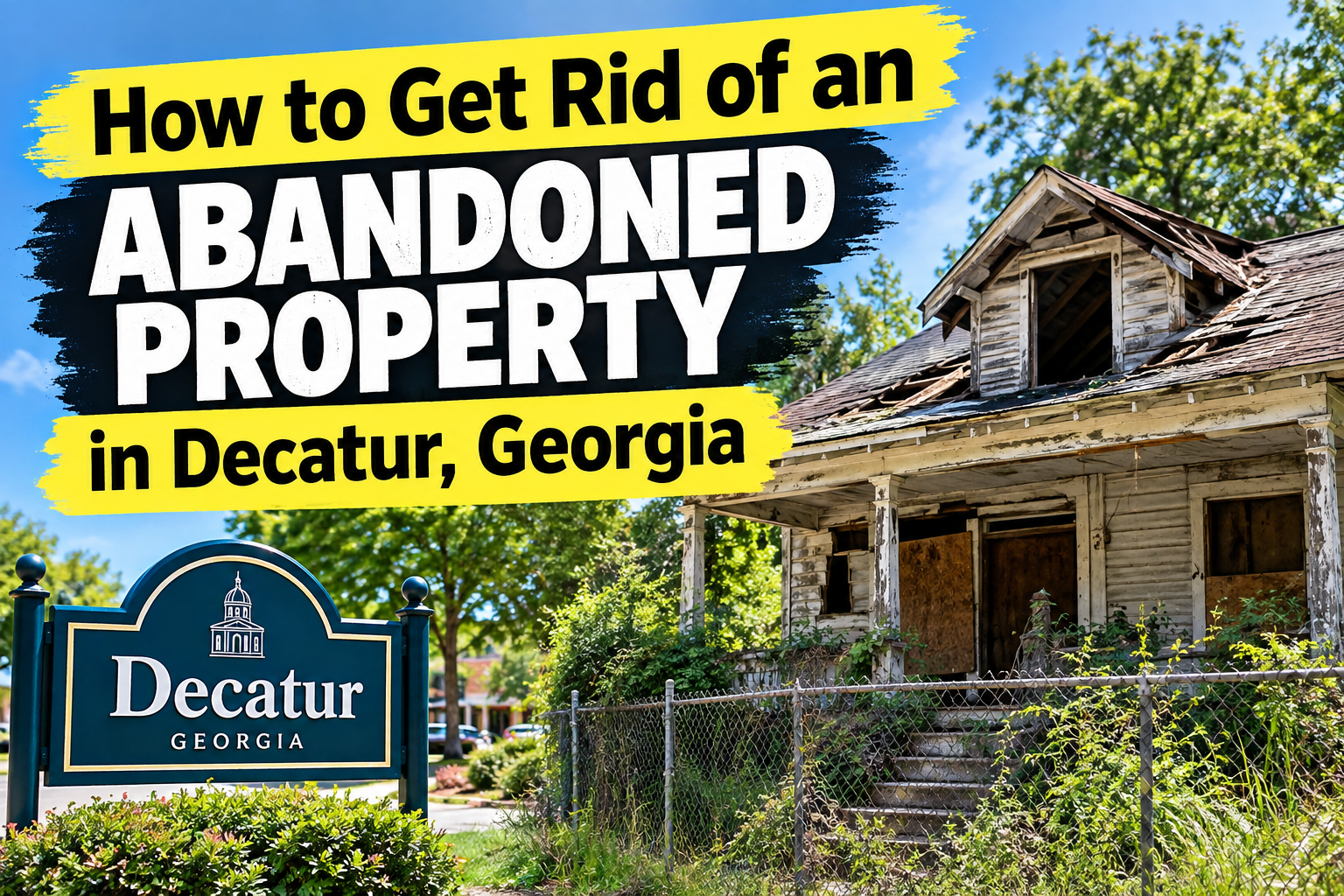
Maybe it is a house you inherited and have not been inside in years. Maybe it is a lot that keeps collecting trash, or a building that costs more to insure than it is worth. If you are trying to figure out how to get rid of abandoned property in Decatur, Georgia, you are not alone, and you are not out of options.
Owners in this situation often feel stuck. Tax bills keep coming. A code letter shows up. A neighbor calls about tall grass or someone sleeping inside. If you live out of state, or you are handling a parent’s estate, it can feel impossible to know where to start.
Here is the good news: “getting rid of” a property does not mean ignoring it, walking away, or signing it over to the first person who asks. It means understanding your real options, which may include:
- Repairing it and keeping it
- Cleaning it up and listing it with an agent
- Selling it as-is
- Working through probate or title issues first
- Addressing back taxes or liens
- Getting advice from qualified professionals
- Considering a direct sale when speed and convenience matter most
This guide walks through each option for houses, vacant lots, mobile homes, and commercial property in the Decatur area. It also lists the local resources to check first.
This article is general information, not legal, tax, or title advice. Every property and ownership situation is different.
First, Identify What You Actually Own
Before you can decide what to do, get clear on what you own. “The property” can mean very different things:
- A house: occupied, vacant, boarded, damaged, or unlivable
- A vacant lot: bare land with no buildings
- A mobile home on land: which may involve two kinds of ownership records
- Commercial property: a storefront, warehouse, office, mixed-use building, or commercial lot
- A partial interest: an inherited share of a property owned with siblings or other relatives
- A vacant building vs. bare land: a structure adds insurance, safety, and code concerns that bare land usually does not
Why the details matter
The parcel number, deed, street address, and ownership status decide almost everything that follows: which government office has authority, who must sign, what taxes are owed, and whether a buyer can close. Mailing addresses alone can be misleading, so the parcel number on your tax bill is usually the most reliable identifier.
Documents to gather
Collect whatever you can find. You do not need all of these to start, but each one helps:
| Document | Why it helps |
| Deed | Shows who owns the property and how it is described |
| Property tax bill | Shows the parcel number and tax status |
| Code notice or citation | Shows the case number, issue, and deadline |
| Probate or estate papers | Shows who has authority to sell an inherited property |
| Mobile home title | Shows ownership of a separately titled home |
| Survey or plat | Shows boundaries and access |
| Lien letters or judgments | Shows debts that may need to be paid at closing |
| Insurance documents | Shows coverage, especially for damage or vacancy |
| Recent photos | Shows current condition without anyone needing to enter |
If the property came to you through a family member, our page on selling inherited land explains common next steps. You can also confirm parcel details through DeKalb County property records.
Is Your Property in the City of Decatur or Unincorporated DeKalb County?
This question trips up a lot of owners. “Decatur” is used two ways:
- The City of Decatur, an incorporated city with its own government, services, and departments.
- Unincorporated DeKalb County, where many properties have a “Decatur” mailing address even though they are outside city limits and are served by DeKalb County.
Mailing addresses, school zones, and local shorthand all cause confusion. A property can say “Decatur, GA” on the envelope and still be governed by DeKalb County, not the City of Decatur. Other nearby cities in DeKalb have their own governments too.
Why it matters: the office that handles code enforcement, property maintenance rules, and many permits depends on the property’s actual jurisdiction, not its mailing address. Before you contact code enforcement, respond to a notice, or try to understand maintenance requirements, confirm which government covers your parcel.
Start with the DeKalb County Property Appraisal records for your parcel, and check the notice itself. Code letters list the issuing agency. If you are unsure, call the office named on the notice and ask.
Why Abandoned Property Becomes Expensive to Hold
A property you are not using can still cost money every month. These holding costs and risks add up quietly:
- Property taxes: the bill arrives every year whether anyone lives there or not.
- Insurance: vacant properties can be harder or more expensive to insure, and some policies limit coverage for vacancy.
- Maintenance: lawn care, securing doors and windows, and fixing damage all cost money.
- Code notices: overgrowth, debris, or an unsecured structure can trigger a municipal notice and a compliance deadline.
- Overgrowth and dumping: tall grass and weeds invite illegal dumping, which can be expensive to haul away.
- Theft and vandalism: copper, appliances, and fixtures are common targets in empty houses.
- Trespassing and squatters: an unsecured structure can attract people who should not be there.
- Water intrusion and roof damage: a small leak can turn into mold, rot, and structural damage when no one is watching.
- Liability: someone could be hurt on the property.
- Neighbor complaints: these often lead to inspections and notices.
- Commercial blight concerns: neglected commercial buildings may draw added attention from local governments.
Ignoring the problem rarely makes it go away. Depending on the jurisdiction, unresolved notices can lead to fines, liens, court action, or the government addressing the condition and seeking to recover its costs. If you are not sure what a violation means, our guide to what a code enforcement violation is explains the basics.
How to Get Rid of Abandoned Property in Decatur, Georgia: Your Main Options
There is no single right answer. The best option depends on your budget, timeline, the property’s condition, and its ownership situation.
| Option | Best When | Main Cost/Risk | Typical Next Step |
| Repair and keep | You want to use or rent the property and can fund repairs | Repair cost, time, and ongoing holding costs | Get contractor estimates and confirm permit needs |
| Clean up and list with an agent | The property is marketable and title is clear | Cleanup cost, commission, and time on market | Talk to a local agent about value and prep |
| Sell as-is to a direct buyer | Speed, convenience, or condition matter more than top price | Usually a lower price than a fully repaired retail sale | Request a no-obligation review from a local buyer |
| Sell land separately | Legally and physically possible to separate land from structures | Subdivision, zoning, and survey requirements | Ask the planning office and a surveyor |
| Resolve probate or title first | The owner of record has died or title is unclear | Legal fees and time | Consult a Georgia probate or real estate attorney |
| Work out a resolution plan with the responsible authority | You have a tax or code issue and want to keep the property | Must meet terms and deadlines | Contact the tax office or issuing code office |
| Demolish or remove a structure | The structure is unsafe or beyond repair | Demolition cost and required approvals | Ask the local permitting office what is required |
| Do nothing | Almost never | Taxes, fines, liens, liability, and growing damage | Choose one of the options above |
Doing nothing is usually the riskiest path. Even if you are not ready to decide, gathering documents and confirming your jurisdiction moves you forward.
Selling an Abandoned House in Decatur
[Image: Small brick house with boarded windows and a damaged roof. Alt text: “Vacant house in Decatur GA with boarded windows and roof damage”]
Abandoned houses come in every condition. Some just need cleaning. Others have problems that make a traditional sale difficult:
- Boarded or open structures with broken doors or windows
- Fire damage or smoke damage
- Water damage from leaks, burst pipes, or flooding
- Roof problems that let water inside
- Structural deterioration such as sagging floors or failing foundations
- Personal property left inside, like furniture, clothing, and trash
- Squatters or trespassers, which create safety and legal concerns
Title and safe access come first
Before anyone can buy the house, the buyer and closing attorney will need to confirm who owns it and what is owed against it. If the house is unsafe, do not go inside, and do not send anyone else in. Photos taken from outside are a fine place to start.
Direct sale vs. listing
A house in good condition with clear title may bring more money through a traditional listing. But many abandoned houses will not qualify for conventional financing because of their condition, which shrinks the pool of retail buyers. In those cases, a direct as-is sale to a local cash buyer may be simpler.
What a cash buyer usually reviews
- Location and lot size
- Visible condition and likely repair needs
- Tax status and any recorded liens
- Ownership and whether probate is needed
- Access, zoning context, and comparable sales
What not to spend money on yet
Before you understand your options, avoid big spending such as a full cleanout, major repairs, or demolition. If you end up selling as-is, that money may not come back to you. Basic safety steps, like securing an open structure, are a different matter and may be important to do right away.
Atlanta Land Buyers is best known for land, but we also review houses that need work, damaged structures, and other difficult property. Learn more about how we buy difficult land and property for cash, or see our page on selling a house that needs a lot of work.
Getting Rid of a Vacant Lot or Overgrown Land in Decatur
Vacant lots seem simple, but they create their own headaches:
- Overgrowth: tall grass, vines, and brush grow fast in Georgia summers.
- Trash and dumping: empty lots attract illegal dumping.
- Trees and brush: dead trees can become a hazard to neighbors.
- Access issues: some lots have no road frontage or depend on an easement.
- Back taxes: small lots are easy to forget about until a delinquency notice arrives.
- Zoning and use questions: not every lot can be built on.
- Neighbor complaints and code notices: often triggered by overgrowth or debris.
Some Decatur-area lots have real infill potential, meaning a builder may want to put a home on them. Others are small, oddly shaped, or hard to reach. For a small or difficult parcel, a clean retail sale is not always worth the time and cost of clearing, surveying, and marketing it.
Atlanta Land Buyers regularly reviews vacant and overgrown lots across metro Atlanta, including lots with back taxes. If taxes are behind, our page on selling tax-delinquent land explains how that can work.
If your lot has no road access, our guide to selling landlocked property covers easement issues. It is written for Fulton County, but the access questions are the same in DeKalb. For tax questions specific to DeKalb, see how long you can be behind on property taxes in DeKalb County.
What If There Is an Abandoned Mobile Home or Trailer on the Land?
Mobile homes add an extra layer, because the home and the land may have separate ownership records.
Land deed vs. mobile home title
- The land is real estate, recorded with a deed.
- The mobile home may have its own title, like a vehicle, or it may have been permanently affixed to the land and treated as part of the real estate.
Whether the home is separately titled or affixed affects who owns it, how it can be transferred, and what paperwork is needed. Sometimes the person who owns the land is not the person named on the home’s title.
Condition concerns
Abandoned mobile homes often have roof leaks, soft floors, broken plumbing, disconnected utilities, and debris inside and around them. If the home is in a park, park rules may also apply. If it sits on private land, local land-use rules may affect whether it can stay.
Do not remove, transfer, demolish, or sell a mobile home until you have verified who legally owns it and what title steps are required. A title company or closing attorney can help sort this out.
A direct buyer can look at the whole picture, the land and the home together, and explain what would need to happen for a sale to close.
How to Handle an Abandoned Commercial Property
Commercial property in the Decatur area, such as a vacant storefront, warehouse, small office, mixed-use building, or commercial lot, can be one of the hardest kinds of property to carry.
Common concerns
- Security: large empty buildings attract break-ins and vandalism.
- Insurance: coverage for vacant commercial buildings can be limited or costly.
- Roof and systems: commercial roofs, HVAC, and plumbing are expensive to repair.
- Environmental concerns: past uses, old tanks, or materials may need professional evaluation.
- Zoning and use restrictions: what a building can be used for affects who will buy it.
What can complicate a commercial sale
Existing leases, liens, ownership through an LLC or other entity, open permits, and past code cases can all complicate a sale. The person with authority to sign may be a company officer or member, not an individual owner.
DeKalb County has recently discussed and implemented enhanced tax consequences for certain severely neglected commercial properties (WABE coverage). The applicability and status of any program can change, so property owners should verify their own situation directly with the county or qualified counsel.
Commercial owners should consider speaking with a Georgia real estate attorney, a CPA, and, where appropriate, a qualified commercial broker or contractor. A direct buyer may be able to review some vacant commercial lots and smaller buildings, but commercial property is reviewed case by case.
What to Do if You Have a Code Notice, Back Taxes, or a Lien
A. If you have a code notice
- Read the whole notice carefully.
- Save the code case number, the code section cited, and any compliance deadline.
- Confirm the jurisdiction: City of Decatur, DeKalb County, or another city.
- Contact the issuing office using the information on the notice.
- Ask what compliance means for your property, and whether more time is possible.
- Document any work with dated photos, and keep receipts.
- Do not ignore deadlines. If you plan to sell, tell the issuing office and your closing attorney.
B. If you have back taxes
Confirm your balance directly with the DeKalb County Tax Commissioner or the proper tax authority, and ask about the account’s status and any upcoming deadlines. In many sales, back taxes can be paid from the sale proceeds at closing, subject to title review and enough proceeds to cover them. See our page on selling property with back taxes for more. If your parcel has already been listed for delinquency, our guide to the DeKalb County delinquent property tax list explains what that means.
C. If there are liens or title issues
A lien does not always stop a sale, but it must be identified and then paid, released, or otherwise resolved at or before closing. Common examples include tax liens, code-enforcement liens, judgments, old mortgages, and HOA balances. A title search by a Georgia title company or closing attorney is how these are found.
A Simple 7-Step Plan to Get Rid of a Problem Property
Safety first: if there is an immediate fire, electrical, gas, structural-collapse, or public-safety danger, call 911 or the appropriate emergency or utility service. Do not enter an unsafe building.
- Secure the property if it poses a safety risk. Boarding openings or locking gates can prevent harm and further damage. Use qualified help if needed.
- Collect property documents: deed, tax bill, notices, estate papers, and photos.
- Verify jurisdiction: City of Decatur, unincorporated DeKalb, or another city.
- Check taxes, code cases, and recorded ownership with the right offices.
- Estimate the realistic cost of keeping, repairing, cleaning, listing, or demolishing.
- Compare a traditional listing with an as-is or direct sale, looking at price, time, and effort.
- Close through a qualified Georgia closing professional, such as a title company or closing attorney, and review the closing statement before signing.
A word of caution: avoid “deeding the problem away.” Signing a quitclaim deed or transferring property for $1 to someone you do not know can create serious problems, and it may not end your responsibility for taxes, liens, or liability. Get qualified professional guidance before signing any deed.
Decatur and DeKalb County Resources to Check First
- DeKalb County Code Compliance: investigates code violations in unincorporated DeKalb County. Its public information says owners of vacant residential property in unincorporated DeKalb County are required to register the property, and vacant properties must be secured, maintained, and kept free of code violations. This office may not cover properties inside the City of Decatur or other cities, so confirm your jurisdiction first.
- DeKalb County Property Search and Values: look up parcel information, assessments, and property records.
- DeKalb County Property Appraisal: the county department responsible for property assessments.
- DeKalb County Magistrate Court Nuisance Abatement: nuisance abatement may become relevant when regular code-enforcement efforts do not resolve serious unsafe, vacant, deteriorated, or unfit structures. It does not apply to every abandoned property.
- City of Decatur FAQs: among other topics, the city’s FAQ page directs people to report storm structure blockages, flooding, or illegal dumping to its Design, Environment and Construction Department. It is one of several city resources, not the only reporting channel.
- DeKalb County Tax Commissioner: for property tax bills, balances, and payment questions.
When Selling As-Is May Be the Right Fit
An as-is, no-repair property sale may make sense if you are:
- An out-of-state owner who cannot easily visit or manage the property. See our page for out-of-state landowners.
- An heir sorting out a family property. Our guide to probate real estate in Georgia explains common steps.
- An older owner or caregiver who does not have the time or energy for repairs.
- Behind on taxes and worried about the balance growing.
- Facing repeated maintenance or citation issues.
- Holding a property that will not qualify for conventional financing because of its condition.
- Without cash for cleanup or repairs.
- In need of a known timeline for personal or financial reasons.
To be fair, a retail listing may be the better choice if you have time, the property is clean and marketable, title is clear, and getting the highest possible price matters more to you than speed and certainty.
How Atlanta Land Buyers Can Review a Decatur Property
If you would like a second opinion, here is how our process works. There is no pressure and no obligation.
- Send us the address, parcel number, or rough location. Photos help but are not required.
- We review the basic public facts, such as location, size, access, visible condition, tax status, zoning context, and comparable sales.
- You get an honest answer. If the property fits what we buy, we can make a no-obligation offer. If it does not, we will tell you, and we may point you toward a better option.
- If you choose to sell, the closing takes place through a licensed Georgia title company or closing attorney, and you can choose the timeline that works for you.
We do not charge commissions or listing fees, and you are never obligated to accept an offer. Existing back taxes, code-enforcement liens, judgments, HOA balances, or other recorded matters may need to be paid or resolved at closing, depending on title review and the sale terms. We cannot promise that every property qualifies or that every lien can be cleared.
Have an abandoned, vacant, inherited, damaged, or unwanted property in Decatur? Send the address or parcel number to Atlanta Land Buyers and ask for a no-pressure review.
Call or text (404) 913-7086, or visit Atlanta Land Buyers.
Frequently Asked Questions
Can I sell an abandoned house in Decatur, Georgia?
Often, yes. Many abandoned or vacant houses can be sold as-is, even with damage, debris, or overgrowth. Whether a sale can close depends on things like clear ownership, liens, back taxes, and the condition of the property. A title search through a Georgia title company or closing attorney is usually the first step to finding out what needs to be resolved.
Can I sell a vacant lot in Decatur with overgrowth or dumping?
In many cases, yes. Some buyers purchase vacant lots as-is, including lots with tall grass, brush, or dumped debris. Access, zoning, back taxes, and title will still affect whether and how a lot can be sold. If you have received a code notice about the lot, contact the issuing office to understand what is required while you explore your options.
What if I inherited an abandoned property in Decatur?
It depends on how the property passed to you and whether the estate has been handled. If the property is still in a deceased person’s name, a probate process or other legal steps may be needed before anyone can sign a deed. A Georgia probate or real estate attorney can explain the options for your situation.
Can I sell property with back taxes in DeKalb County?
Often, yes. Back taxes do not always prevent a sale. In many sales, delinquent taxes are paid from the sale proceeds at closing, as long as the proceeds are enough and title review allows it. Confirm the current balance directly with the DeKalb County Tax Commissioner, and do not ignore tax notices while you decide.
Can I sell a property with a code enforcement violation?
Often, yes. A code violation does not automatically stop a sale, but it may need to be disclosed, resolved, or addressed as part of the transaction. Some fines or liens may have to be paid at closing. Ask the issuing office about the status of your case, and talk to your closing attorney about how it affects the sale.
What happens if I ignore a code enforcement notice?
Ignoring a notice is usually the riskiest choice. Depending on the jurisdiction and the case, it may lead to court action, fines, liens, or the government taking steps to address the problem, which can add costs. The exact consequences depend on the notice and local rules, so contact the issuing office promptly and consider getting professional advice.
Can I sell a mobile home and land together in Georgia?
Often, yes, but the paperwork depends on how the home is titled. Some mobile homes have their own title as personal property, while others may have been permanently attached to the land and treated as part of the real estate. A title company or closing attorney can review the records and explain what is needed to transfer both.
What if the mobile home title is missing?
A missing title can complicate a sale, but it is not always the end of the road. The process for replacing or researching a title depends on the home’s history and how it was recorded. Contact the appropriate Georgia titling authority or a closing attorney before you try to sell, move, or remove the home.
Can I sell a commercial building that has been vacant for years?
Possibly. Vacant commercial buildings can be sold, but they often involve more complex issues, such as environmental concerns, zoning, leases, entity ownership, liens, and building safety. A Georgia real estate attorney, CPA, and qualified commercial professionals can help you understand your options.
Do I have to clean out an abandoned property before selling it?
Not always. Many as-is buyers purchase property with furniture, trash, or debris still inside. If you are selling through a traditional listing, cleaning out the property may help it sell. Before spending money on cleanup, compare your options and ask potential buyers what they need.
Can I sell an abandoned property from out of state?
Often, yes. Many closings in Georgia can be arranged so out-of-state owners sign documents remotely or by mail, depending on the title company or closing attorney and the documents involved. Ask the closing professional what options are available for your situation.
How fast can an as-is property sale close in Georgia?
It depends. Some as-is sales close in a few weeks, while others take longer because of title problems, probate, liens, or missing documents. No one can promise an exact closing date until title has been reviewed. A direct buyer can often work around the seller’s preferred timeline once those issues are understood.
You Do Not Have to Keep Carrying a Property That Has Become a Burden
Figuring out how to get rid of abandoned property in Decatur, Georgia starts with a few simple steps: know what you own, confirm the jurisdiction, and compare your options honestly.
If a direct sale might help, Atlanta Land Buyers can take a look. There is no obligation, no commission, and no need to make repairs before you ask questions. You can compare our answer with every other option and decide what is right for you. If you have a notice or deadline, it is wise to act promptly, whatever path you choose.
Ready To Sell Your Land? Start Here…
We are direct land buyers. There are no commissions or fees and no obligation whatsoever. Start below by sharing where your property is and where we can send your offer…
"*" indicates required fields