

We Buy Ugly Houses in Atlanta, Georgia
If you have a house in Atlanta that’s outdated, damaged, or in need of major repairs, get a no-obligation cash offer and sell it as-is.
"*" indicates required fields
We Buy Ugly Houses in Atlanta, GA: The Local, Honest Way to Sell Your House As-Is (2026 Guide)

If you typed “we buy ugly houses” into Google from an Atlanta zip code, you probably are not shopping for fun. You have a house with a sagging porch in West End, a water-stained ceiling in Lakewood Heights, a parent’s bungalow in Collier Heights that nobody has touched since 1994, or a rental in South Fulton the last tenant left in pieces. You want to know three things: will someone actually buy it the way it is, what will they pay, and can you trust them?
This guide answers all three for the Atlanta market specifically. I am Gerald Harris, and my company, Atlanta Land Buyers, buys houses and land across Atlanta and Fulton County with our own money. We buy ugly houses, and we are not shy about it. But I also think you deserve more than a billboard slogan. So below you will find real 2026 Atlanta market numbers, the problems that make Atlanta houses “ugly” in the first place, how an offer is actually calculated, a plain-English look at the Dallas “We Buy Ugly Houses” franchise fraud case that made national news this week, and a checklist for vetting any cash buyer in Georgia, including us.
| Quick answer: Yes, you can sell an ugly house in Atlanta as-is, for cash, without repairs, cleaning, showings, or agent commissions. A local direct buyer like Atlanta Land Buyers can usually close in 7 to 14 days through a Georgia closing attorney, with back taxes, code liens, and mortgage payoffs handled out of the proceeds at the closing table. The trade-off is price: a cash offer reflects the repairs the buyer will fund. The right choice depends on how much time, money, and patience you have, and this guide shows you the math. |
“We Buy Ugly Houses” in Atlanta: The Phrase vs. the Brand
Most Atlantans first saw the phrase on the yellow billboards along I-20 and I-285. We Buy Ugly Houses® is a registered trademark of HomeVestors of America, a Dallas-based company that licenses the name to a network of independently owned and operated franchisees. Its own Atlanta pages describe that network model, a typical closing window of about three weeks or longer, and a history of more than 150,000 houses purchased nationally since 1996.
Over time, though, “we buy ugly houses” has also become the everyday way homeowners describe a whole category of buyer: someone who purchases distressed property as-is, for cash, off the market. When you search that phrase, you are really asking, “Who will take this house off my hands without making me fix it?” In Atlanta, the answer includes national franchise networks, iBuyers, wholesalers, local investors, and small local companies like ours.
To be clear, Atlanta Land Buyers is not affiliated with HomeVestors of America or its franchisees. We are a local, family-owned company. We use the phrase the way you do, to describe what we do: we buy ugly houses in Atlanta. The difference is that when you call (404) 913-7086, you talk to me, the person who will walk your house, sign the contract, and show up at the closing table.
The 2026 Atlanta Market: Why Ugly Houses Sit Longer Than Ever
Three years ago, almost anything with a roof sold in Atlanta. That is no longer true. The metro market has shifted into balanced territory, and buyers now have the time and inventory to be picky. Preliminary Homes.com data for August 2026 shows the metro Atlanta median sale price at about $395,000, roughly $5,000 lower than a year earlier, with homes taking a median of 59 days to sell and more than 33,000 listings on the market. Georgia MLS figures for Atlanta’s core show the same trend, with the August median slipping to $400,000 from $420,000 in July.
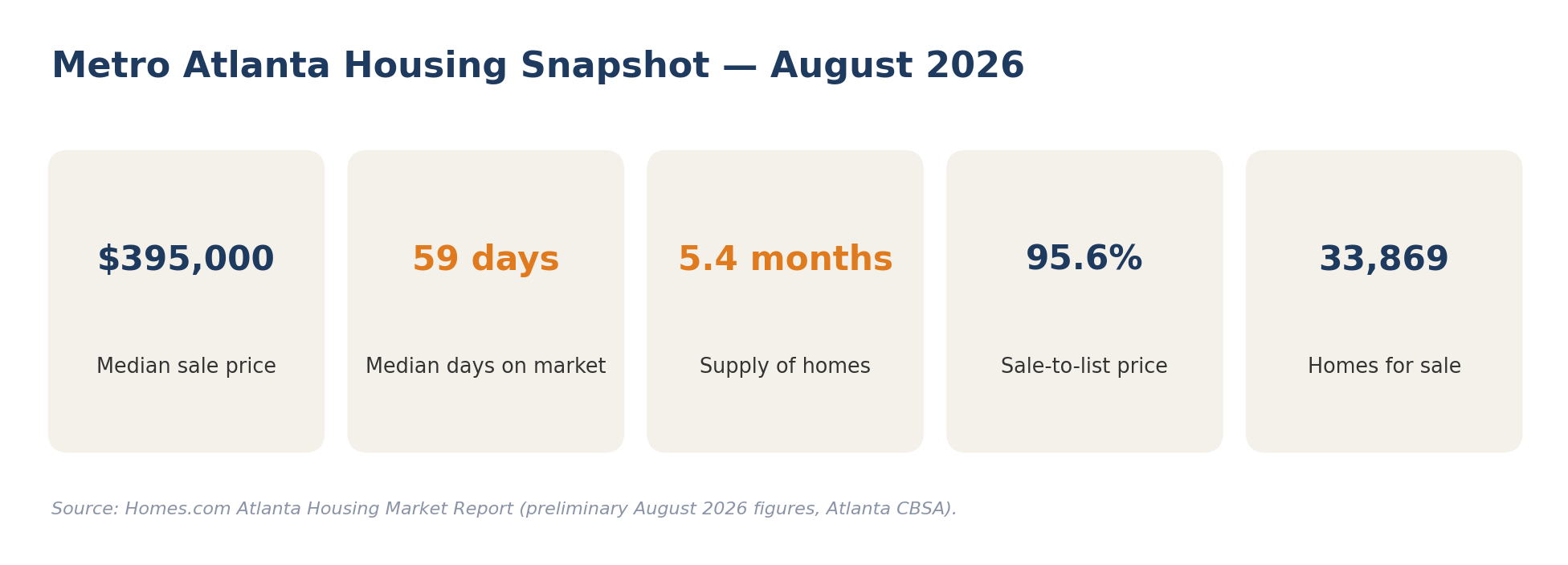
Averages hide the real story for distressed property. When buyers have 5.4 months of supply to choose from, they choose the house with the new roof and the renovated kitchen. Analysis of Atlanta REALTORS and FMLS data puts a well-priced intown home at roughly 30 days on market, while an overpriced listing or a house that needs work can sit for more than 100 days. Every one of those extra days carries Atlanta property taxes, insurance, utilities, lawn cutting, and the risk of a break-in or a code enforcement notice on a vacant house.
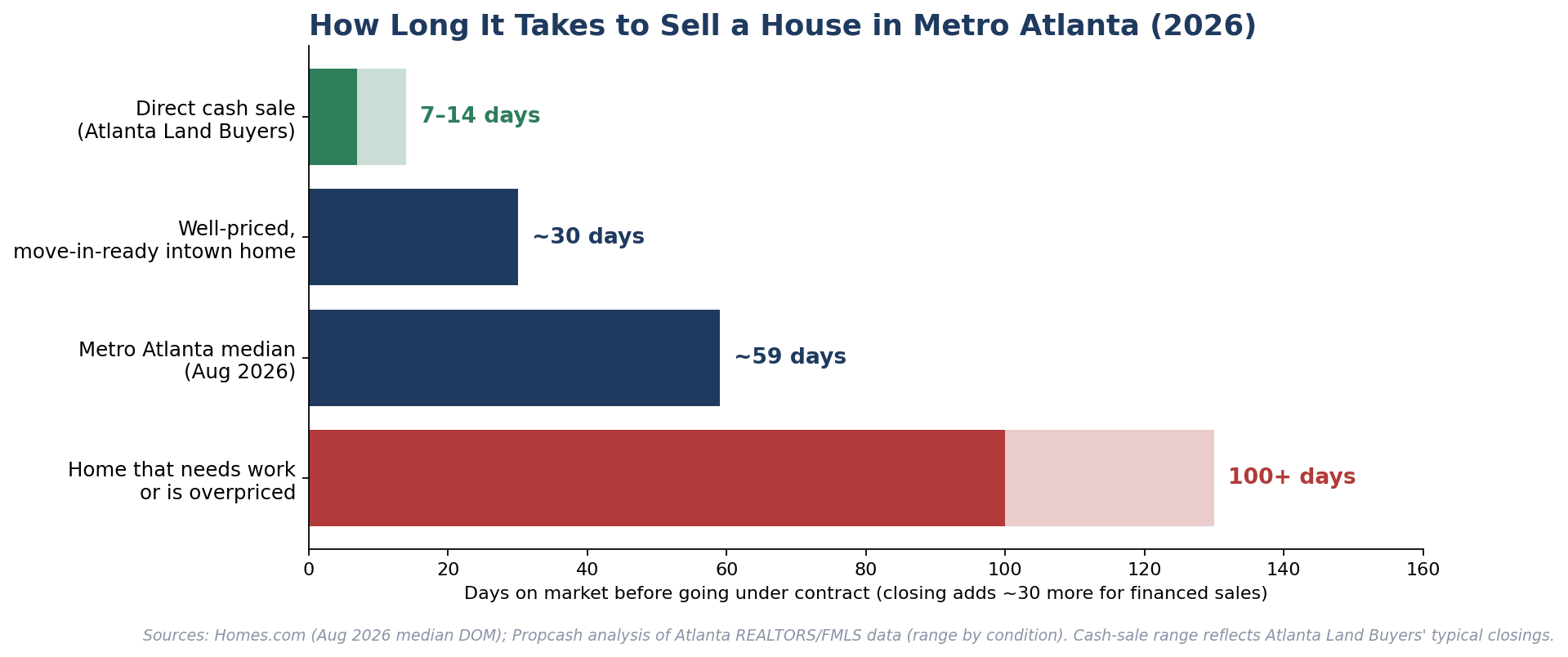
That is the gap a “we buy ugly houses” buyer fills. The worse the condition, the smaller the pool of retail buyers, and the more a fast, certain, as-is sale is worth to you.
What Counts as an “Ugly House” in Atlanta?
Ugly is a broad word. In real estate, it covers everything from dated paint and shag carpet to a foundation that is actively moving. Knowing where your house falls on that spectrum tells you what kind of buyer to expect and how an offer will be built.
Cosmetic issues vs. structural problems
Cosmetic issues include outdated kitchens and baths, worn carpet, dated fixtures, peeling paint, and an overgrown yard. They hurt curb appeal and listing photos but are relatively inexpensive to fix. Structural and systems problems are a different category: foundation settling, roof failure, plumbing and electrical defects, mold, and fire or water damage. These are the issues that scare off retail buyers and make financing difficult, because many conventional and FHA lenders will not fund a loan when the appraisal flags a major safety or structural defect.
Problems specific to Atlanta’s housing stock
Atlanta’s housing stock is old, wooded, and built on red clay, and that creates a predictable set of issues that national “we buy ugly houses” pages never mention. When I walk a house in the city, these are the things I look for first:
- Red clay and foundation movement. Georgia’s clay soils swell when wet and shrink during dry spells. Combined with pier-and-beam foundations on older bungalows, that produces sloping floors, sticking doors, and stair-step cracks in brick.
- Termite and wood-destroying insect damage. Georgia’s warm, humid climate is ideal for subterranean termites, and older crawlspace homes in neighborhoods like Kirkwood, Adair Park, and Capitol View often have hidden damage in sills and joists.
- Knob-and-tube wiring and undersized panels. Many pre-1950 Atlanta homes still carry original wiring or 60-amp service, which insurers and lenders increasingly refuse to cover.
- Polybutylene, galvanized, and cast-iron plumbing. Homes from the 1950s through the mid-1990s commonly have supply lines or sewer laterals nearing the end of their life.
- Storm and tree damage. Atlanta is known as the city in a forest. Mature oaks and pines are beautiful until one comes through the roof during a summer thunderstorm or a tropical system.
- Moisture, mold, and crawlspace rot. Long humid summers mean vacant houses with no air conditioning can develop mold quickly.
- Lead-based paint. Any home built before 1978 falls under federal lead-paint disclosure rules, and a large share of intown Atlanta housing predates that year.
- Open code enforcement cases. Overgrowth, junk and debris, and unsecured vacant structures regularly draw notices from the City of Atlanta. Our guide to code enforcement violations in Atlanta explains how those notices can turn into liens.
Deferred maintenance and curb appeal
Many of the ugly houses I see in Atlanta are not badly damaged so much as neglected. Years of deferred maintenance, a yard taken over by kudzu, peeling exterior paint, and a carport full of belongings can make a solid, livable house look far worse than it is. Even so, poor curb appeal alone can keep a listing sitting for months in a market where buyers have plenty of choices.
Why Atlanta Homeowners Say “I Want to Sell My Ugly House”
Every situation is different, but the same reasons come up again and again from sellers across Atlanta and Fulton County:
- The home is outdated and would need a full renovation to compete with flipped houses on the same street.
- Storm, fire, or water damage has left the property in rough shape, and the insurance claim either fell short or stalled.
- The house was inherited and has sat vacant, collecting deferred maintenance and rising property taxes. If the deed is still in a parent’s name, start with our guide to probate real estate in Atlanta and our inherited property page.
- The City of Atlanta has issued a code enforcement notice for an unsafe structure, overgrowth, or unpermitted work.
- The house is a former rental left in poor condition, and the owner is tired of managing repairs and tenants from a distance.
- Back property taxes are piling up and the parcel is headed toward the Fulton County tax sale.
- Foreclosure, divorce, a job relocation, or a health change means the house has to be sold quickly without spending money upfront.
- Hoarding conditions or decades of clutter make the house feel impossible to list.
Rising values in neighborhoods near the Atlanta BeltLine and the Westside have added a twist. Many longtime owners in places like Pittsburgh, Mechanicsville, English Avenue, Vine City, and Grove Park own houses that are ugly by any standard, but sit on land that has become genuinely valuable. That combination attracts a lot of buyers, not all of them fair. It is one more reason to understand exactly how offers are calculated before you sign anything.
The Problem With Listing an Ugly House on the Atlanta MLS
Traditional home sales are built around move-in-ready properties. Listing photos, open houses, inspections, and buyer financing all assume a house in reasonably good condition, which puts distressed property at a serious disadvantage.
Repair costs add up fast
A listing agent will often hand you a list of recommended repairs before going live: new flooring, fresh paint, a roof, perhaps foundation work or a sewer line. For sellers who do not have the cash, or who do not want to manage contractors, permits, and Atlanta’s tree ordinance on a renovation, that advice feels like a dead end.
Buyers expect move-in ready, and lenders require it
Most retail buyers use conventional or FHA financing, and those loans depend on an appraisal. If the appraiser flags a failing roof, exposed wiring, or structural damage, the loan can stall or die. Even when a buyer is under contract, the inspection period becomes a second negotiation where repair credits eat into your price. Meanwhile, taxes, insurance, and utilities keep running.
The real math: renovate, list as-is, or sell for cash
Here is an illustrative example based on the type of house we see every month in southwest Atlanta: a three-bedroom brick ranch with an after-repair value (ARV) of about $300,000 that needs roughly $70,000 of work, including a roof, HVAC, electrical updates, and a kitchen.
| Renovate, then list | List as-is on the MLS | Direct cash sale | |
| Sale price | $300,000 | $225,000 | $190,000 |
| Repairs you pay | –$70,000 | $0 | $0 |
| Agent commissions (5.5% illustrative) | –$16,500 | –$12,375 | $0 |
| Buyer concessions / repair credits | $0 | –$5,000 | $0 |
| Holding costs (~$1,500/month) | –$9,000 (6 mo.) | –$4,500 (3 mo.) | $0 |
| Seller closing costs | –$3,000 | –$2,000 | Paid by buyer |
| Estimated net to you | $201,500 | $201,100 | $190,000 |
| Time and risk | 6–9 months; you fund and manage the rehab | 3–5 months; financing and inspection risk | 7–14 days; no repairs, showings, or fees |
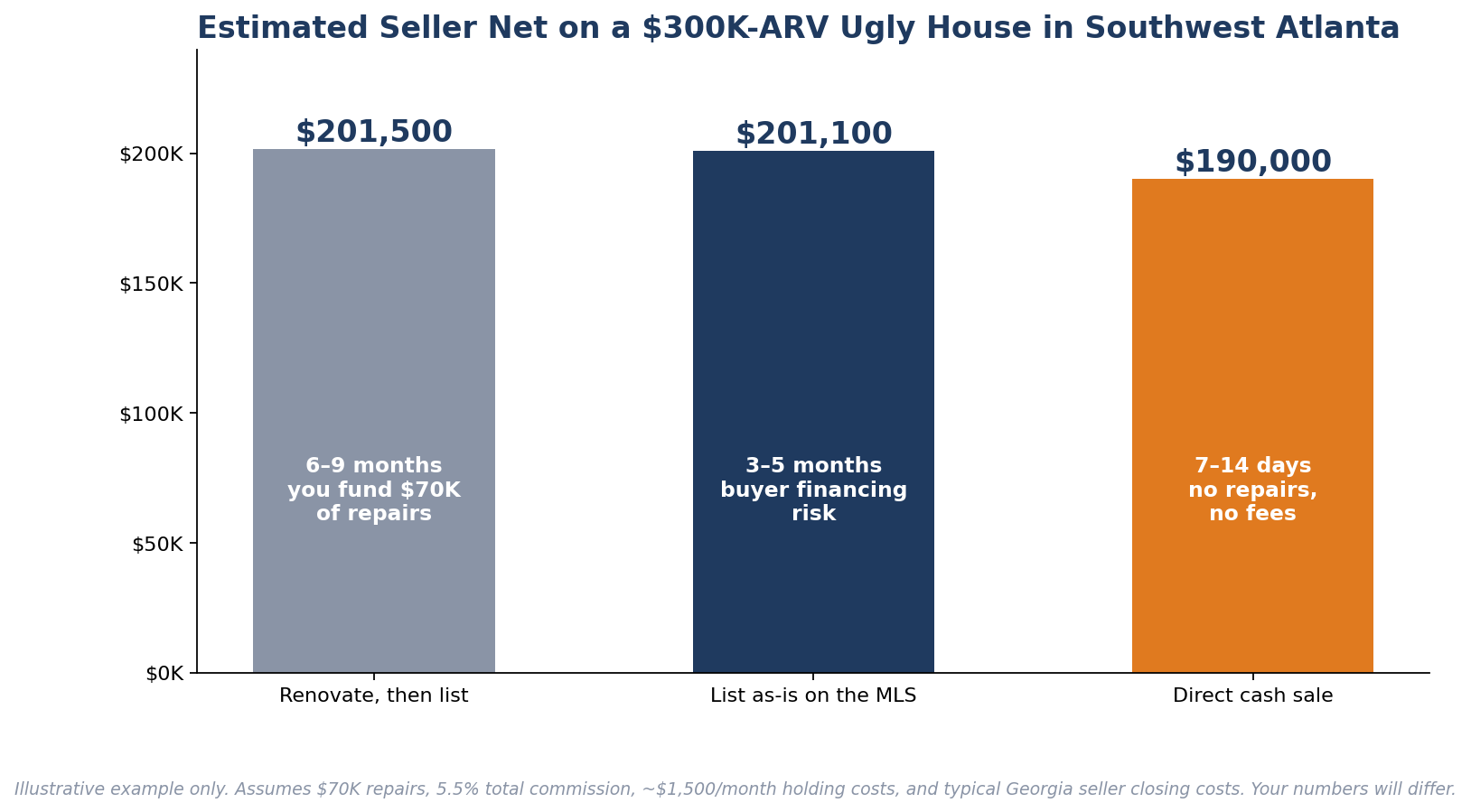
Notice what this example shows, because most “we buy ugly houses” pages will not tell you: in a lot of cases, a cash sale nets somewhat less than a perfect traditional sale. What you are buying with that difference is time, certainty, and the ability to walk away without spending another dollar or another weekend on the property. If you have the cash, the time, and the stomach for a renovation, listing may put more in your pocket. If you do not, or if the house has problems that could blow up a financed deal, a direct sale is often the better outcome. I would rather you make that decision with real numbers than with a slogan.
How We Buy Ugly Houses in Atlanta: Our Process, Step by Step
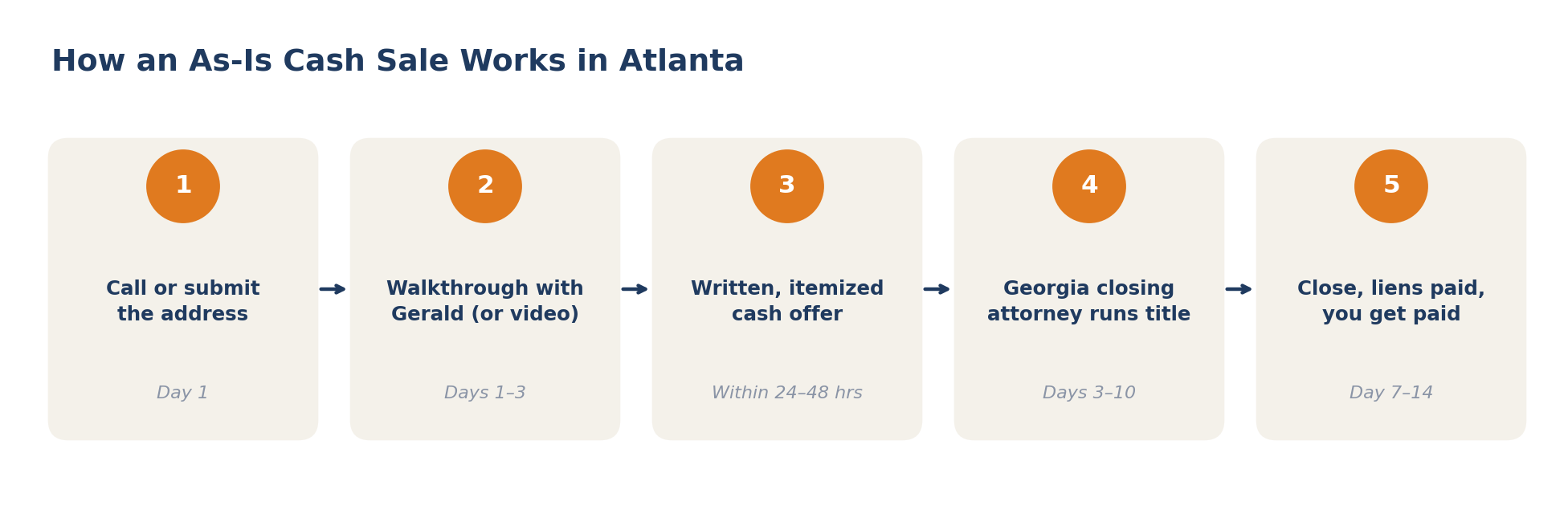
Cash buyers exist to solve exactly this problem. Rather than asking you to renovate before selling, we buy the house in its current condition and handle every repair after closing. Here is how it works with Atlanta Land Buyers.
- Tell us about the house. Call or text (404) 913-7086 or request a cash offer online. An address and a few sentences about the condition is plenty.
- Walkthrough. I walk the property with you, or by video if you live out of state. You do not need to clean, empty, or explain anything. As-is means as-is, including furniture, debris, and whatever is in the shed.
- Written, itemized offer. You get a written offer, usually within 24 to 48 hours, that shows how we arrived at the number, including known liens and back taxes. No offer shouted over the phone and no hidden deductions later.
- Georgia closing attorney. Georgia is an attorney-closing state, so an independent, licensed Georgia real estate attorney handles title search, payoffs, and the deed. We pay typical closing costs.
- Close and get paid. On your chosen date, often 7 to 14 days out, the attorney pays off any mortgage, back taxes, code liens, or HOA balances from the proceeds, and you receive the rest by wire or check.
Sell as-is, no repairs required
An as-is cash sale means no painting, no cleanup, no contractor bids, and no renegotiating repair credits after an inspection. Whether the house needs a full gut renovation or just decades of clutter cleared out, we buy it in its current condition. Take what you want and leave the rest.
Fast closings without financing delays
Because we are not relying on a mortgage approval, there is no appraisal contingency and no risk of the deal falling apart over a lender’s condition list. Most of our closings happen in 7 to 14 days once title work is complete, compared with the 30 to 60 days a financed sale typically takes after a contract is signed. If you need more time to move, you pick the date.
Liens and back taxes are handled at closing
You do not need cash upfront to clear a tax lien, a City of Atlanta code lien, or an HOA balance. Those are paid from the proceeds at closing, the same way a mortgage payoff is. Our article on selling property with a lien on it in Georgia walks through how multiple payoffs are coordinated, and our tax-delinquent property page covers houses already behind on taxes.
How a Cash Offer on an Ugly House Is Actually Calculated
Nobody likes a mystery number. Here is the formula almost every legitimate cash buyer uses, whether or not they tell you:
| After-repair value (ARV) – repair costs – holding, insurance, and financing costs – resale closing costs and commissions – buyer’s margin for risk and profit = your cash offer |
The ARV comes from recent sales of renovated homes nearby, not from a Zillow estimate. Repair costs come from what the house actually needs, which is why I walk it. Holding and resale costs are real: the buyer will pay taxes, insurance, and utilities during the rehab, then pay commissions and closing costs to resell. The margin covers the risk that the rehab uncovers more rot, more wiring, or a failed sewer line than anyone could see.
When a buyer walks you through each of those numbers, you can check the work. When a buyer refuses, or when a high verbal offer mysteriously drops right before closing because of “things we found,” that is a red flag. Our written offers list the assumptions so there are no surprises.
The Dallas “We Buy Ugly Houses” Franchise Case: What Atlanta Sellers Should Know
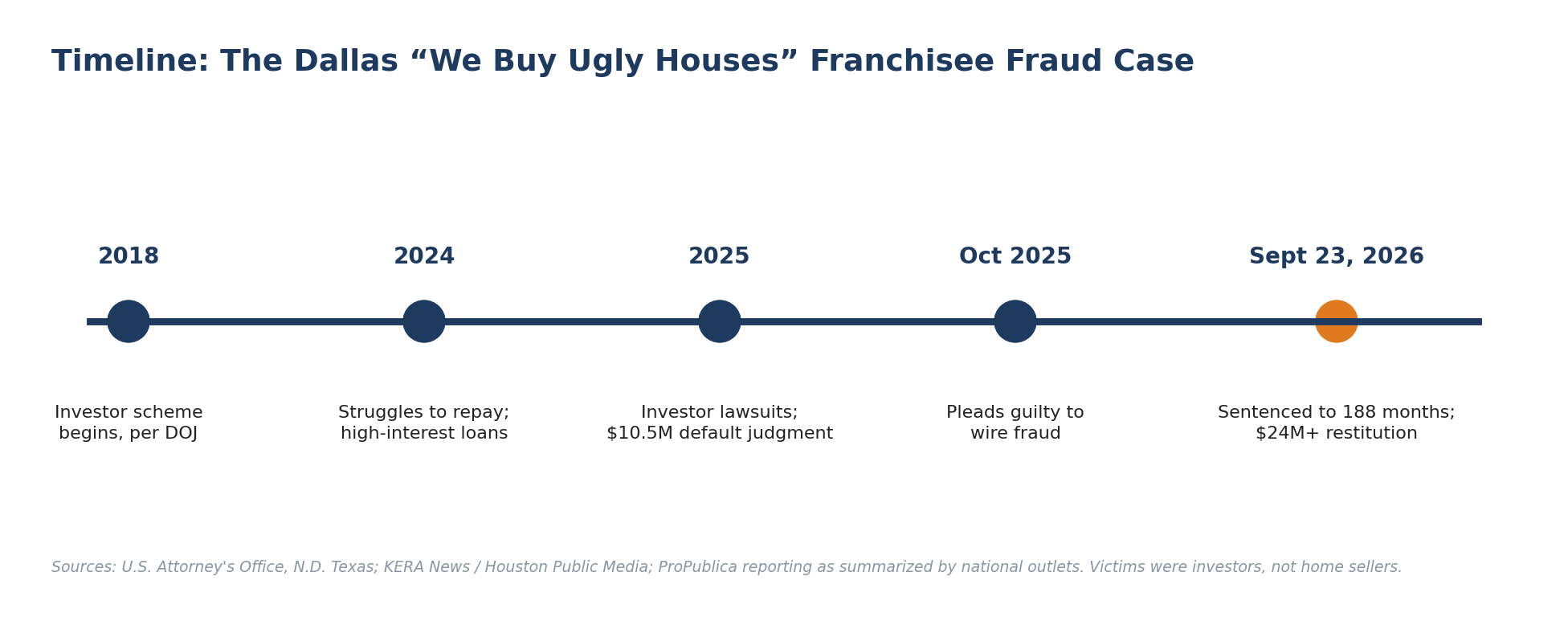
This week, the phrase “we buy ugly houses” made national headlines for the wrong reasons. On September 23, 2026, a federal judge in Dallas sentenced Charles Carrier, 67, the former owner of Dallas-based C&C Residential Properties, a HomeVestors franchise, to 188 months in federal prison, just over 15 years, for wire fraud. He had pleaded guilty in October 2025. The story was reported by KERA News and republished by Houston Public Media, and the details below come from that reporting and the U.S. Attorney’s Office for the Northern District of Texas.
What happened
According to federal prosecutors, from roughly 2018 through 2024 Carrier told investors their money would be used to buy, renovate, and resell specific houses, often secured by what investors believed were priority liens. Instead, prosecutors said he sold properties without telling investors, used forged or unauthorized lien releases to complete those sales, and diverted money to personal expenses, unrelated business costs, and payments to earlier investors. The intended loss was calculated at about $39.5 million across more than 80 investors, many of them retirees. He was ordered to pay more than $24 million in restitution, on top of more than $3.2 million owed to victims from three civil lawsuits in Dallas County.
Reporting on the case described Carrier as a fired former franchisee, and HomeVestors argued in the civil suits that it bore no responsibility for his conduct. The coverage also noted that the brand had already faced scrutiny after a ProPublica investigation described several cases in which franchisees bought homes at steep discounts from elderly sellers with diminished mental capacity. HomeVestors responded at the time that those cases represented a small fraction of its franchises and transactions.
What this does and does not mean for you
It is important to be fair here. The victims in the Dallas case were investors, not homeowners selling their houses, and nothing in the reporting suggests any wrongdoing by HomeVestors franchisees in Atlanta. Most cash buyers in this city, franchise and independent alike, are honest people doing hard work.
Still, the case is a useful reminder of three things every Atlanta homeowner should understand before selling to any cash buyer:
- A brand is not a buyer. Franchise networks and lead-generation websites often pass your information to an independently owned business. Ask who, specifically, is signing the contract and whose money is buying the house.
- Liens and title are where fraud hides. Forged lien releases only work when nobody is checking. In Georgia, insist that an independent, licensed closing attorney, not the buyer, controls title, payoffs, and the deed.
- Track records can mask trouble. Carrier was reportedly a top performer for years before his operation collapsed. Reviews are helpful, but they are not a substitute for a clean, attorney-supervised closing.
How to Vet Any “We Buy Ugly Houses” Buyer in Atlanta
Whether you sell to us, a national franchise, or the neighbor who left a note on your door, run through this checklist first. Anyone legitimate will pass it without blinking.
- Never pay a fee. Real buyers do not charge application, processing, or “hold” fees. Ever.
- Get it in writing and itemized. A real offer is a written contract that shows the price, the closing date, and how liens and taxes will be handled.
- Insist on a Georgia closing attorney. Ask for the attorney’s name and call the firm yourself. Be wary of anyone who wants to close at their own office without one.
- Ask whether they are buying or assigning. Some buyers put a house under contract and sell that contract to someone else. That can be legal in Georgia, but you deserve to know. Ask directly, and get the answer in writing.
- Ask for proof of funds. A buyer paying cash should be able to show it.
- Never sign a deed in exchange for a promise. Deeding your house to someone who “takes over the taxes” with a verbal agreement that you can stay or buy it back is one of the most common ways Atlanta families lose equity.
- Never sign documents with blanks. Every line should be filled in before your pen touches paper.
- Watch the pressure. If someone insists you decide today on a sale that does not need to close for a month, the urgency is theirs, not yours.
- Bring someone you trust. Older sellers especially should have a family member, attorney, or advocate review the contract. A good buyer welcomes that.
- Check the county records. Confirm the buyer’s business is registered with the Georgia Secretary of State, and look up your own parcel with the Fulton County Tax Commissioner so you know what is owed before you hear an offer.
One more Georgia-specific note: Georgia is largely a “buyer beware” state, but sellers still have a legal duty not to conceal known hidden defects. Selling as-is protects you from making repairs; it does not require you to hide anything. Tell your buyer what you know. A professional cash buyer expects problems and prices for them.
Local Direct Buyer vs. National Franchise vs. Listing vs. iBuyer
Here is how the main ways to sell an ugly house in Atlanta compare. Franchise details reflect what the We Buy Ugly Houses® Atlanta pages publish about their own process.
| Atlanta Land Buyers (local direct) | National franchise network | Listing with an agent | iBuyer | |
| Who buys | Gerald Harris’s company, with its own funds | An independently owned local franchisee | A retail buyer, usually financed | A corporate buyer using an algorithm |
| Condition accepted | Any, including fire, hoarder, code cases | Any; houses bought as-is | Best for move-in ready | Usually only light-repair homes |
| Repairs required | None | None | Often recommended | Deducted from offer |
| Commissions and fees | None | None, per their site | Typically negotiated, often 5–6% total | Service fees reported from 5% to 14% |
| Typical closing | 7–14 days | As little as ~3 weeks, per their site | 30–60 days after contract | Varies |
| Who you talk to | The owner, start to finish | A franchise property specialist | Your agent and the buyer’s agent | Online platform, then a rep |
| Land, lots, mobile homes | Yes, it is our core business | Varies by franchise | Yes | Rarely |
Special Atlanta Situations We Handle Every Week
Inherited and heirs’ property
Many ugly houses in southwest and westside Atlanta are heirs’ property, passed down without a will or a probated estate. Title has to be cleared before anyone can sell. We work alongside probate and heirs’ property attorneys and can wait while that happens. See how to sell inherited land and the Georgia Heirs Property Law Center for help untangling ownership.
Back taxes and tax sales
If the house is behind on property taxes, time matters. Read what happens if you don’t pay property taxes, and if it has already sold at auction, check whether you are owed Fulton County excess funds.
Foreclosure and HOA liens
Georgia mortgage foreclosures are nonjudicial and can move quickly. If you are behind, read about the 120-day foreclosure rule and whether you can sell a house in foreclosure. If the pressure is coming from an association, see how to stop an HOA foreclosure in Atlanta.
Out-of-state owners
If you live in Charlotte, Houston, or anywhere else, you can sell without flying in. Walkthroughs happen by video, and Georgia closing attorneys routinely handle remote signings. Here is how we work with out-of-state owners.
Houses that need a lot of work, mobile homes, and land
If the structure is beyond saving, the land still has value. We buy vacant land, mobile and trailer homes, and houses that need lots of work throughout Atlanta, including East Point, College Park, and South Fulton.
Should You Sell at All? Options to Keep Your Atlanta Home
A good buyer should also tell you when selling is not your best move. If you want to stay in your home, look into these first:
- Homestead and senior exemptions. Many long-time Atlanta owners are missing exemptions that could lower their tax bill. See our guide to senior property tax relief for Atlanta homeowners and check your record with the Fulton County Board of Assessors.
- Westside anti-displacement help. Eligible legacy homeowners in certain Westside neighborhoods may qualify for programs that cover property tax increases. Ask your council office or a local housing nonprofit what is available for your address.
- Free legal help. Atlanta Legal Aid Society assists income-eligible residents with foreclosure, heirs’ property, and predatory-purchase issues, and Georgia Senior Legal Aid serves homeowners age 60 and older.
- Payment arrangements. If you are behind on taxes but want to keep the house, contact the Fulton County Tax Commissioner before the account moves toward a levy.
If none of those change the math, selling as-is on your timeline, while you still control the price, is almost always better than waiting for a tax sale or foreclosure to decide for you.
Fulton County and City of Atlanta Resources
Before selling an ugly house in Atlanta, it helps to confirm a few details about the property. These are the offices I send sellers to most often:
- Fulton County Tax Commissioner: check your property tax balance and payment history.
- Fulton County Board of Assessors: review assessed value, exemptions, and appeal deadlines.
- City of Atlanta Code Compliance and Inspections: check for open code violations or permit issues.
- Fulton County Probate Court: estate and administration questions for inherited houses.
- Fulton County Government: general county services and departments.
Frequently Asked Questions: We Buy Ugly Houses in Atlanta
Will an ugly house actually sell for cash in Atlanta?
Yes. Cash buyers purchase distressed, outdated, and damaged houses in Atlanta every week, including fire-damaged homes, hoarder houses, and properties with foundation problems. The offer reflects the current condition, but the sale does not require repairs.
Is Atlanta Land Buyers part of We Buy Ugly Houses® or HomeVestors?
No. We Buy Ugly Houses® is a registered trademark of HomeVestors of America, which licenses it to independent franchisees. Atlanta Land Buyers is an independent, local, family-owned company. When you call us, you deal with the owner directly.
Do I need to clean out the house before selling it as-is?
No. As-is includes furniture, belongings, trash, and anything left in the attic or yard. Take what matters to you and leave the rest.
How fast can you close on an ugly house in Atlanta?
Most of our closings happen within 7 to 14 days after you accept a written offer, depending on title work. If you need more time to move, you choose the closing date.
What if my house has a City of Atlanta code violation or an open permit?
That is workable. We regularly buy houses with open code enforcement cases and handle resolution after closing. Any recorded code liens are paid from the proceeds at the closing table.
Can I sell if I am behind on property taxes or in foreclosure?
Usually, yes, as long as the sale closes before a tax sale or foreclosure auction. Back taxes and mortgage balances are paid off from the proceeds. The earlier you act, the more options and equity you keep.
Is a cash offer the same as a lowball offer?
Not necessarily. A fair cash offer is based on after-repair value minus real repair, holding, and resale costs. It will not match a fully renovated retail price, but it eliminates repairs, commissions, carrying costs, and financing risk. Ask any buyer to show you the math.
Do I need a real estate agent to sell my ugly house?
No. Selling directly to a cash buyer skips listing, showings, and commissions. You are always welcome to have an agent or attorney review our offer.
Who handles the closing in Georgia?
A licensed Georgia real estate attorney. Georgia is an attorney-closing state, and we use independent closing attorneys who run title, prepare the deed, and pay off liens before you receive your funds.
What did the Dallas We Buy Ugly Houses case involve?
A former Dallas franchisee, Charles Carrier, was sentenced in September 2026 to more than 15 years in federal prison for defrauding investors in a house-flipping scheme. The victims were investors rather than home sellers, and there is no suggestion of wrongdoing by Atlanta franchisees, but the case is a good reminder to insist on an independent closing attorney and clear title with any buyer.
Do you buy houses outside the City of Atlanta?
Our focus is Atlanta and Fulton County, including East Point, College Park, South Fulton, Roswell, Alpharetta, and Johns Creek. We also buy land and select houses in DeKalb, Cobb, Clayton, Henry, and Gwinnett counties.
Is there any obligation if I request an offer?
None. Our offers are free, and you can say no, ask questions, or take time to think. We will also tell you honestly if listing or keeping the house looks like the better option.
Get a Cash Offer on Your Ugly House in Atlanta Today
| If you have been thinking “I want to sell my ugly house” and you are tired of pricing roofs, chasing contractors, or paying taxes on a house you do not want, let’s talk. Whether your Atlanta property has cosmetic issues, storm damage, code violations, back taxes, or years of neglect, we buy ugly houses as-is, with no repairs, no commissions, and no fees. Call or text Gerald directly at (404) 913-7086, request your no-obligation cash offer, or contact us with your property address. Want to know who you would be working with? Read about me and our company. Atlanta Land Buyers | 1270 Caroline Street D120, Atlanta, GA 30307 | (404) 913-7086 |
Related reading from Atlanta Land Buyers
Selling Tax-Delinquent Property in Atlanta
How to Sell a House That Needs Lots of Work
What Is a Code Enforcement Violation?
Can I Sell Property With a Lien on It in Georgia?
Understanding Probate Real Estate in Atlanta
How the Fulton County Tax Sale Works
Ready To Sell Your Land? Start Here…
We are direct land buyers. There are no commissions or fees and no obligation whatsoever. Start below by sharing where your property is and where we can send your offer…
"*" indicates required fields

And if you would rather talk it through, call us anytime at (404) 913-7086 to discuss your land and back taxes in person.