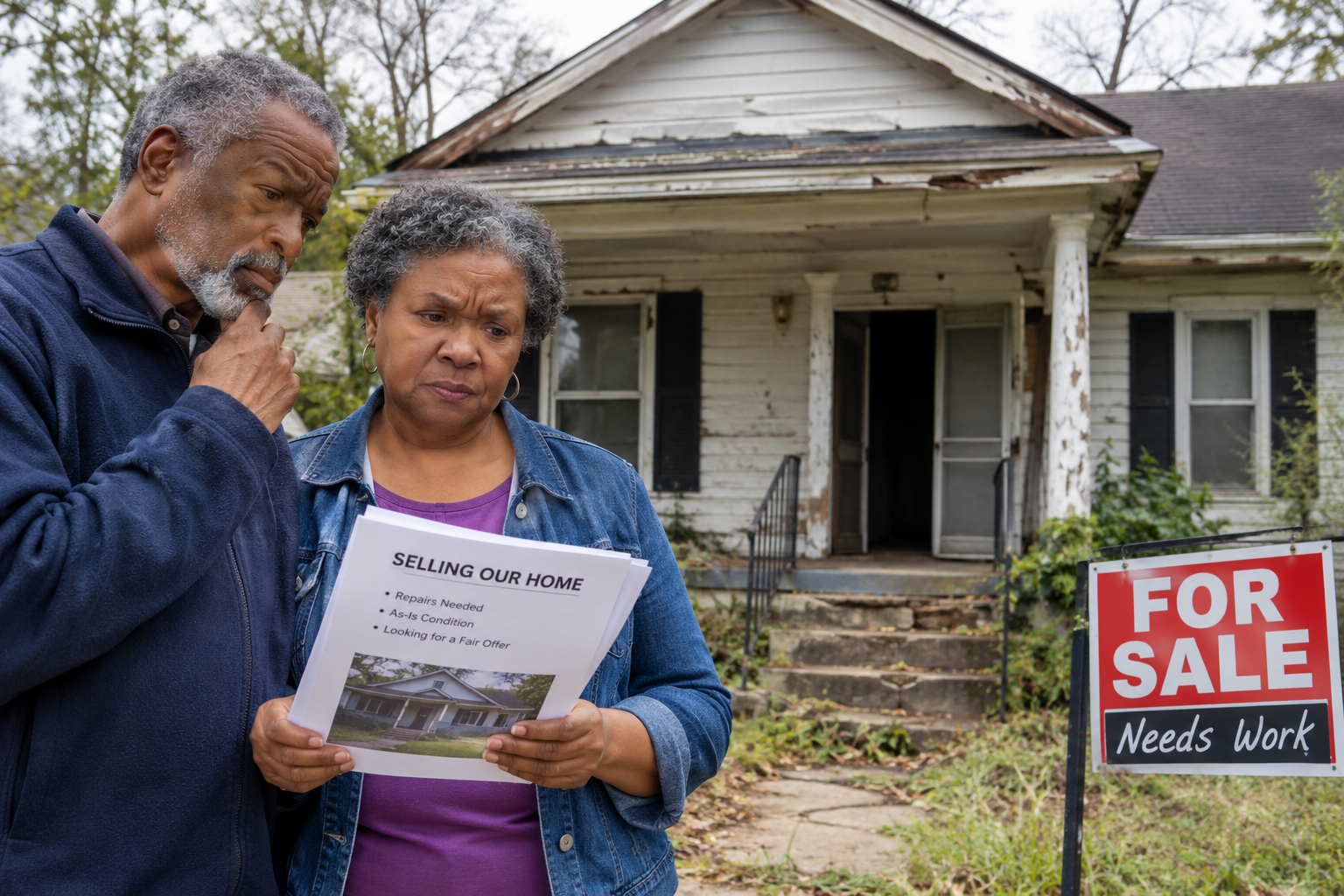
If you are trying to figure out how to sell a house that needs lots of work, the honest starting point is this: you have four real options, and the right one depends almost entirely on two numbers — what the house is worth fixed up, and how much cash and time you actually have to get it there. Everything else is detail.
Most sellers in this position are not weighing a renovation the way a flipper would. They inherited the place. Or a tenant left it destroyed. Or the roof went, then the HVAC went, then the taxes came due. The house has been quietly getting worse for years, and now it needs more work than the family has money or appetite for.
This guide walks through what “needs work” means to a buyer, what repairs realistically cost in metro Atlanta, the four ways to sell, and the specific situations where selling as-is nets you more money than fixing anything. It is written for Fulton County owners in particular, with local resources at the end.
First, Define “Needs Lots of Work” the Way a Buyer Does
Sellers and buyers use that phrase to mean completely different things. Sellers usually mean “it is dated and tired.” Buyers, lenders, and appraisers mean something narrower and more expensive: the house cannot be financed as it sits.
That distinction drives your entire strategy. A conventional or FHA loan generally requires a property to be safe, sound, and sanitary. When a house fails that test, roughly 80 to 90 percent of the retail buyer pool disappears overnight, because those buyers need a mortgage and the mortgage will not fund. What is left is cash buyers, renovation-loan buyers, and investors.
Deal-killers that push a house into the cash-only category:
- An active roof leak, missing shingles, or visible structural sag
- No working heat, or an HVAC system that is red-tagged
- Knob-and-tube or aluminum wiring, an unpermitted panel, or exposed romex
- Galvanized or failing plumbing, or water shut off long enough that the system is untested
- Foundation movement, significant termite or moisture damage, or mold
- Missing kitchen cabinets, missing appliances, no functioning bathroom
- Open code violations or a condemnation placard from the city
If your house has three or more of those, you are not selling a fixer-upper. You are selling a project, and you should price and market it that way from day one rather than discovering it after sixty days on the market and two failed appraisals.
What Repairs Actually Cost in Metro Atlanta
Before choosing an option, get a rough number. These are typical 2026 ranges for a 1,200 to 2,000 square foot Atlanta-area home. They are estimates for planning purposes, not quotes — get three written bids before committing to anything.
| Repair | Typical Atlanta cost | Deal-killer for a mortgage? |
| Full roof replacement | $9,000 – $20,000 | Yes |
| HVAC system replacement | $7,000 – $14,000 | Yes |
| Whole-house rewire | $10,000 – $25,000 | Yes |
| Repipe (galvanized or polybutylene) | $6,000 – $15,000 | Often |
| Foundation / structural repair | $5,000 – $40,000+ | Yes |
| Mold or water remediation | $2,000 – $10,000 | Yes |
| Termite damage repair | $3,000 – $15,000 | Often |
| Kitchen remodel | $25,000 – $60,000 | No |
| Bathroom remodel (each) | $12,000 – $25,000 | No |
| Cosmetic refresh (paint, floors, fixtures) | $15,000 – $40,000 | No |
| Full property cleanout / junk removal | $500 – $3,000 | No |
| Roll-off dumpster, 10–20 yard | $400 – $750 | No |
Two things sellers consistently underestimate. First, repairs cascade: you cannot replace the roof without discovering the decking, and you cannot open a wall without meeting the wiring. Budget a 20 to 30 percent contingency and mean it. Second, you keep paying to own the house the entire time — taxes, insurance (which is expensive and hard to get on a vacant property), utilities, and lawn care run $600 to $1,500 a month on a typical Fulton County home.
Option 1: Renovate First, Then List at Full Retail
This is the highest-ceiling option and the highest-risk one. You fix everything, list with an agent, and compete with move-in-ready inventory.
Best when: you have the cash on hand (renovation loans on a house you already own are slow and paperwork-heavy), the house is in a neighborhood where finished comps clearly support the spend, the problems are known rather than mysterious, and you have six to nine months of patience.
The math that matters: take the after-repair value, subtract the full renovation cost, subtract 5 to 6 percent in agent commission, subtract 1 to 3 percent in seller closing costs, subtract the carrying costs for the whole project, subtract your contingency. If the remainder does not beat a straightforward as-is sale by a meaningful margin, the renovation is buying you stress rather than profit.
Where it goes wrong: over-improving for the block, unpermitted work that surfaces at closing, and a contractor who disappears at 60 percent complete. Permits matter — in the City of Atlanta, work done without them can force expensive retroactive inspections when you sell.
Option 2: List As-Is on the MLS
You list with an agent, disclose the condition, and let the market price the work. No repairs, but you still get exposure to buyers who want a project.
Best when: the house needs work but is still financeable, the location is strong enough to attract renovation-loan buyers and small investors, and you can tolerate 60 to 120 days on market plus showings of a house in rough condition.
Understand what “as-is” does and does not mean in Georgia. It means you are not agreeing to make repairs. It does not eliminate your obligation to disclose known material defects, and it does not stop a buyer from inspecting, renegotiating, or walking during due diligence. Georgia contracts give buyers a due diligence period specifically so they can back out — and on distressed properties, many do.
Where it goes wrong: the appraisal. A financed buyer offers a good price, the appraiser flags the roof and the missing heat, the lender requires repairs before funding, and now you are being asked to pay for a new roof on a house you are selling. That loop can repeat with two or three buyers before you accept what the house really is.
Option 3: Sell Direct to a Cash Buyer, As-Is
You sell the house in its current condition to a buyer who is not borrowing. No repairs, no cleanout, no showings, no appraisal, no financing contingency. This is what we do at Atlanta Land Buyers — see I want to sell my ugly house for how the process works on a distressed house specifically.
Best when: the house is not financeable, you do not have repair money, there is a deadline (a foreclosure date, a tax sale, an estate that needs to close), the house is full of belongings, you live out of state, or heirs simply want the thing resolved.
The honest trade-off: a cash offer on a distressed house comes in below what a perfectly renovated version would eventually fetch, because the buyer is absorbing the repair cost, the carrying cost, and the risk of what is behind the walls. What you get in exchange is real: no commission, no closing costs charged to you, no repairs, no cleanout, no appraisal, no financing falling through, and a closing in roughly 7 to 14 days. Compare net proceeds and net timelines, not headline prices.
One thing to insist on: a written offer with the deductions shown line by line — back taxes, liens, and payoffs itemized. A verbal number over the phone is not an offer. And if you already have an offer from another buyer, say so and let a second buyer try to beat it.
Option 4: Auction or Seller Financing
The least common route, but occasionally the right one. At a real estate auction you set a date, market the property hard for three to four weeks, and let bidders set the price. Seller financing means you carry the note for a buyer — often a contractor — who renovates while paying you.
Best when: the property is genuinely unusual and hard to comp, there is real competing interest, or you want income rather than a lump sum and can afford the risk of default and the cost of foreclosing.
Where it goes wrong: auction sellers pay marketing costs and a buyer premium arrangement regardless of outcome, and a thin bidder pool produces a disappointing number with no do-over. Seller financing puts you back in the position of owning a distressed house if the buyer stops paying. Neither should be attempted without a Georgia real estate attorney.
When Selling As-Is Actually Makes Sense
Selling as-is is the right answer more often than sellers expect. Specifically, when any of the following is true:
- The repair bill exceeds what you can pay in cash. Financing a renovation on a distressed property you already own is difficult, slow, and often lands at a rate that erases the upside.
- There is a deadline. A scheduled Fulton County tax sale, a foreclosure sale date, or an estate that has to be settled. Once a sale is advertised, your options narrow fast — see can I sell my house if it is in foreclosure and the 120-day foreclosure rule.
- The house is inherited and heirs disagree. Renovation requires consensus and ongoing spending from multiple people. A single sale requires one decision. Start with probate real estate in Georgia and our guide to selling inherited property.
- There are liens or back taxes attached. These are usually settled from proceeds at closing rather than out of your pocket — see can I sell property with a lien on it in Georgia and selling tax-delinquent property.
- You live somewhere else. Managing a renovation from another state is how good money follows bad. Here is how we work with out-of-state owners.
- The house is full. Decades of belongings, a hoarding situation, or a tenant who left everything behind. Cleanout alone can take weeks and thousands of dollars before a single repair starts.
- The carrying cost is the real problem. If taxes, insurance, and utilities are bleeding you monthly on a house nobody lives in, speed is worth more than the last few percent of price.
| Quick test: Estimate the after-repair value. Subtract repairs plus 25 percent contingency, 6 percent commission, 2 percent seller closing costs, and six months of carrying costs. If that number is not clearly and comfortably above a written cash offer, selling as-is is the better trade — and it removes every risk in the renovation column. |
Georgia Disclosure: What You Still Have to Tell Buyers
Selling as-is does not mean selling silently. Georgia sellers must disclose known material defects — problems that affect value or safety that a buyer could not reasonably discover on their own. Concealing a known foundation problem or a history of flooding creates liability that outlives the closing.
Practical approach: write down everything you know, including things you only suspect, and hand it over. On a genuinely distressed sale to a cash buyer this costs you nothing, because the buyer is pricing for problems already. What it buys you is a closing that stays closed.
Fulton County Specifics Worth Knowing
Fulton is Georgia’s most populous county and one of its most aggressive on tax collection. If the house has been sitting, check the tax status before you do anything else. Look the parcel up on the Fulton County Board of Assessors site or through qPublic parcel search, then confirm the balance with the Fulton County Tax Commissioner at 404-613-6100.
If the owner of record is deceased, the estate generally needs legal authority to sell before a closing can fund. That runs through the Fulton County Probate Court at 136 Pryor Street SW. If a property already sold at a tax sale for more than the debt owed, the surplus belongs to the former owner — see Fulton County excess funds.
Condition standards and code enforcement vary by jurisdiction across the county, and a house in East Point or College Park is handled differently than one in Roswell, Alpharetta, Johns Creek, South Fulton, or Chattahoochee Hills.
Local Fulton County Resources
If you decide to clean up or repair before selling, these metro Atlanta businesses and offices handle the work that comes up most often on a distressed property.
Cleanouts and debris
- JUSTJUNK Atlanta — full-property cleanouts, volume-based pricing, same or next-day service. 404-445-4025.
- Bin There Dump That Atlanta — driveway-friendly roll-off dumpsters with walk-in doors, serving Fulton and surrounding counties. 404-882-1509.
- Peachtree Waste — roll-off containers for residential and construction debris across metro Atlanta.
- EZ Atlanta Junk Removal (89 Woodward Ave SE, Atlanta) — 678-841-8655, and SS Pro Junk Removal in southeast Atlanta — 770-203-8119.
Estate contents
- Peachtree Battle Estate Sales & Liquidations, 700 Miami Circle NE, Atlanta — 770-653-5247.
- Professional Estate Sales, LLC, 1900 Century Place NE, Atlanta — 770-648-1919. Signature Estate Sales in Roswell — 404-737-6067.
Inspections and closings
- Property Inspectors of Atlanta — 770-912-0012. Paris Pressley Real Estate Inspector, 260 Peachtree Street NW — 404-755-9556. A pre-listing inspection is worth the few hundred dollars: it converts unknown risk into a number.
- Campbell & Brannon — long-established metro Atlanta real estate closing attorneys, with offices in Buckhead and on Seminole Avenue. The Hudson Law Firm on Piedmont Road — 678-999-6030.
Free and low-cost help
- Atlanta Legal Aid Society — free civil legal help for income-qualifying residents of Fulton and four surrounding counties, including housing, foreclosure, and heirs’ property matters. Fulton office: 404-524-5811.
Frequently Asked Questions
How do I sell a house that needs lots of work without fixing anything?
Sell it as-is, either on the MLS to a renovation buyer or directly to a cash buyer. A direct sale skips repairs, showings, appraisals, and financing contingencies entirely; you disclose the condition, the buyer prices for it, and closing typically runs 7 to 14 days. Request a no-obligation offer here.
Will a bank finance a house that needs major repairs?
Usually not on a standard loan. Lenders require the property to be safe, sound, and sanitary, so a missing roof, no heat, or unsafe wiring will stop the appraisal. Renovation loans exist, but they are slower, require contractor bids and draw schedules, and shrink the buyer pool considerably.
How much less will I get selling as-is?
It depends on the repair gap, but compare net proceeds rather than headline prices. Against a retail sale you save 5 to 6 percent commission, 1 to 3 percent seller closing costs, the entire repair budget plus contingency, and several months of taxes, insurance, and utilities. On a house needing significant work, those savings often close most of the gap.
Do I have to disclose problems if I sell as-is?
Yes. Georgia sellers must disclose known material defects. Selling as-is means you are not agreeing to make repairs; it does not relieve you of disclosure, and it does not prevent a buyer from inspecting during due diligence.
Can I sell if I owe back taxes or there is a lien?
Usually yes. Liens and back taxes are typically paid from the sale proceeds at closing rather than out of pocket, with releases recorded afterward. See can I sell property with a lien on it in Georgia and tax foreclosure in Georgia.
What if I inherited the house and other heirs are involved?
The estate needs legal authority to sell — Letters Testamentary or Letters of Administration from probate court — and every heir with an ownership interest generally has to sign. It is solvable, but identify it early. See how to sell inherited property.
Should I clean the house out before selling?
If you are listing on the MLS, yes — a full house shows badly and scares off financed buyers. If you are selling to a cash buyer, usually no. Most direct buyers will take the property with the contents in it, which saves you the cleanout cost and several weekends of work.
How fast can a cash sale close?
Most run 7 to 14 days once an offer is accepted, assuming clear title. Probate, unresolved liens, or missing heir signatures add time. Closings go through a licensed Georgia closing attorney or title company.
What about a mobile home or a house on acreage?
Both are common in south and west Fulton. We also buy trailer and mobile homes on land and vacant land in almost any condition.
The Bottom Line
A house that needs lots of work is not one decision, it is a comparison. Renovating and listing has the highest ceiling and the highest risk. Listing as-is splits the difference but depends on the house still being financeable. A direct cash sale trades price for certainty and speed. Auction and seller financing are situational.
Run the arithmetic honestly, including the carrying costs and the contingency most sellers leave out, and the answer usually becomes obvious. What is rarely the answer is waiting. Distressed houses do not stabilize — the roof gets worse, the taxes compound, and the deadline gets closer.
| Get a straight answer on your property. Atlanta Land Buyers purchases houses and land across Fulton County as-is — repairs, contents, liens, and back taxes included — with no fees, no commissions, and closings that typically run 7 to 14 days. Call or text Gerald directly at (404) 913-7086. |
You can also request a no-obligation cash offer or contact us with a question about your situation. If selling is not the right move for you, we will tell you that too. Read more about our team.