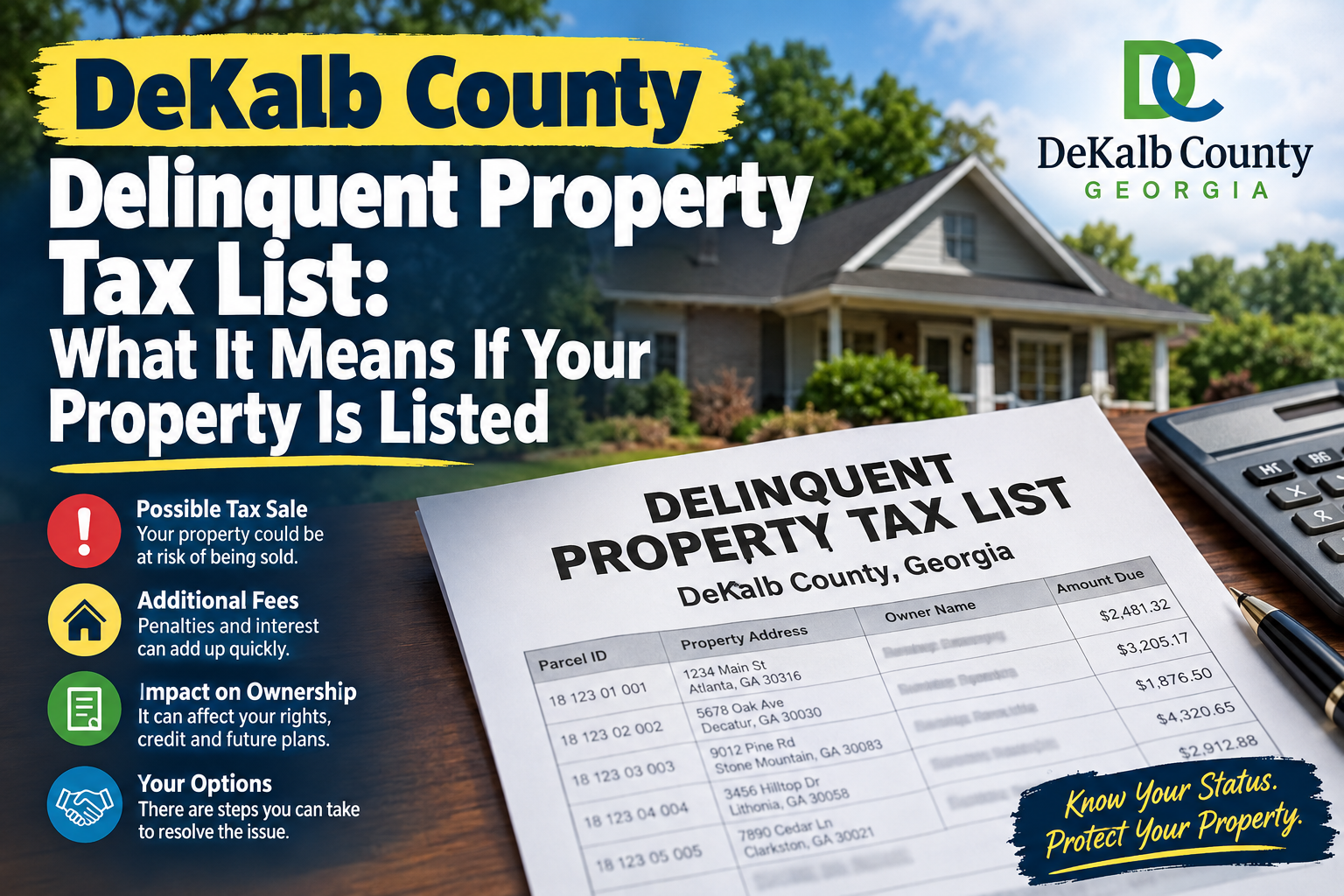
Short answer: being on a DeKalb County delinquent tax list is not the same as losing your property, and it is not the same as being on the tax sale list. There are actually three separate documents, they mean three very different things, and knowing which one your parcel is on tells you almost exactly how much time you have left.
Most people find this page the same way. Either a letter arrived from somebody offering to buy the house, or a neighbor mentioned seeing the address in the newspaper, or an adult child typed the parcel number into Google at midnight and found it sitting on a county spreadsheet with a dollar figure next to it.
It is a genuinely alarming thing to see in print. It is also widely misread. Owners who see their parcel on the seven-year delinquent report panic as though an auction were scheduled next Tuesday, and owners whose parcels are on the actual tax sale listing sometimes assume they have years left. Both mistakes are expensive, and they run in opposite directions.
This article explains which lists DeKalb County publishes, how to check whether your parcel is on any of them, how to read the columns line by line, and what each stage actually does to your title, your options, and your mailbox.
Quick answer: DeKalb County publishes a delinquent property tax report covering parcels with taxes due within the last seven years, and a separate tax sale listing of parcels actually levied and scheduled for auction. Appearing on the first means a balance exists and a lien is likely recorded. Appearing on the second means your parcel has been levied, advertised in The Champion Newspaper, and will be sold on the courthouse steps on the first Tuesday of the month unless it is paid in certified funds first.
There Is No Single “DeKalb Delinquent Tax List”
This is the source of most of the confusion. People search for the DeKalb delinquent tax list as though it were one document. The Tax Commissioner’s Office maintains several, and they sit at different points on the timeline.
1. The delinquent property tax report. The Tax Commissioner publishes a report of all properties with taxes due within the last seven years. It is broad. A parcel that missed a single installment last November can appear on it alongside a parcel that has not been paid since 2019. The county notes that some properties may have additional taxes due beyond what the report shows, and that anything older than seven years requires contacting the Delinquent Division directly. This is the list most homeowners stumble onto, and it is the least urgent of the three.
2. The tax sale listing. This is the real one. It shows parcels that have been levied under a recorded execution and scheduled for a specific auction date. It carries the sale date, the parcel ID, the owner of record, the levy date, the tax years involved, and the total due. If your parcel is here, a clock is running in weeks, not years.
3. The legal advertisement. Georgia requires notice of a tax sale to be published once a week for four weeks immediately preceding the sale in the county’s legal organ, which in DeKalb is The Champion Newspaper. This is the version your neighbors see, and it is also the version scraped by mailing-list companies, which is why the letters and calls tend to start about a month before the sale.
There is a fourth list, published after the fact: the excess funds list, naming parcels that sold for more than the taxes and costs owed, with money still sitting unclaimed. More on that below.
Is My Property on the DeKalb Tax Sale List? How to Check
You can answer this in about five minutes without calling anyone.
- Get your parcel ID. It is on your tax bill, and it can be looked up by address through the county’s property information search. DeKalb parcel IDs look like
15 126 06 011— a district, land lot, block, and parcel sequence. Searching by owner name is unreliable when a deed is still in a deceased relative’s name or held by an LLC. Search by address or parcel. - Check the tax sale listing. The Tax Commissioner publishes the current tax sale property listing online. Find your parcel ID in the left column. If it is there, note the sale date.
- Check the delinquent report. The seven-year delinquent property listing tells you whether any balance exists at all, including years you may have forgotten about.
- Pull the account balance. Search and pay through the county’s property tax portal. The balance shown here is the live figure, which the published lists are not.
- Call to confirm. The Tax Commissioner’s Office is at 404-298-4000. Ask two specific questions: whether an execution has been recorded against the parcel, and whether the parcel is currently scheduled for a sale date. Those are different answers.
One caution. If nothing shows up under your name, that does not mean nothing is wrong. Owners of inherited property routinely search their own name when the deed still carries a parent’s. Search the parcel, not the person.
How to Read the Tax Sale Listing, Column by Column
The listing is a raw database export, and the column headings are not written for homeowners. Here is what they actually mean.
Tax Sale Date. The scheduled auction date. In DeKalb this is the first Tuesday of a month. Sales are generally held monthly from April through December, and the county reserves the right to add or cancel sales.
Parcel ID / Map Ref. Your parcel’s identifier in the county system. Match this against your bill exactly; addresses on vacant land are frequently wrong or missing.
Tax Sale ID. The county’s internal reference for this specific levy, typically formatted with the tax year, an R number, and the sale month. Quote this number when you call — it gets you to the right file immediately.
Owner / Tenant / Defendant. The “defendant in fi.fa.” is the party the execution was issued against, which is the owner of record when the execution issued. If your deceased mother’s name appears here, that is a signal that title was never moved and the county’s notices have been going to her, not to you.
Levy Type. Which taxing authority levied. A parcel inside a city may carry both county and municipal obligations. This matters enormously in Decatur, which bills separately on a different schedule and a different assessment ratio — see our breakdown of City of Decatur property taxes versus DeKalb County.
Lien Book / Page. Where the execution is recorded in the county records. This is what a title examiner finds, and it is why a listed parcel cannot be cleanly sold or refinanced until the balance is satisfied.
Levy Date. When the levying officer formally levied on the property. This is the step that converts a recorded lien into a scheduled sale.
Min Year / Max Year. The earliest and latest tax years included in this levy. A parcel showing 2019 through 2025 has been delinquent for six cycles. A parcel showing 2025 to 2025 missed one.
Total Tax Due. The figure the listing was generated with. This is not your payoff. Opening bids at a DeKalb tax sale include all prior year taxes due, and interest, penalties, title research, advertising, levy, recording, and sheriff’s costs continue to accrue. Always get a written payoff figure rather than working off the published number.
What Being on the List Actually Means
It means an execution has probably been recorded. In Georgia, a tax lien attaches to property at its valuation date of January 1 (O.C.G.A. § 48-2-56), and on December 31 of each year the Tax Commissioner is required to issue an execution — a Fi.Fa., short for fieri facias — against all delinquent taxpayers (O.C.G.A. § 48-3-3). DeKalb states plainly that accounts with an outstanding balance after December 31 are subject to a lien. That execution is a recorded encumbrance, and a tax lien against real property is superior to other liens.
It means the balance is growing on its own. Interest accrues on the unpaid balance, a penalty attaches at intervals after the due date, and once collection activity begins, administrative and advertising costs are added. Our guide to what happens if you don’t pay property taxes walks through how quickly that compounds.
It means your title is clouded. You can still own and occupy the property. You cannot cleanly sell or refinance it without satisfying the balance, though in a normal closing the payoff is handled out of proceeds rather than out of pocket. See can I sell property with a lien on it in Georgia.
It does not mean you have lost the property. Nothing transfers until an auction happens and a tax deed is issued. Until the gavel falls, you hold title.
It does not guarantee the sale will happen on the printed date. Parcels come off the list when paid, and the county can add or cancel sales. Do not plan around a cancellation.
It does not mean the county is trying to take your house. The office’s own materials encourage payment and accept partial payments in any amount. Staff have far more room to work with an owner who calls in March than one who appears at the counter on the Monday before a Tuesday sale.
The Detail That Catches People at the Last Minute
Once a property has been scheduled for tax sale, DeKalb accepts only cash, a bank-issued cashier’s check, or a bank wire transfer, payable to the DeKalb County Tax Commissioner. Personal checks, business checks, third-party checks, money orders, and debit or credit cards are refused at that stage.
Every year, people arrive with a card and a plan and leave without a property. If you intend to pay at the deadline, you need certified funds physically in hand, and you need the bank open. A Tuesday sale means Monday is your last banking day.
Why Your Mailbox Suddenly Filled Up
The lists are public records, and they are harvested the moment they publish. If your parcel appeared on the tax sale listing or in The Champion, expect letters, postcards, texts, and calls — sometimes dozens.
Some of those senders are legitimate local buyers. Some are lead brokers who will never buy anything and are selling your information onward. A few are predatory. The distinctions are worth knowing:
- Legitimate buyers never ask you for money. Not an upfront fee, not a “processing” charge, not a deposit to hold an offer.
- Be extremely careful with anything asking you to sign a deed in exchange for a promise. Deeding your property in exchange for someone assuming the taxes, with a verbal understanding you can stay or buy it back, is how families lose equity permanently.
- Watch for blank spaces in documents. Never sign an instrument with unfilled terms.
- A real offer is written and itemized, showing back taxes, liens, and payoffs line by line. A number shouted over the phone is not an offer.
- You are allowed to have an attorney read it. Anyone who resists that is telling you something.
If somebody is pressuring you toward a decision this week on a sale that is two months out, that urgency is theirs, not yours.
What to Do, Depending on Where You Are on the Timeline
You are on the seven-year delinquent report, but no sale is scheduled
This is the good position, and it is where the cheapest options live.
- Start partial payments now. Every dollar reduces the base that penalties and interest compound against.
- Verify your exemptions. Missing homestead, senior, or disability exemptions inflate every future bill. Check the DeKalb exemptions page, and if you are 62 or older, the county’s seniors resources.
- Appeal the value if it is wrong. Assessment notices go out in late spring with a 45-day appeal window, handled by the DeKalb County Board of Assessors. An exemption cannot fix an inflated valuation.
- Fix the deed if an owner has died. You cannot claim homestead on a parcel titled to a deceased parent, and the notices are going to them. Start with probate real estate in Georgia and how to sell inherited land.
- Go in person. The Central Office at 4380 Memorial Drive handles property tax in person Monday through Friday.
For the full stage-by-stage picture, see how long you have to pay delinquent property taxes in DeKalb County.
Your parcel is on the tax sale listing
The window is now measured in weeks.
- Get a written payoff good through the sale date, not the number printed on the list.
- Arrange certified funds early, not the day before.
- If the payoff is out of reach, decide fast. A sale that clears for little more than the taxes owed destroys equity that a normal sale would have preserved. Selling before the auction, even at a discount, almost always leaves the family with more than the courthouse steps will.
- Do not assume a second lien or mortgage protects you. Property taxes run on a separate track from any mortgage. Our guides on the 120-day foreclosure rule and whether you can sell a house in foreclosure cover how the two timelines interact.
The sale already happened
You still have rights, and they are time-limited.
Georgia gives the taxpayer, and anyone with a right, title, interest in, or lien on the property, twelve months from the sale to redeem. The redemption price is the amount paid for the tax deed plus any taxes the purchaser has since paid, plus 20% of that amount for the first year or fraction of a year, and 10% for each additional year until redemption (O.C.G.A. § 48-4-42). The purchaser is not entitled to rents or profits during that period.
After twelve months, the purchaser may begin to bar the right of redemption by proper notice served on all parties with recorded interests (O.C.G.A. § 48-4-45). Our article on tax foreclosure in Georgia and what happens to unpaid property taxes after foreclosure explain what follows.
And check the excess funds list. When a sale produces more than the taxes, costs, and fees owed, the surplus belongs to the former owner and other entitled parties, not to the county or the buyer. DeKalb holds it until claimed, claims go to Delinquent Collections Claims, and they must be filed by the entitled party or their Georgia-licensed attorney — powers of attorney are not accepted. If competing claims arise, the office may interplead the funds into Superior Court, which is a slower and more expensive path; see what an interpleader action is and our overview of excess funds.
Five Things DeKalb Owners Get Wrong About the List
- Treating the published figure as the payoff. It is a snapshot. Costs accrue after it publishes.
- Assuming disappearing from the list clears the lien. Payment is what gets an execution marked satisfied. Confirm that it has been.
- Assuming the county has their current address. Notices go to the address of record. If you moved, inherited, or never updated it after a refinance, the letters went somewhere else.
- Forgetting the second bill. Parcels inside Decatur, Atlanta, and other DeKalb municipalities can be current with one authority and delinquent with another. See our Fulton versus DeKalb property tax comparison for how these structures differ.
- Ignoring vacant land. No mortgage means no escrow, and no escrow means nobody is quietly paying the taxes. Unused lots in Lithonia, Stonecrest, and unincorporated south DeKalb are heavily represented on these lists precisely because nobody drives past them.
Q&A: DeKalb County Delinquent Tax List
Is my property on the DeKalb tax sale list? Search your parcel ID on the Tax Commissioner’s tax sale property listing. If it appears there with a sale date, it has been levied and scheduled. If it appears only on the seven-year delinquent report, a balance exists but no auction is set. Call 404-298-4000 to confirm both points against your account.
What is the difference between the delinquent tax list and the tax sale list? The delinquent list covers parcels with taxes due within the last seven years — a wide net that includes recent misses. The tax sale list covers parcels actually levied and scheduled for a specific auction date. One is a balance. The other is a deadline.
Where is the DeKalb County tax sale held, and when? On the steps of the DeKalb County Courthouse in Decatur, on the first Tuesday of the month. Sales are generally held monthly from April through December, and the county can add or cancel them. The county’s tax sale page lists a scheduled start of noon or sooner with legal sale hours from 9 a.m. to 4 p.m., and individual sale notices have posted earlier start times with check-in beforehand — read the specific notice for your sale date.
How will I know if my property is advertised? Notice is published once a week for four weeks immediately preceding the sale in the county legal organ, currently The Champion Newspaper. The county does not maintain a mailing list for tax sales, so the listing and the newspaper are the two public sources.
Can I pay with a credit card to stop the sale? No. Once scheduled, only cash, a bank-issued cashier’s check, or a bank wire transfer is accepted, payable to the DeKalb County Tax Commissioner.
Does being on the list hurt my credit? The Tax Commissioner’s Office does not report to credit agencies, but a recorded tax lien can still surface on credit reports and affect your rating, and it clouds title regardless.
Can I sell a property that is on the DeKalb delinquent tax list? Usually yes, right up until the sale occurs. You remain the owner, and the back taxes are typically paid out of the proceeds at closing rather than in advance. Timing is the constraint: the closer to the auction date, the fewer buyers can actually perform. Our tax-delinquent property page explains how that works in practice.
The owner on the list is deceased. What do we do? The estate generally needs legal authority before anyone can sell or, in many cases, claim excess funds. That runs through probate. Start with probate real estate in Georgia and our inherited land guide, and expect it to take longer than the tax calendar allows if you wait.
I live out of state and just found out. Is it too late? Not necessarily, and this is more common than people think — out-of-state owners are the ones most likely to miss mailed notices. Most of a sale can be handled remotely through a Georgia closing attorney. See how we work with out-of-state owners.
How many years can a property stay delinquent in DeKalb? There is no fixed countdown from lien to auction, which is exactly why the lists include parcels stretching back years alongside recent ones. See how many years you can be behind on property taxes in Georgia.
Local DeKalb County Resources
DeKalb County Tax Commissioner — 404-298-4000. dekalbtaxga.gov. Note the office moved to this domain; older dekalbtax.org bookmarks redirect.
- Central Office (property tax, in person): 4380 Memorial Drive, Suite 100, Decatur, GA 30032, Monday–Friday 8:00 a.m.–5:00 p.m.
- North Office: 3653 Clairmont Road, Chamblee, GA 30341 (walk-in only)
- South Office: 2801 Candler Road, Suite 66, Decatur, GA 30034, inside The Gallery at South DeKalb (walk-in only)
- Delinquent tax information and listings · Tax sale information · Search and pay taxes · Excess funds claim form
DeKalb County Board of Assessors — values are set here, not by the Tax Commissioner. Appeals and valuation questions: dekalbcountyga.gov/property-appraisal.
The Champion Newspaper — DeKalb’s legal organ, where tax sales are advertised: thechampionnewspaper.com.
Deeds, liens, and plats — searchable statewide through the Georgia Superior Court Clerks’ Cooperative Authority at search.gsccca.org.
DeKalb County Probate Court — 556 North McDonough Street, Room 1100, Decatur, GA 30030. General number 404-371-2601. Where letters testamentary and letters of administration are issued.
Atlanta Legal Aid Society, DeKalb office — free civil legal help for income-qualifying residents, including housing and heirs’ property matters. 246 Sycamore Street, Suite 120, Decatur, GA 30030. 404-377-0701. atlantalegalaid.org.
Georgia Senior Legal Aid — advice and referrals for Georgians over 60, including property tax and housing problems. 404-389-9992.
The Bottom Line
A DeKalb County delinquent tax list is a status report, not a verdict. The seven-year report says a balance exists. The tax sale listing says a date has been set. The advertisement in The Champion says that date is inside of a month. Each one narrows what you can do and raises what it costs, and the gap between the first and the last is where every good option lives.
So find out which list you are actually on before you do anything else. Pull the parcel, get a written payoff, and call 404-298-4000. If the number is payable, pay it and get the execution marked satisfied. If it is not, make the decision while a sale is still something you control rather than something you attend.
If the balance is beyond reach — a house with years of back taxes, an inherited parcel nobody agrees on, or a vacant lot in DeKalb that has never earned a dollar — we buy property across the county as-is, with no fees or commissions, and most closings run 7 to 14 days. Call or text Gerald at (404) 913-7086, request a no-obligation cash offer, or contact us with your parcel number. We will tell you where you stand either way — including when the answer is to go pay the county and keep it.