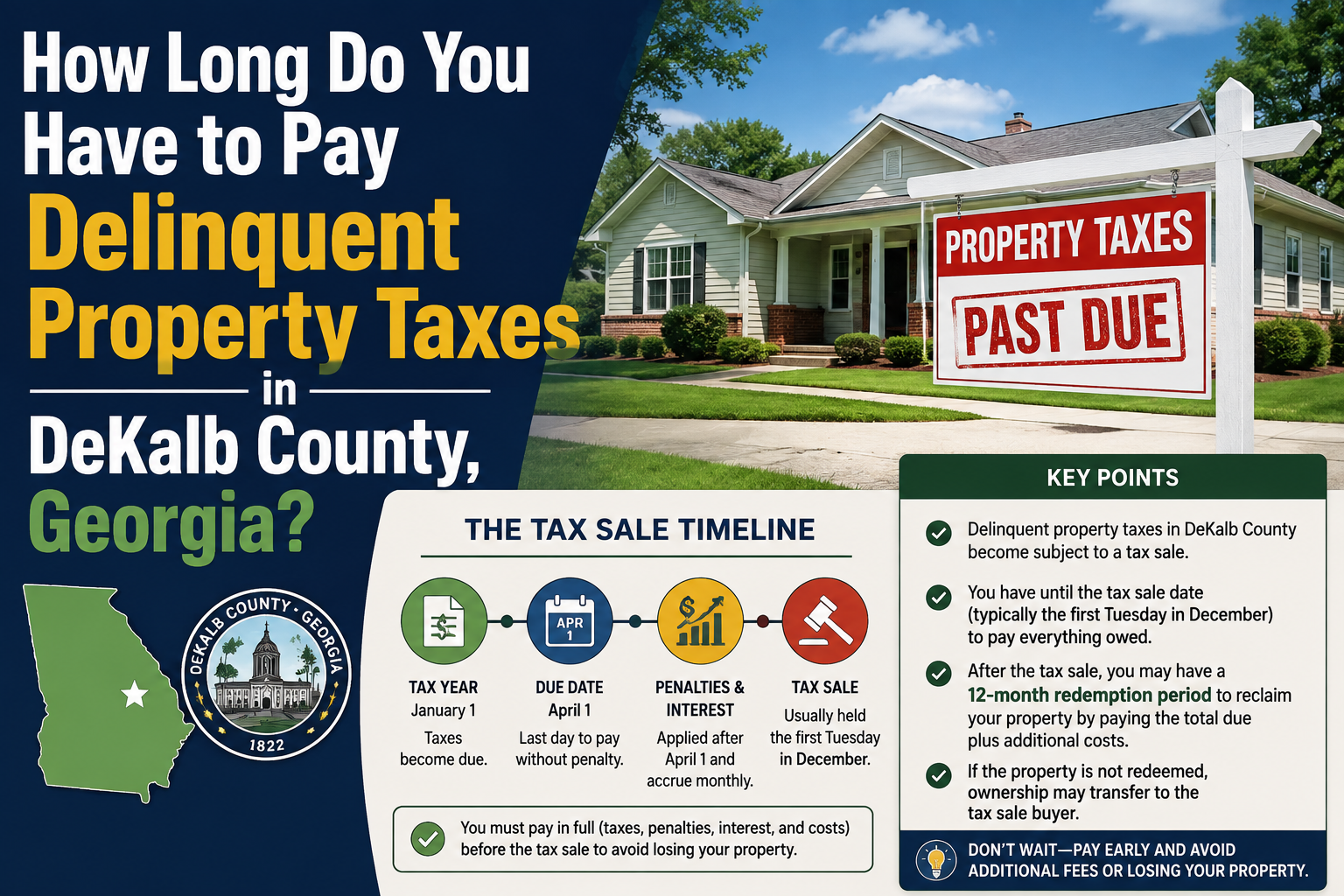
If you have fallen behind on your DeKalb County property taxes, the question that keeps you up at night is a simple one: how much time do I actually have before I lose the house?
There is no single deadline. There are three separate clocks, they run one after another, and each is more expensive than the last. Miss the first and you get a lien. Miss the second and your property goes to auction on the courthouse steps in Decatur. Miss the third and it is gone permanently. Here is how the DeKalb timeline works, what each stage costs, and what you can still do at each point.
The Short Answer: Three Deadlines, Not One
- December 31. DeKalb subjects any account with an outstanding balance after December 31 to a tax lien. This is your cleanest, cheapest window.
- Roughly 4 to 12 months after the lien. Once a FiFa is recorded, the county can levy and advertise the property for a tax sale held the first Tuesday of the month in front of the DeKalb County Courthouse.
- 12 months after the sale. If the property sells, you have one year to redeem it — by paying the buyer’s bid plus a 20% premium.
| Quick answer: In DeKalb County, taxes are delinquent the day after the installment due date, and any balance still unpaid after December 31 is subject to a tax lien. From there the county can move to a tax sale within months. If the property is sold, you have 12 more months to redeem it by paying the purchaser’s bid plus a 20% premium and costs. |
The DeKalb County Property Tax Calendar
DeKalb mails tax bills in mid-August and splits the year into two installments: the first due September 30, the second in mid-November (November 16 for the current cycle). Paying the whole bill at once must be done by September 30 to avoid a late charge. Bills for City of Atlanta properties inside DeKalb are mailed separately, on a later schedule.
Two things trip people up every year.
- Not receiving a bill does not extend the deadline. If it never arrived, you are still responsible. Look your account up and pay through the county portal.
- Mortgage servicing changes. When a loan is sold or paid off, the escrow account that quietly handled your taxes can stop doing so — one of the most common ways an owner ends up delinquent without knowing it. After any change, confirm your account shows a zero balance.
You can look up and pay a DeKalb bill any time at the county’s online property tax portal.
What It Costs You to Wait
DeKalb accepts partial payments, and you can make as many as you need. But penalties and interest keep accruing on whatever remains, and they compound the delay:
- Interest accrues on the unpaid balance at the bank prime rate plus 3% annually, charged monthly (O.C.G.A. § 48-2-40).
- A 5% penalty attaches 120 days after the due date, and again every 120 days thereafter, up to a maximum of 20% of the original principal (O.C.G.A. § 48-2-44).
- Once collection actions begin, title research, advertising, levy, and sheriff’s costs are added to the balance.
A $2,400 bill does not stay $2,400. Between penalties, interest, and administrative costs, a balance can grow by a third or more before the property ever reaches auction.
Clock One: December 31, Before a Lien Attaches
This is the deadline most DeKalb homeowners never hear about, and it is the one that matters most. The Tax Commissioner’s office states plainly that accounts with an outstanding balance after December 31 are subject to a lien.
That lien is a FiFa — short for fieri facias, also called a tax execution. It is a recorded encumbrance authorizing the Tax Commissioner or the Sheriff to take whatever action state law allows to collect. It is also, in the county’s own words, the first step toward taking your property to tax sale.
Although the Tax Commissioner’s office does not report to credit bureaus, a recorded tax lien can still surface on your credit reports. It also clouds your title, so you cannot cleanly sell or refinance until it is satisfied.
Paying the taxes plus fees, penalties, and interest gets the lien marked satisfied. If you can clear the balance before December 31, do it — everything after costs more and gives you fewer options. Details are on the DeKalb County Tax Commissioner’s delinquent tax page.
Clock Two: From FiFa to the Courthouse Steps
Once a lien is recorded there is no fixed countdown to auction. DeKalb schedules sales periodically rather than monthly, and recent lists have included delinquencies stretching back many years. That cuts both ways: you may have longer than you fear, or far less. When a sale is scheduled, the process runs like this:
- The property is levied under the FiFa and added to the sale list.
- The sale is advertised for four consecutive weeks in the county legal organ, and notice is sent to the owner of record.
- The auction is held on the first Tuesday of the month in front of the DeKalb County Courthouse in Decatur. Legal sale hours run 9 a.m. to 4 p.m.
- Opening bids include all prior year taxes due, plus accrued costs.
One detail catches people badly. Once your property has been scheduled for tax sale, DeKalb will only accept cash, a bank-issued cashier’s check, or a bank wire transfer. Personal checks, business checks, money orders, and debit or credit cards are all refused at that stage. If you plan to pay at the last minute you need certified funds in hand, not a card.
You can check whether a parcel appears on the county’s tax sale listing, and the office publishes a report of all properties with taxes due within the last seven years.
Clock Three: The 12-Month Right of Redemption
If the property sells, you are not finished — but the terms get harsh. Georgia gives the former owner, creditors, and anyone else with an interest in the property 12 months from the sale date to redeem it.
Redemption is not repaying your back taxes. Under O.C.G.A. § 48-4-42 you must pay the purchaser the full bid amount, any taxes and special assessments they have paid since the sale, plus a 20% premium for the first year and 10% for each year or fraction of a year after that.
Do the arithmetic before counting on this. A homeowner who could not pay a $5,000 bill is now asked for the purchase price plus 20% at once. The right is real, but it rescues far fewer homes than owners expect.
After 12 months the purchaser can serve a barment notice under O.C.G.A. § 48-4-45 to foreclose your right of redemption permanently, and title ripens automatically four years after the tax deed is recorded. During the redemption year the purchaser cannot take possession, collect rent, or make improvements.
Excess Funds: Money You May Be Owed After a Sale
This is the part almost nobody knows about, and it costs DeKalb families real money every year. When a tax sale brings in more than the taxes, costs, and fees owed, the surplus is called excess funds, and the Tax Commissioner holds it until an entitled party claims it.
A home worth $250,000 sold over a $9,000 tax debt can generate tens of thousands in excess funds. That money belongs to the former owner and other interested parties, not the county or the buyer — but it does not arrive automatically. You have to claim it.
Claims go to the Delinquent Collections Claims division, are evaluated case by case on your documentation, and must be filed by the entitled party or their Georgia-licensed attorney. Powers of attorney are not accepted. If competing claims arise the office may interplead the funds into Superior Court, after which it cannot give updates.
If a property you owned went to tax sale in DeKalb, check the county’s published excess funds list and download the excess funds claim form. Be wary of anyone who contacts you offering to recover the money for a large cut — you can file yourself.
What to Do If You Are Behind on DeKalb County Property Taxes
- Start making partial payments now. DeKalb accepts them, and every dollar paid reduces the base that penalties and interest compound on.
- Confirm your exemptions. Missing homestead, senior, or disability exemptions inflate every future bill. Check the DeKalb exemptions page and, if you are 62 or older, the county’s dedicated seniors resources.
- Appeal the assessment if the value is wrong. Assessment notices go out in late May and you have 45 days to appeal through the DeKalb Property Appraisal Department. An exemption cannot fix an inflated valuation.
- Go in person before a sale is scheduled. Staff have more room to work with you early than late. See DeKalb tax office locations or call 404-298-4000.
- Fix title problems immediately. If the home is still deeded to a deceased parent, you cannot claim homestead and may not even receive the notices. See our guide to heirs’ property and probate in Georgia.
- Know what you qualify for at 65. Senior exemptions can cut a DeKalb bill substantially. Read do I have to pay property taxes after age 65 in Georgia.
If the balance is beyond reach, consider selling before the auction. A tax sale clears for little more than the back taxes, wiping out equity a normal sale would preserve. Selling ahead of the date, even at a discount, almost always leaves the family with more than the courthouse steps will. We buy DeKalb County houses in this situation, including homes that need repairs and homes with liens attached. Request a no-obligation cash offer or get in touch to talk through the timeline.
Frequently Asked Questions
How long do you have to pay delinquent property taxes in DeKalb County?
There is no single deadline. Taxes are delinquent the day after the installment due date, and any balance still outstanding after December 31 is subject to a tax lien. From there DeKalb can schedule a tax sale within months. If the property sells, you have 12 more months to redeem it.
When are DeKalb County property taxes due?
Bills are mailed in mid-August and payable in two installments, the first due September 30 and the second in mid-November. Paying the full amount at once must be done by September 30 to avoid a late charge. City of Atlanta properties in DeKalb are billed separately on a later schedule.
What is a FiFa, and what does it do to me?
A FiFa (fieri facias) is a recorded tax lien, also called a tax execution. It authorizes the Tax Commissioner or Sheriff to collect the debt and is the first step toward a tax sale. It clouds your title and can appear on your credit reports, even though the Tax Commissioner’s office does not report to credit bureaus.
Where and when are DeKalb County tax sales held?
Tax sales are conducted in front of the DeKalb County Courthouse in Decatur on the first Tuesday of the month, with legal sale hours from 9 a.m. to 4 p.m. Sales are held periodically rather than every month, and upcoming listings are posted on the county website.
How much does it cost to redeem my property after a DeKalb tax sale?
You must pay the purchaser’s full bid, any taxes and special assessments they have paid since the sale, plus a 20% premium for the first year and 10% for each year after. That is on top of everything already owed, and it must generally be paid at once.
What are excess funds and how do I claim them?
When a tax sale raises more than the taxes, costs, and fees owed, the surplus is held by the Tax Commissioner until claimed. Claims go to Delinquent Collections Claims and must be filed by the entitled party or their Georgia-licensed attorney; powers of attorney are not accepted.
The Bottom Line
The time you have to pay delinquent property taxes in DeKalb County is longer than panicked homeowners assume and shorter than complacent ones do. December 31 is the deadline that protects your title. Everything after is damage control, and each stage costs more than the last.
Act while you still hold the cheapest options. Call the Tax Commissioner, verify your exemptions, appeal the value if it is wrong, and if the number is out of reach, sell before the auction rather than after. We can help you understand where you stand.