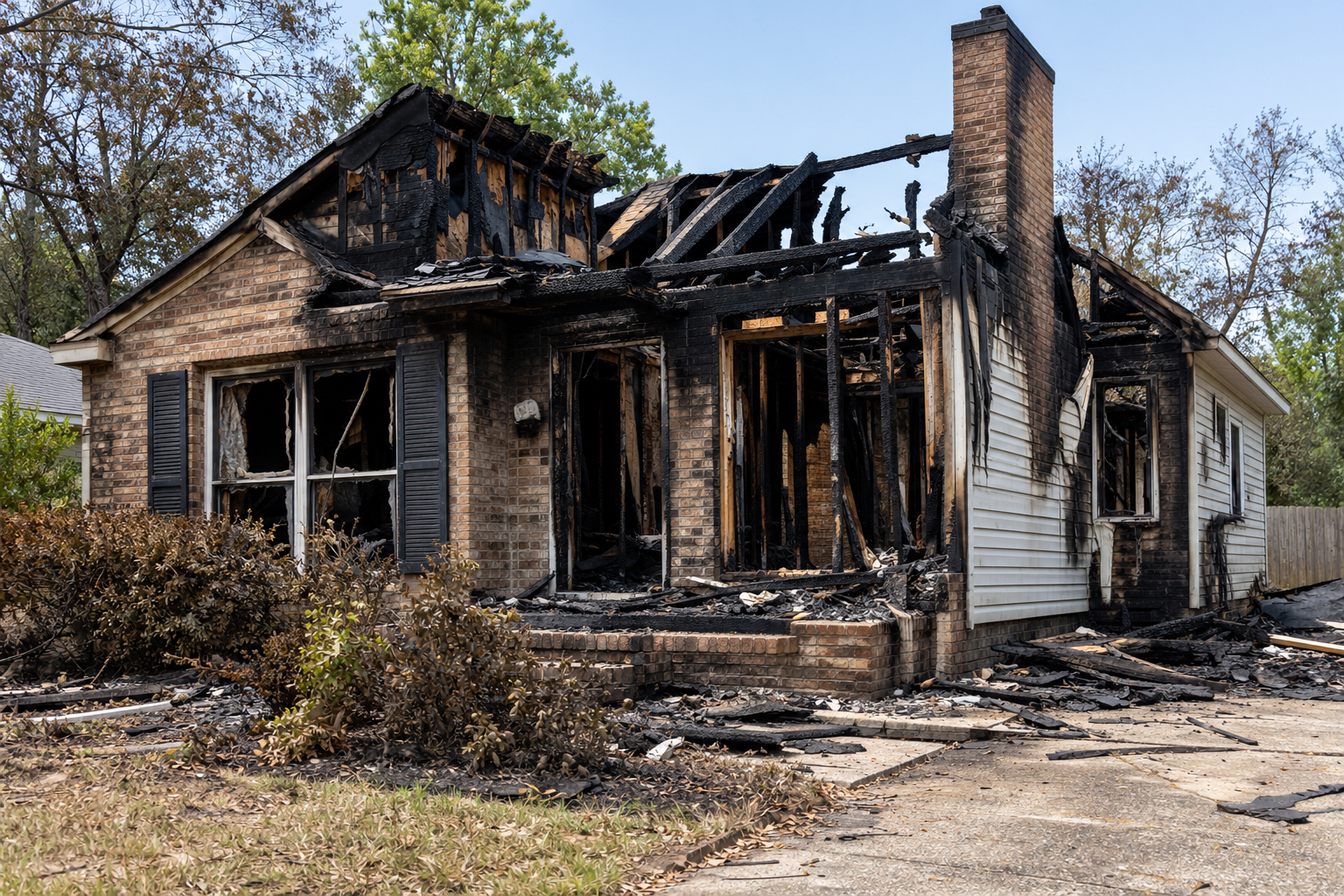
A house fire turns your biggest asset into your biggest problem overnight. If you are wondering how to sell a fire damaged house in Atlanta without spending months and tens of thousands of dollars on repairs, the short answer is this: you can sell it as-is, in its current condition, to a cash buyer. You can still keep your insurance settlement, and you can close in as little as one to two weeks.
But “as-is” is not the only option, and it is not always the one that puts the most money in your pocket. The right path depends on how bad the damage is, what your insurance will pay, whether you still owe a mortgage, and how long you can afford to carry a house you cannot live in.
This guide is written for Atlanta and Fulton County homeowners, heirs, and landlords. It covers what to do in the first days after a fire, how to get your Atlanta Fire Rescue report, and how Georgia’s “buyer beware” disclosure rules actually work. It also runs through a real money comparison of repairing first versus selling as-is, and walks step by step through selling your fire damaged house for cash to Atlanta Land Buyers.
Quick answer: To sell a fire damaged house without repairs: (1) secure the property and file your insurance claim, (2) get the fire incident report, (3) get a repair estimate so you know the numbers, (4) decide between listing, selling as-is, or selling the lot, and (5) close with a licensed Georgia title company. Want a number today? Request a free cash offer or call (404) 913-7086.
What to Do First After a House Fire in Atlanta
Before you think about selling, protect two things: your safety and your insurance claim. The steps you take in the first days after a fire shape how much you can recover later, whether you repair or sell.
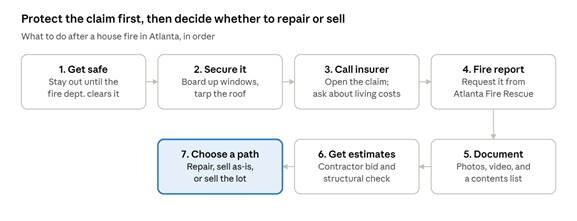
Steps after a house fire · 7 stages before you sell
Stay out, then secure the property
Do not go back inside until the fire department says it is safe. Fire weakens floors, roofs, and wiring in ways you cannot see. Once you are cleared, board up broken windows and doors and tarp any roof openings. Most policies expect you to prevent further damage, and an open, burned house in Atlanta quickly attracts break-ins, squatters, and dumping.
Call your insurance company and open the claim
Report the fire right away and ask your insurer three questions. What does my policy cover for the structure and contents? Does it pay additional living expenses while I cannot live there? Does selling the house affect my claim? Get the answers in writing. If you have a mortgage, your lender is usually named on the policy, so claim checks for the structure are often made out to both you and the lender.
Watch the vacancy clause too. Many homeowners policies limit coverage once a home sits empty for an extended period. Ask your agent what applies to a house you cannot live in.
Get the fire incident report
The fire report confirms the date, cause, and scope of the fire. Insurers, lenders, and buyers will all ask for it. In the City of Atlanta, request it from Atlanta Fire Rescue through an open records request: online, by email to openrecords@atlantaga.gov, by mail, or in person at Atlanta Public Safety Headquarters, 226 Peachtree Street SW. The department’s main number is 404-546-7000. If your home is outside city limits, in places like Sandy Springs, South Fulton, or DeKalb County, request the report from the fire department that responded.
Document everything
Take date-stamped photos and video of every room, the roof, and the exterior before anything is removed. Make a written list of damaged contents. Keep every receipt for hotel stays, board-up, and cleanup.
Get a repair estimate, even if you plan to sell
A licensed contractor’s estimate, and a structural inspection if framing or the roof burned, tells you what the house needs. You need that number to judge any offer, including ours. It is the difference between a smoke-damaged house that can sell to a regular buyer and a structurally damaged one that lenders will not finance.
A warning about “fire chasers.” Within hours of a fire, you may get calls, texts, or door knocks from investors and contractors. Some are legitimate. Some push you to sign a contract or an assignment of your insurance benefits while you are in shock. Do not sign anything in the first few days. A fair buyer will still be there next week.
Should You Repair the Fire Damage or Sell As-Is?
Repairing first usually brings a higher sale price. Selling as-is usually brings more certainty, less risk, and cash in weeks instead of months. Which one leaves you better off depends on how bad the damage is and what your insurance covers.
How fire damage affects value
Industry estimates cited by Opendoor and sourced to Realtor.com put the value hit in three rough tiers:
| Damage level | What it looks like | Typical value impact | Who can buy it |
| Smoke and cosmetic | Soot, odor, stained ceilings, minor scorching | About 3% to 10% | Most buyers, including those with FHA or conventional loans |
| Structural | Burned framing, roof damage, failed wiring | About 25% to 50% | Mostly cash buyers and investors, since lenders will not finance an uninhabitable home |
| Total loss | Structure cannot be saved | Worth roughly the land value, less demolition | Builders, land buyers, and investors |
In Atlanta, location softens or sharpens those numbers. FMLS data put the metro Atlanta median sale price at $400,000 in August 2026, and Fulton County’s median at $477,300. A burned house on a desirable intown lot still has real value, because the land alone is worth a lot.
The money: repair first vs. sell as-is
Here is a worked example for a typical Atlanta home worth $400,000 before a fire with moderate structural damage.
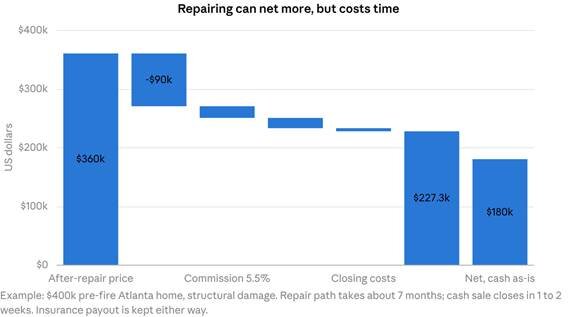
Illustrative example · assumptions listed below the chart · not an appraisal or offer
Assumptions in this example: $90,000 contractor estimate; the repaired home sells for $360,000 (90% of pre-fire value, reflecting fire history and a slower market); 5.5% agent commission; 7 months of mortgage, taxes, insurance, and utilities at $2,500 a month; about 1.5% seller closing costs. The cash offer is 50% of the after-repair price, the middle of the 40% to 60% range commonly reported for fire damaged homes. Your numbers will differ.
On paper, repairing first nets about $47,000 more here. In real life, that gap can shrink or flip:
- You need the cash up front. Insurance checks with your lender’s name on them are often released in stages as work is inspected, so you may have to front costs.
- Budgets run over. Fire often hides damage inside walls, ductwork, and insulation that only shows up after demolition begins.
- Time is money. Every extra month adds roughly $2,500 of carrying costs in this example, plus the risk of vandalism on an empty house.
- Underinsured or disputed claims leave you paying the gap yourself.
Remember: you keep your insurance payout
Your insurance settlement generally belongs to you whether you repair or sell. If your policy pays $90,000 and you sell as-is for $180,000, your total recovery is about $270,000 before paying off any mortgage. Confirm with your adjuster in writing before you sign a sale contract.
When selling as-is is usually the smarter move: the house is vacant or inherited, you do not have savings to fund repairs, the damage is structural or a total loss, your claim is small or disputed, you live out of state, or you are already behind on the mortgage or property taxes.
5 Ways to Sell a Fire Damaged House in Atlanta, Compared
There are five realistic ways to sell a fire damaged house in Atlanta. The best one depends on how much damage there is, how fast you need the money, and whether you want to manage a renovation.
[Image: Side-by-side photo of a smoke-damaged kitchen and a fully burned-out room. Alt text: “Smoke damage vs structural fire damage in an Atlanta home”]
| Option | Repairs needed | Typical time to close | Commission | Best for |
| Repair, then list with an agent | Full restoration | Months of repairs, plus time on market | Yes | Smoke or light damage, strong insurance, time to wait |
| List as-is with an agent | None | Weeks to months; investor buyers only if damage is structural | Yes | Desirable areas where investors bid against each other |
| Sell to an iBuyer | None or light | Days to weeks | Service fee | Mostly cosmetic damage; iBuyers often pass on structural damage |
| Sell to a local cash buyer | None | As fast as 7 to 14 days | No | Structural damage, vacant or inherited homes, tight deadlines |
| Demolish or sell as a lot | Demolition or none | Varies | Depends on buyer | Total losses and valuable intown lots |
Option 1: Repair, then list
This path brings the full retail buyer pool back. It makes the most sense for smoke or light damage, when insurance covers the work and you can wait. In Fulton County, homes averaged about 63 days on market in August 2026, and that clock starts only after repairs are finished and permits are closed.
Option 2: List as-is with an agent
An agent can market the house to investors on FMLS. This can work well in high-demand intown neighborhoods, where builders compete for the lot. You still pay a commission, and deals often fall apart after inspections.
Option 3: Sell to an iBuyer
Companies like Opendoor make quick online offers, but their model works best for homes in fair condition. Opendoor’s own guide says it is not the right fit for severe structural fire damage or total-loss properties.
Option 4: Sell to a local cash buyer
A local cash buyer purchases the house as-is with its own funds. There are no repairs, cleanup, showings, or lender approvals. This is the path most owners choose for structural damage, vacant or inherited homes, or when bills are piling up. It is what we do at Atlanta Land Buyers. See our page on selling an ugly house in any condition.
Option 5: Sell the lot
If the house is a total loss, what you are really selling is land. In much of Atlanta, a buildable lot close to the Beltline, MARTA, or job centers holds significant value on its own. You can demolish first and sell a clean lot, or sell as-is and let the buyer handle demolition. We buy both burned houses and vacant land across Fulton County, so we can price either path. For more on lot sales, read about our Georgia land buyers service.
Georgia Rules to Know Before You Sell a Fire Damaged House
Selling a fire damaged house in Georgia comes with a few legal and financial issues that national guides get wrong or skip. None of them stop a sale, but each one can cost you money if you ignore it.
Disclosure: Georgia is a “buyer beware” state, with limits
Many national articles say every state requires you to disclose fire damage on a disclosure form. Georgia works differently. It follows caveat emptor, or “buyer beware.” Georgia law does not require a seller’s disclosure form, and buyers are expected to inspect the property themselves.
That does not mean you can hide a fire. Georgia sellers can still be liable if they conceal a known defect that a buyer could not find with a reasonable inspection, or if they answer a buyer’s direct question falsely. A Georgia REALTOR legal column describes a case where a seller won after not mentioning charred timbers in the attic, but only because the court found a careful inspection would have revealed them. Hidden smoke damage in ductwork or a patched-over burned wall is a different story.
The safe approach is simple: disclose the fire, share the fire report and repair estimate, and sell with clear as-is language in the contract. With a cash buyer like us, the buyer inspects and accepts the condition, and the fire history is already known up front.
Code enforcement and vacant burned houses
A burned house that sits empty in Atlanta is a code enforcement target. Open windows, a damaged roof, debris, and overgrowth can bring citations, fines, and even liens if the city steps in to board or clear the property. If you have already received a notice, read what a code enforcement violation is and how it affects a sale. Many cash buyers, including Atlanta Land Buyers, will purchase a house with open violations as-is.
Your mortgage keeps running
A fire does not pause your mortgage. Keep making payments while the claim is open. When you sell, the sale proceeds pay off the loan at closing, just like any other sale. If your lender is holding insurance money in a loss draft account, ask how those funds are released when the house is sold instead of repaired.
Property taxes keep running too
Fulton County property taxes are still due whether or not the house is livable. For owners outside the City of Atlanta, Fulton’s deadline is October 15. Georgia values property as of January 1, so a fire later in the year does not lower this year’s bill. It may support an appeal of next year’s assessment. See our guide to the Fulton County property tax appeal. If taxes fall behind, the county can file a Fi.Fa. and eventually hold a tax sale. We regularly buy tax-delinquent property and pay the back taxes at closing.
Inherited or out-of-state fire damaged houses
Many fire damaged homes in Atlanta belong to heirs or owners who live elsewhere. If the house is still in a deceased parent’s name, the estate’s personal representative or all heirs will usually need to sign. See inherited land and probate real estate in Atlanta. If you live out of state, we can handle the sale remotely. See out-of-state owners.
[Image: Boarded-up fire damaged house with a code enforcement notice on the door. Alt text: “Vacant fire damaged house in Atlanta facing code enforcement”]
This section is general information, not legal advice. Talk with a Georgia real estate attorney about your specific situation.
How to Sell a Fire Damaged House for Cash in Atlanta, Step by Step
If you decide not to repair, selling your fire damaged house to a local cash buyer takes one walkthrough and one closing. Here is exactly how it works with Atlanta Land Buyers.
Atlanta Land Buyers process for fire damaged houses · 5 steps
- Tell us about the house. Call (404) 913-7086 or fill out the short form on our sell my house fast page. Share the address, what burned, and whether you have an open insurance claim.
- We walk the property. We look at the structure, review the fire report and any contractor estimate, and check the county records for the mortgage balance, back taxes, and liens. You do not need to clean out debris or remove belongings.
- You get a written cash offer. Usually within a day or two, we send an offer that shows how we arrived at the number. It is based on the house as it stands, so no repair credits or inspection surprises come later. There is no cost and no pressure to accept.
- We close with a licensed Georgia title company. The title company handles the deed, pays off your mortgage and any back taxes or liens from the proceeds, and records the sale. If you live out of state, signing can often be arranged remotely.
- You get paid. Most sales close in 7 to 14 days after you accept, or on the date you choose if you need more time to wrap up your insurance claim.
What we buy
We buy fire damaged houses in any condition across Atlanta and Fulton County, including East Point, College Park, South Fulton, Sandy Springs, Roswell, and Alpharetta, and in DeKalb, Clayton, and Cobb counties. That includes:
- Homes with smoke and soot damage only
- Homes with burned framing, roofs, or wiring
- Total losses, where we are really buying the lot
- Vacant, inherited, and rental properties
- Houses with liens, back taxes, or code violations
How to compare cash offers
Not every “we buy fire damaged houses” company is the actual buyer. Some collect your information and sell it to other investors. Before you sign, ask:
- Are you the buyer on the contract, or will you assign it?
- Which title company will close, and can I call them?
- Is there any fee or earnest money I pay?
- How did you get to this price?
We answer all four in writing. For more on vetting buyers, see our guide to finding land buyers near me and why you keep getting letters to buy your house.
Frequently Asked Questions About Selling a Fire Damaged House
How do I sell a fire damaged house without making repairs?
Sell it as-is, either to a cash buyer or through an agent who markets it to investors. Secure the property, open your insurance claim, get the fire report and a repair estimate, then compare offers. A cash buyer can close in one to two weeks without any repairs or cleanup.
Can I sell my house before the insurance claim is settled?
Often, yes. The claim is usually tied to you as the policyholder, not to the new owner. Confirm with your adjuster in writing that selling will not affect your payout, and tell your buyer the claim is open. We can close before or after your claim is paid.
Do I keep the insurance money if I sell the house as-is?
Generally, yes. The settlement belongs to the policyholder whether you repair or sell. If your lender is named on the policy, it may hold structure funds until the mortgage is paid off at closing.
Do I have to disclose a fire when selling a house in Georgia?
Georgia does not require a seller’s disclosure form, and it follows “buyer beware.” But you cannot hide a known hidden defect or lie when a buyer asks directly. The safest move is to disclose the fire and share the report.
How much does fire damage reduce a home’s value?
Industry estimates put smoke and cosmetic damage at roughly 3% to 10% off, and structural damage at about 25% to 50% off. A total loss is worth about the value of the land, minus demolition.
How much will a cash buyer pay for a fire damaged house?
Cash offers for fire damaged homes commonly fall around 40% to 60% of the after-repair value. Where yours lands depends on the damage, the neighborhood, and the lot. In desirable Atlanta neighborhoods, the land value alone can support a strong offer.
Can I get a mortgage buyer for a fire damaged house?
Only if the damage is cosmetic and the home is still livable. FHA and conventional lenders generally will not finance a home with structural fire damage, so your buyers will be cash buyers or investors using private loans.
How do I get a fire report in Atlanta?
Submit an open records request to Atlanta Fire Rescue online, by email to openrecords@atlantaga.gov, by mail, or in person at 226 Peachtree Street SW. Outside city limits, ask the fire department that responded.
Should I demolish the house before selling?
Usually not until you have compared offers. Demolition costs money and needs a permit. Many buyers will take the house as it stands and handle demolition themselves. If the lot is valuable, get offers both ways.
Can I sell a fire damaged house with a mortgage or back taxes?
Yes. The mortgage, back taxes, and liens are paid from the sale proceeds at closing, and you receive what is left.
I inherited a house that burned. Can I still sell it?
Yes. If it is still in a deceased owner’s name, the estate’s personal representative or all heirs usually need to sign. We work with families and probate attorneys regularly.
How fast can I sell a fire damaged house in Atlanta?
With Atlanta Land Buyers, most sales close in 7 to 14 days after you accept our offer. Repairing and listing typically takes several months or more.
Ready to Sell Your Fire Damaged House in Atlanta? Get a Cash Offer
You have already been through enough. You do not need to manage contractors, argue over change orders, or pay for a house you cannot live in for another six months. If selling as-is makes sense for you, we will make it simple.
Atlanta Land Buyers is a local company at 1270 Caroline Street in Atlanta. We buy fire damaged houses and lots across Atlanta and Fulton County as-is: smoke damage, structural damage, or a total loss.
- No repairs, cleanup, or demolition
- No commissions or fees
- Mortgage, back taxes, and liens paid at closing
- Close in as little as 7 to 14 days, or on your schedule
- No obligation to accept
Call (404) 913-7086 or request your free, no-obligation cash offer today.
If repairing and listing would put more money in your pocket, we will tell you that too.
Atlanta Land Buyers · 1270 Caroline Street D120, Atlanta, GA 30307 · About us · Contact us