Atlanta land owners: here is what a code violation really means for your property.
| Quick Answer A code enforcement violation is an official finding that a property breaks a local rule about health, safety, or appearance, such as overgrown grass, dumped trash, an open vacant building, or unpermitted construction. In Atlanta, unresolved violations can lead to fines, city cleanup charges, and liens that are collected like property taxes. |
If you own land in Atlanta and just found a notice taped to a post or sitting in your mailbox, you are not alone. Thousands of Metro Atlanta owners, many of whom live out of state, inherited a lot from a family member, or simply fell behind during a hard stretch, receive code violation notices every year. The notice itself is not the end of the world. What happens after it, especially if you also owe back property taxes, is what can cost you the land.
This guide explains what a code enforcement violation is in plain English, who enforces codes in Atlanta, the most common violations on vacant land, and how a violation can quietly combine with unpaid taxes to put your property on the Fulton County tax sale or DeKalb County sale list. We will also walk through your real options, from fixing the problem to deciding it is time to sell. I am Gerald Harris, and we buy land in Atlanta, including a lot of parcels with code citations on them, so this is the conversation I have with owners every week.
What Is a Code Enforcement Violation? The Simple Definition
Every city and county adopts “codes,” which are local laws that set minimum standards for property. They cover things like how tall grass can grow, whether trash can sit on a lot, how buildings must be maintained, what can be built without a permit, and how land can be used under zoning.
Code enforcement is the government’s process for making sure property owners follow those rules. A code enforcement violation is the specific finding that your property does not meet one of those standards. Think of it as a ticket for your land rather than your car.
Here is the key point many owners miss: in Georgia, the responsibility almost always falls on the owner of record, meaning the name listed with the county tax assessor. It does not matter if you live in Charlotte, never visit the lot, or did not know a neighbor dumped tires there. If the property is in your name, the notice is addressed to you and the costs attach to your land. This is exactly why out-of-state landowners are the owners most likely to be blindsided.
Code Violation vs. Criminal Charge
Most code violations are civil or quasi-criminal matters, not crimes in the everyday sense. You will not usually be arrested for tall weeds. However, Atlanta can cite owners into Municipal Court, and ignoring court dates can create bigger problems. For vacant and problem properties, the city can also use its In Rem process, which acts against the property itself rather than the person.
Who Handles Code Enforcement in Atlanta?
Atlanta is unusual because code enforcement is split across several offices. Knowing who sent your notice helps you respond to the right place.
- APD Code Enforcement Section. Housing, property maintenance, junk and debris, overgrowth, graffiti, and open vacant structures inside Atlanta city limits have historically been handled by the Atlanta Police Department’s Code Enforcement Section, located at 818 Pollard Blvd SW.
- Department of City Planning (DCP). Zoning violations and illegal or unpermitted construction are handled by DCP’s zoning enforcement team, which can issue Stop Work Orders.
- ATL311. Most complaints start with a call to 311 (404-546-0311 from outside the city) or a report on ATL311.com. You can also use ATL311 to look up the status of a case on your own property.
- Outside city limits. If your land is in unincorporated Fulton or DeKalb County, or in cities such as South Fulton, East Point, College Park, Decatur, Stonecrest, or Union City, that jurisdiction runs its own code enforcement department with its own rules and deadlines.
Tip: Check the top of your notice for the issuing department and a case number. Always reference that case number when you call.
The Most Common Code Violations on Atlanta Land
The violations Atlanta code officers see most often on vacant and neglected land.
Alt text: Checklist of the most common code violations on vacant land in Atlanta, including overgrown grass over 12 inches, junk and debris, open vacant structures, and graffiti
Owners of vacant lots and older homes tend to run into the same handful of violations. Vacant land is especially exposed because nobody is there to notice the problem, and as we explain in our post on property taxes on vacant land, there is no mortgage escrow quietly keeping the account current either. Here is what each violation means in Atlanta:
1. Overgrowth and Tall Weeds
Atlanta defines overgrowth as uncultivated growth taller than 12 inches measured from the ground. Under Chapter 158 of the Atlanta Code, owners of vacant property cannot let weeds pass that height. One detail worth knowing: the rule generally does not apply to single-owner tracts of 40,000 square feet or more unless they sit inside a platted subdivision. In Atlanta’s humid summers, kudzu and brush can blow past 12 inches in a few weeks, which is why this is the number one violation for absentee lot owners.
2. Junk, Trash, and Illegal Dumping
Vacant lots attract dumped mattresses, tires, and construction debris. Even if someone else dumped it, the owner is responsible for removal. The city notes these cases can take months to fully process, but the clock on your compliance deadline starts once you are notified.
3. Open, Vacant, and Unsecured Structures
Any building on your land that is empty and open to entry violates the Atlanta Housing Code. The city requires vacant structures to be secured against unforced entry. Broken windows, missing doors, and signs of squatting all trigger this violation.
4. Unpermitted Construction, Clearing, or Grading
Clearing trees, grading, adding a structure, or placing fill dirt without permits can bring a Stop Work Order from the Department of City Planning. Atlanta also protects many trees under its tree ordinance, so removing them without approval can result in steep recompense fees.
5. Graffiti, Abandoned Vehicles, and Hazardous Trees
Graffiti must be removed within the deadline on the notice. Inoperable or abandoned vehicles on a lot, dead trees leaning toward the street, and brush blocking sidewalks are also common citations in neighborhoods like West End, Adair Park, Pittsburgh, Mechanicsville, English Avenue, and Vine City, where many vacant parcels exist.
How the Code Enforcement Process Works in Atlanta
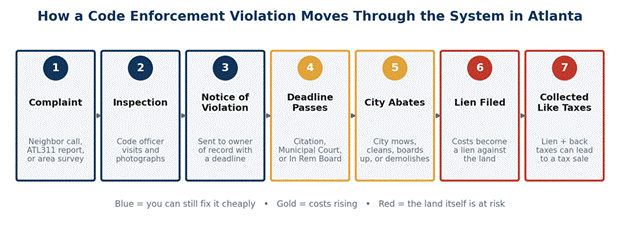
From complaint to tax sale: the seven stages of an Atlanta code enforcement case.
Alt text: Flowchart of the Atlanta code enforcement process from complaint and inspection to notice of violation, city abatement, lien, and tax sale
While every case is different, most Atlanta violations follow the same path:
- Complaint or observation. A neighbor calls 311, a council office flags the lot, or an officer spots it during an area survey of nearby properties.
- Inspection. A code officer visits, photographs the conditions, and confirms the ownership through county records.
- Notice of Violation. The owner of record is notified by mail and often by a posted notice. It lists the violation, the code section, and a deadline to fix it.
- Re-inspection. If the deadline passes without correction, the officer may issue a citation to Municipal Court. Corporate or LLC owners may go through a civil process instead.
- City abatement. For persistent problems, the city can hire contractors to cut, clean, board up, or in serious cases demolish a structure.
- Lien. The cost of that work, plus administrative fees, becomes a lien on the land.
- Collection. Under Georgia law, those liens can be enforced and collected much like property taxes, which is where the real danger begins for owners already behind.
Why Code Violations Are So Dangerous When You’re Behind on Property Taxes
This is the part most articles skip, and it matters enormously if you own land and are behind on property taxes. (If you are not sure how urgent your situation is, read how many years you can be behind on property taxes in Georgia.) A code violation by itself is a manageable problem. A code violation combined with unpaid taxes creates a snowball.
Code Liens Can Be Collected Like Taxes
Georgia’s unfit buildings statute, O.C.G.A. § 41-2-9, allows local governments to place a lien for demolition and abatement costs, including court costs, appraisal fees, and administrative costs, against the property. Those liens can be enforced through the tax collection system and carry interest and penalties. In practical terms, your city cleanup bill can end up riding alongside your tax bill.
The statute also contains a helpful provision: the government may release the lien if the owner signs an agreement with a rehabilitation timetable and shows the financial means to complete it. That is worth asking about if you plan to keep the property.
How Georgia Tax Sales Work
Georgia is a tax deed state. When taxes go unpaid, the tax commissioner issues a tax execution (called a fi. fa.) and can eventually sell the property at public auction, typically held on the first Tuesday of the month. In Fulton County, sales take place at the courthouse downtown; see our guide to how the Fulton County tax sale works. DeKalb owners should read what it means if your parcel is on the DeKalb delinquent tax list. You can check your balance directly with the Fulton County Tax Commissioner or the DeKalb County Tax Commissioner. For the bigger picture, see what happens if you don’t pay property taxes.
After a sale, O.C.G.A. § 48-4-40 gives the owner a right to redeem the property, generally within 12 months. But redemption is not cheap: you must pay the winning bid plus a premium (20% in the first year for most current sales), plus certain costs the buyer incurred. Our post on the 12-month redemption period breaks down the math. If you could not afford the tax bill, coming up with 120% of the sale price in a lump sum is often out of reach.
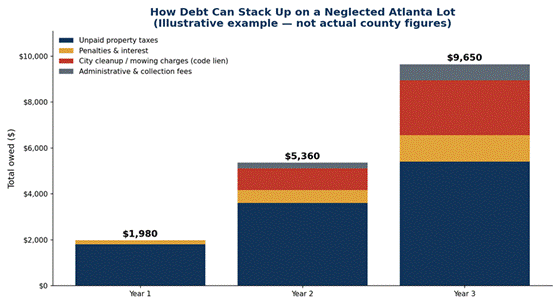
Illustrative example: debt on a neglected lot can grow quickly when code charges are added to back taxes.
Alt text: Stacked bar chart showing how unpaid property taxes, penalties, city cleanup code liens, and fees can grow from about $2,000 to over $9,600 in three years on a neglected Atlanta lot
Look at the example above. A lot that starts with about $1,800 in unpaid taxes can grow to nearly $10,000 in three years once penalties, interest, mowing and cleanup charges, and collection fees are layered on. None of these figures are official county numbers, but the pattern is exactly what we see with neglected Atlanta parcels.
Illustrative example: the equity gap between what a lot is worth and what it may sell for at a tax sale.
Alt text: Bar chart comparing an Atlanta lot market value of $85,000 to about $9,650 owed, a possible $14,000 tax sale price, and $16,800 needed to redeem in year one
The second chart shows why waiting is so expensive. Tax sales often start at the amount owed, so a lot worth $85,000 could sell for a fraction of that. Georgia law does provide for excess funds to go to the former owner, but claiming them takes time and legal work, and you lose the property along the way. Read more about tax foreclosure in Georgia.
Special Situations for Atlanta Land Owners
Inherited and Heirs Property
Many vacant lots in southwest and westside Atlanta are “heirs property,” land passed down without a will or clear title. Notices often go to a deceased relative’s name, so nobody responds until the lien is already filed. If you have inherited land with unclear title, start with our guide to probate real estate in Georgia. The Georgia Heirs Property Law Center can also help sort out ownership.
Out-of-State Owners
If your mailing address on file with the tax assessor is outdated, you may never see the notice. Update your mailing address with the county and check ATL311 periodically for open cases on your parcel. Most of a sale can also be handled remotely; here is how we work with out-of-state owners.
LLC and Corporate Owners
Atlanta requires corporate-owned properties with housing and commercial maintenance code violations to go through a civil process, which lets the city resolve the case without the owner appearing in court. Investors and small LLCs should not assume “civil” means “minor,” since fines and liens still attach to the land.
What to Do If You Receive a Code Violation Notice
- Do not ignore it. Deadlines are short, often 10 to 30 days depending on the violation.
- Read the notice carefully. Note the case number, code section, issuing department, and compliance date.
- Call the issuing office. Confirm what “compliance” means and ask for an extension in writing if you need one.
- Fix it and document it. Take dated photos after mowing, cleaning, or securing the property and send them with your case number.
- Check your tax status. Look up the parcel on the county tax commissioner’s site to see if you owe back taxes or have an existing fi. fa.
- Get help if needed. Low-income owners can contact Atlanta Legal Aid Society. For complex title or tax sale questions, speak with a Georgia real estate attorney.
Your Options When Code Violations Meet Back Taxes
A general comparison of cost, speed, and risk for each path. Your situation may differ.
Alt text: Chart comparing four options for Atlanta land owners with code violations and back taxes: fix and keep, payment plan, sell as-is for cash, or do nothing
Option 1: Fix the Violation and Keep the Land
If you have the cash and a plan for the property, correcting the violation quickly is the cheapest path. Pay the taxes, clear the lien, and consider a maintenance contract so a mowing crew visits every few weeks during Atlanta’s long growing season.
Option 2: Ask About Payment Arrangements
Contact the tax commissioner’s office to ask what arrangements are available for delinquent taxes on your parcel. Getting current can stop the tax sale clock, but it will not remove code liens on its own, so address both. DeKalb owners facing a sale date should read how to stop a tax sale in DeKalb County.
Option 3: Sell the Land As-Is
If you do not want to keep paying for a lot you never use, selling is often the cleanest exit. As we explain in can I sell property with a lien on it in Georgia, back taxes and code liens are typically paid from the sale proceeds at closing, so you do not need cash up front. See how to sell land with back taxes in Georgia for the closing mechanics. We buy vacant land in almost any condition across Fulton County and DeKalb County, including overgrown and dumped-on lots, mobile homes on land, and houses that need work.
Option 4: Do Nothing
Doing nothing is the most expensive choice. Fines grow, liens accrue interest, and eventually the property can be sold for a fraction of its value, leaving you with nothing but a credit and legal headache.
Frequently Asked Questions About Code Enforcement Violations in Atlanta
What is a code enforcement violation in simple terms?
It is an official finding that your property breaks a local rule about safety, health, or maintenance, such as overgrown grass, junk, an unsecured building, or unpermitted work.
How do I find out if my Atlanta property has a code violation?
Call 311 (or 404-546-0311 from outside the city) or search ATL311.com with your address. Outside city limits, contact your county or city code enforcement office.
How tall can grass be on a vacant lot in Atlanta?
Atlanta treats uncultivated growth over 12 inches as overgrowth. Large single-owner tracts of 40,000 square feet or more outside platted subdivisions are generally exempt.
Can a code violation become a lien on my land?
Yes. When the city performs cleanup, board-up, or demolition, the costs can become a lien on the property under Georgia law and may be collected like taxes.
Can I lose my property because of code violations?
Indirectly, yes. Unpaid code liens combined with delinquent property taxes can lead to a tax execution and a public tax sale.
I did not know about the violation. Am I still responsible?
Generally yes. Notices go to the owner of record, so keep your mailing address current with the county tax assessor. This is especially important for out-of-state owners and heirs.
How long do I have to redeem my land after a Georgia tax sale?
Generally 12 months from the sale under O.C.G.A. § 48-4-40, and until the buyer formally forecloses the right to redeem. You must pay the bid amount plus a premium and certain costs.
Can I sell land that has code violations and back taxes?
Yes. Liens and taxes are usually paid from the proceeds at closing. Atlanta Land Buyers purchases land as-is, including overgrown lots with open code cases, and most closings take 7 to 14 days.
Does a code violation affect my credit?
A code violation itself usually does not appear on a credit report, but related court judgments and unpaid debts can create financial and legal problems.
Who do I call about a violation on inherited land?
Start with the issuing office on the notice, then confirm who holds legal authority over the property. The Georgia Heirs Property Law Center and Atlanta Legal Aid can help with title issues, and our inherited land page explains what has to happen before a sale is possible.
Ready to Stop the Fines and Protect Your Equity?
| Get a Cash Offer for Your Atlanta Land If you own land in Atlanta, Fulton County, or DeKalb County and you are dealing with code violations, back taxes, or both, you do not have to figure it out alone. Atlanta Land Buyers is a local, family-owned company with 15+ years in Georgia real estate. We buy land as-is, pay eligible back taxes and code liens out of the proceeds at closing, and usually close in 7 to 14 days. No commissions, no fees, no cleanup required. And if selling is not the right move for you, I will tell you that. Sometimes the best answer is to pay the county and keep the land. Call or text Gerald directly at (404) 913-7086, request your no-obligation cash offer, or contact us with your parcel number. Want to know who you would be working with? Read more about me and our company. Atlanta Land Buyers | 1270 Caroline Street D120, Atlanta, GA 30307 | (404) 913-7086 |
Related Reading From Atlanta Land Buyers
- Selling Tax-Delinquent Land in Atlanta
- How the Fulton County Tax Sale Process Works
- Can I Get My Property Back After a Tax Sale? The 12-Month Redemption Period
- Can I Sell Property With a Lien on It in Georgia?
- How Long Can You Be Behind on Property Taxes in DeKalb County?
- How To Sell Inherited Land for Cash in Atlanta
- Claiming Fulton County Excess Funds After a Tax Sale
Ready To Sell Your Land? Start Here…
We are direct land buyers. There are no commissions or fees and no obligation whatsoever. Start below by sharing where your property is and where we can send your offer…
"*" indicates required fields