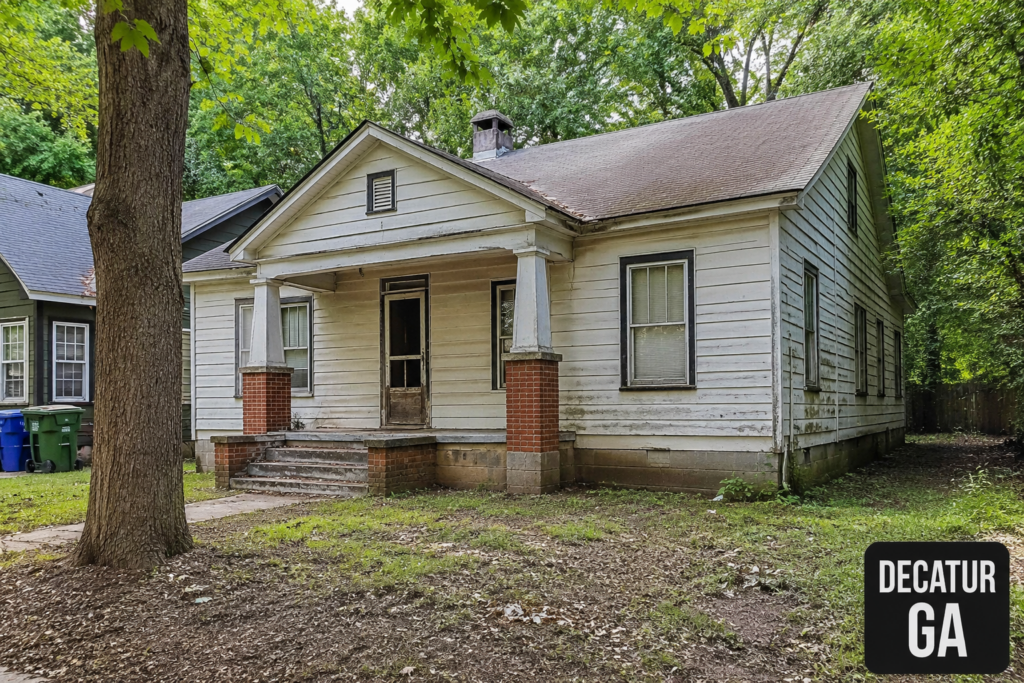
A practical guide for Decatur, Georgia property owners on installment billing, assessment ratios, millage rates, and how a single parcel can be current with one taxing authority and delinquent with the other.
Most Georgia property owners deal with one property tax bill a year, from one office, with one due date. If you own property inside the City of Decatur, you deal with two separate taxing authorities, two separate billing cycles, and four payment deadlines spread across seven months of the calendar.
This is not a quirk of paperwork. Decatur operates its own tax collection function alongside DeKalb County, bills on a schedule that does not overlap with the county at any point, and calculates your taxable value using a different assessment ratio than the county uses. The result is a structure almost nobody explains to buyers at closing, and one that quietly produces tax liens on properties whose owners genuinely believed they were paid up.
Here is how the two systems actually interact, and where owners get caught.
Why a Decatur Property Gets Two Tax Bills
Decatur sits inside DeKalb County, so the county levies its own ad valorem taxes on the parcel the way it does anywhere else in DeKalb. That is bill number one, issued by the DeKalb County Tax Commissioner.
Bill number two comes from the City of Decatur, and it carries something most municipal bills do not: a full school system. City Schools of Decatur is an independent school district, separate from the DeKalb County School District. Because Decatur residents sit outside the county school system, the school millage that would normally ride on a county bill instead rides on the city bill. That single fact is why the Decatur bill is so large relative to a typical city tax bill, and why owners who assume the county bill is “the real one” are badly mistaken about the proportions.
By the city’s own breakdown, schools account for roughly 61 cents of every dollar collected on the Decatur bill. The general fund takes about 27 cents. Everything else, including capital improvements, bonds, solid waste, stormwater, and the Downtown Development Authority, splits the remainder.
The Four Deadlines, in Calendar Order
The City of Decatur bills in two unequal installments. DeKalb County also bills in two installments, but from a single mailing in August. Neither schedule aligns with the other, and no deadline is shared.
| Bill | Authority | Typically mailed | Due date |
| 1st installment | City of Decatur | By April 1 | June 1 |
| 1st installment | DeKalb County | August | September 30 |
| 2nd installment | DeKalb County | August (same mailing) | November 15 |
| 2nd installment | City of Decatur | October 20 | December 20 |
Watch the weekend rule. Both authorities roll a deadline that lands on a weekend or holiday to the next business day, and both do it independently. For the 2026 cycle, DeKalb’s second installment moved to November 16 because November 15 fell on a Sunday, and Decatur’s billing ordinance set the second installment at December 21 for the same reason. If you calendar the statutory dates rather than the dates printed on this year’s bill, you will eventually be a day off on a payment that carries a five percent penalty.
The Assessment Ratio Difference Almost Nobody Catches
This is the single most misunderstood point in Decatur property taxation, and it is worth reading twice.
Both bills start from the same appraised fair market value. The DeKalb County Board of Tax Assessors appraises every parcel in the county, including every parcel inside Decatur. The city does not run its own appraisal operation; it takes the county’s valuation.
But the two authorities then apply different assessment ratios to that value. DeKalb County uses the standard Georgia ratio of 40 percent of fair market value for its own bills. The City of Decatur uses 50 percent.
On a home appraised at $400,000, the county calculates against an assessed value of $160,000 while the city calculates against $200,000. Same house, same appraisal, two different taxable bases.
The practical consequence is that you cannot compare the two millage rates directly. Stacking a city millage against a county millage and concluding one is higher is an apples-to-oranges comparison, because the denominators differ by 25 percent. Anyone budgeting a purchase, underwriting a rental, or arguing a valuation needs to run each bill on its own base. Our broader comparison of Fulton County vs. DeKalb County property taxes covers how the standard 40 percent ratio works across metro Atlanta, which makes Decatur’s 50 percent the exception rather than the rule.
City of Decatur millage rates for 2026
| Fund (City of Decatur, 2026) | Millage rate |
| General Fund | 8.75 |
| Capital Fund | 2.10 |
| Bond Fund | 0.59 |
| School Bond | 1.18 |
| DDA Fund | 0.35 |
| School Fund (City Schools of Decatur) | 20.30 |
| Total city millage | 33.27 |
Why the Second Decatur Bill Never Matches the First
The word “unequal” in Decatur’s installment structure is doing real work.
The first installment, mailed by April 1 and due June 1, is an estimate. The city calculates it by multiplying the assessed value by the combined city and school millage rate and dividing by two. At that point the current year’s tax digest is not final, so the city is working from the prior year’s value and last year’s millage.
The second installment, mailed October 20 and due December 20, is a restatement of the entire year. It uses the current year’s DeKalb tax digest as approved by the state, applies the final millage rates, applies any homestead exemption changes, and then credits whatever you paid in June. Because the assessed value, the millage, and the exemptions can all move between April and October, the second bill routinely differs from the first by a wide margin.
Owners who set up automatic payments for “half the tax bill” twice a year, or who budget the December payment by doubling the June one, are the ones who get surprised. Treat the June figure as a deposit, not as half the year.
Fees That Only Appear on One Bill
Sanitation and stormwater are billed annually by the City of Decatur and are normally payable in full on the first installment. They appear again as line items on the second installment bill, but only as a restatement of what you already paid, not as a second charge. Owners reading the December statement in isolation frequently think they are being double-billed for trash pickup.
DeKalb County has its own separate residential sanitation assessment on the county bill for parcels it services. Which fees land on which bill depends on the service arrangement for your address, so read the line items rather than assuming.
For vacant lots, this matters in a specific way: stormwater fees are assessed on paved and covered area and are charged to all property owners, including owners of tax-exempt property. An unimproved parcel producing no income can still generate a recurring utility fee alongside an ad valorem bill from each authority. This is a common reason vacant land in metro Atlanta quietly accumulates a balance the owner never budgeted for.
Current With One Authority, Delinquent With the Other
This is the failure mode the two-bill structure produces, and it is more common than it should be.
The two authorities do not share a ledger. Paying DeKalb County does nothing for your City of Decatur account, and paying the city does nothing for the county. Each can assess its own five percent late penalty. Each accrues interest on its own schedule, at the state formula of the bank prime rate plus three percent, which works out to 9.75 percent annually, or 0.8125 percent per month, for 2026. Each can issue its own Fi.Fa., the tax execution recorded against the property that functions as a lien and is the first step toward a tax sale.
So a parcel can show a clean payment history at DeKalb County Public Access while a separate city execution sits recorded against the same property. Owners who check one portal, see a zero balance, and stop looking are the ones who find out at closing, or when the notice arrives.
Two habits prevent it. First, check both portals every year, not one. The city maintains its own lookup at decaturgatax.com with seven years of history. Second, search the GSCCCA statewide lien index for recorded executions against the parcel, which will surface a lien from either authority regardless of which portal you normally use.
If a balance has already gone unpaid long enough to be advertised, read our guides on what happens when you don’t pay property taxes, the Georgia tax foreclosure process, and the 12-month redemption period that follows a tax sale.
The Escrow Trap
Both the City of Decatur and DeKalb County state plainly that they do not mail tax bills to mortgage companies. Your servicer has to request the information, or use a third-party tax service to pull it. And critically, both authorities put the obligation back on the owner: failure to receive a bill does not relieve you of the responsibility to pay it.
A servicer set up to pay a DeKalb County bill on a September and November cycle may have no record of a City of Decatur account on an April and October cycle. This is the classic failure after a refinance or a servicing transfer, where the new servicer inherits the county obligation and never learns the city one exists. The owner sees escrow disbursements, assumes full coverage, and does not discover the gap until a city execution is recorded.
If you escrow, confirm with your servicer in writing that they are paying both accounts, and confirm it again after any refinance or transfer.
Appeals: One Board, Two Bills
Because DeKalb appraises the property, an appeal of your value goes to the DeKalb County Board of Tax Assessors, not to the city. Georgia gives you 45 days from the date on your annual notice of assessment to file.
The outcome flows to both bills, but not on the same timeline. While an appeal is pending, both authorities bill at a temporary value. DeKalb’s default is the lesser of your last final value or 85 percent of the current year value, with alternative elections available, including a 100 percent election and a separate option for non-homesteaded property valued over $2 million. Decatur bills under appeal at a temporary value that is often 85 percent of the proposed assessed value.
The point owners miss: you still owe the full amount shown on each bill by each deadline while the appeal is pending. An appeal does not pause a due date on either bill. When the appeal resolves, you receive either a supplemental bill or a refund, from each authority separately. DeKalb applies interest to appeal differences settled after November 15.
Address Changes Require Two Steps
This is a small procedural detail with outsized consequences, especially for out-of-state owners and for heirs administering an estate.
A mailing address change must be submitted in writing to the DeKalb County Board of Tax Assessors. Once DeKalb has updated its record, you then have to separately notify the City of Decatur through its finance office or its tax portal. Completing only the first step means the county bill follows you and the city bill continues going to an address you no longer control.
For inherited property, this is how a parcel goes delinquent for years without anyone realizing. Bills route to a deceased owner’s address, nothing bounces back to the heirs, and interest compounds on two accounts at once. If you are working through an estate, see our guidance on selling inherited land and what happens when you inherit land in Georgia.
One Naming Trap Worth Knowing
Searching for “Decatur property tax deadlines” will surface results for Decatur County, a separate Georgia county seated in Bainbridge, roughly 240 miles southwest, whose taxes are due December 20 in a single annual payment. It has no relationship to the City of Decatur in DeKalb County.
Confusing the two produces a plausible-looking but wrong calendar: one deadline instead of four. Verify you are on a decaturga.com or dekalbtaxga.gov page before you write a date down.
If You Are Already Behind on One or Both
Penalties and interest on two accounts compound faster than most owners expect, and the gap between “manageable” and “advertised for sale” closes quietly. A few practical steps:
- Get an exact payoff figure from each authority separately. DeKalb: 404-298-4000. City of Decatur Finance: 678-553-6743. A balance from one is not a balance for the parcel.
- Ask each about partial payments. DeKalb accepts them, though partial payment does not by itself stop a parcel from progressing toward levy.
- Confirm whether a Fi.Fa. has been recorded, and by which authority. Check the DeKalb delinquent tax page and the GSCCCA index.
- If the property has already sold at tax sale, the 12-month redemption clock is running and the cost to recover rises with time.
- If keeping the property is no longer the goal, a direct sale settles both balances at closing out of proceeds rather than out of pocket. See selling tax-delinquent land in Atlanta.
Frequently Asked Questions
Does paying DeKalb County cover my City of Decatur taxes?
No. They are entirely separate accounts with separate ledgers, separate deadlines, and separate enforcement. A zero balance with the county tells you nothing about your city account, and vice versa.
When exactly are City of Decatur property taxes due?
In two unequal installments: June 1 and December 20. The first installment is mailed by April 1, the second on October 20. If a due date falls on a weekend, it moves to the next business day, which is why the 2026 second installment was set at December 21.
When are DeKalb County property taxes due?
September 30 and November 15, from a single bill mailed in August. Paying in one lump sum means paying the full amount by September 30. In 2026 the second installment moved to November 16 because November 15 fell on a Sunday.
Why is my City of Decatur bill larger than I expected?
Two reasons. First, the city applies a 50 percent assessment ratio while the county applies 40 percent, so the city bill is calculated on a larger taxable base. Second, City Schools of Decatur is an independent district, so the school millage sits on the city bill rather than the county one. Schools alone represent about 61 cents of every dollar on the city bill.
Do I appeal my value to the city or the county?
To the DeKalb County Board of Tax Assessors. The city does not appraise property; it uses DeKalb’s valuation. You have 45 days from the date on your annual assessment notice to file, and a successful appeal affects both bills.
Do I still have to pay while my appeal is pending?
Yes, on both bills, by both sets of deadlines. Each authority bills at a temporary value, commonly around 85 percent, and issues a supplemental bill or a refund once the appeal resolves. An appeal does not extend a due date.
Why does my second Decatur installment differ so much from the first?
The first installment is an estimate calculated before the current year’s tax digest is final. The second restates the entire year using the final DeKalb digest, final millage rates, and current exemptions, then credits your June payment. The two are not designed to match.
My mortgage company escrows my taxes. Am I covered?
Not necessarily. Neither the city nor the county mails bills to mortgage companies, and both state that failure to receive a bill does not relieve you of the obligation. Servicers sometimes track the county account and miss the city account entirely, particularly after a refinance or a servicing transfer. Confirm in writing that both are being paid.
Can I lose the property over unpaid city taxes alone?
Yes. The City of Decatur can record its own tax execution and pursue collection independently of the county. A parcel fully current with DeKalb can still carry a city lien and move toward a sale.
I changed my mailing address with the county. Is that enough?
No. Address changes go to the DeKalb County Board of Tax Assessors first, then must be submitted separately to the City of Decatur. Doing only the county step means your city bills keep going to the old address.
Do vacant lots in Decatur get both bills?
Yes. Unimproved parcels are assessed and billed by both authorities, and vacant land does not qualify for homestead exemption. Stormwater fees are charged based on paved and covered area to all property owners, including tax-exempt ones.
Is this the same as Decatur County, Georgia?
No. Decatur County is a separate county seated in Bainbridge in southwest Georgia, with a single December 20 deadline. The City of Decatur is the DeKalb County seat in metro Atlanta. The two are frequently confused in search results.
Will you buy a Decatur property that is behind on both bills?
Often, yes. We regularly purchase parcels carrying balances with more than one taxing authority, including recorded executions, and both balances can be settled from proceeds at closing.
Official Resources
- City of Decatur Taxes and Fees — Millage rates, billing schedule, fee detail
- Decatur Tax Search — City account lookup and payment, seven years of history
- City of Decatur Tax FAQs — Installment structure and penalty policy
- DeKalb County Tax Commissioner — County billing, payment, and deadlines
- DeKalb County Public Access — Parcel-level county tax records
- DeKalb Board of Tax Assessors — Valuations, exemptions, and appeals
- GSCCCA Real Estate Index — Recorded deeds, liens, and tax executions
- Georgia Dept. of Revenue — Statewide rules on returns, due dates, and installments
Dealing With a Balance on Either Bill?
A Decatur parcel behind with one authority is usually behind with both, because whatever caused the miss, a bad address, a servicing transfer, an unprobated estate, applies equally to two accounts on two schedules.
Atlanta Land Buyers purchases property throughout DeKalb County as-is, including parcels carrying tax executions from a city, a county, or both. We research the tax status with each authority before making an offer rather than discovering a second lien midway through closing, and both balances are settled from proceeds at closing. Most closings run 7 to 14 days.
Call or text (404) 913-7086, or request a no-obligation cash offer.
Related reading: Sell land in DeKalb County · Tax-delinquent land · Vacant land · Inherited land · Georgia land buyers · Contact us
Ready To Sell Your Land? Start Here…
We are direct land buyers. There are no commissions or fees and no obligation whatsoever. Start below by sharing where your property is and where we can send your offer…
"*" indicates required fields