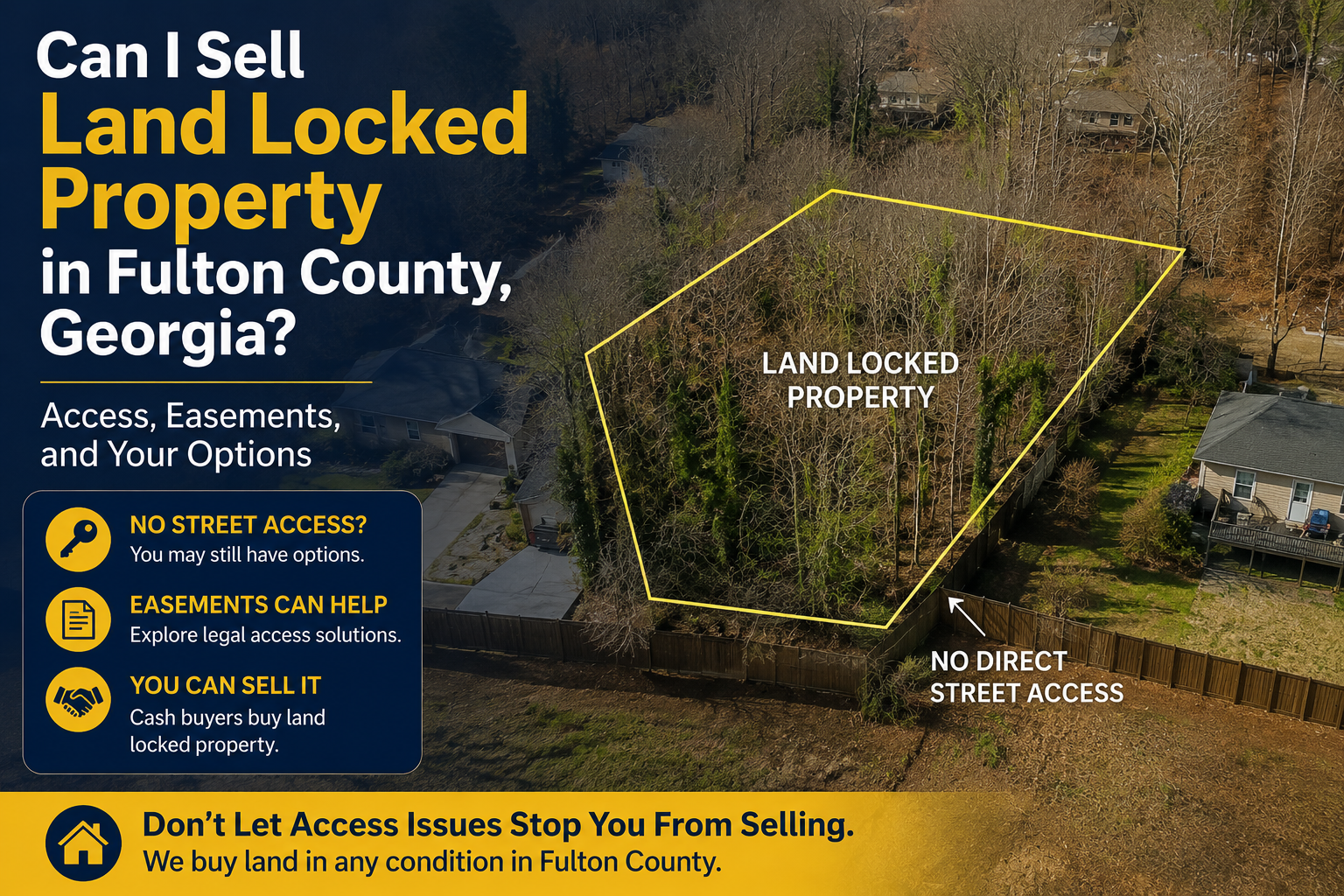
Yes. You can sell land locked property in Fulton County, and people do it every month. Nothing in Georgia law prevents the sale of a parcel without road access.
What changes is who will buy it, what they will pay, and how long it takes. A land locked parcel is not unsellable — it is a parcel with a solvable problem, and how solvable that problem is determines almost everything about its value.
This guide explains what makes a property land locked, what Georgia law actually gives you as remedies (including one statutory right most owners have never heard of), what it does to value, and the realistic paths to selling.
What Does “Land Locked” Actually Mean?
A land locked property is a parcel with no legal right of access to a public road. Every route to it crosses land somebody else owns.
The distinction that matters most: physical access and legal access are not the same thing. Plenty of Fulton County parcels have a gravel drive or worn track leading to them that the owner has used for years. If there is no recorded easement giving the right to use it, the parcel is still legally land locked — and the neighbor can close it tomorrow.
Three situations get confused with each other:
- Truly land locked — no legal access of any kind. The hardest case, and the one with the strongest legal remedies.
- Access by permission only — a neighbor lets you cross. Permission can be revoked, does not transfer with a sale, and — importantly — permission actively defeats a prescriptive easement claim. Owners in this situation often think they are fine.
- Legal access that is unusable — a recorded easement exists but crosses a creek, a ravine, or terrain that makes a driveway impractical. Legally sound, practically difficult, and this affects value too.
A Hypothetical: The Miller Family Lot in South Fulton
Here is how this happens in practice, drawn from the pattern we see most often.
In 1968, a man buys 12 acres in south Fulton County fronting a two-lane county road. He farms part of it and leaves the back wooded.
He dies in 1994 without a will. His three children inherit jointly. To divide things “fairly,” they informally split the land into three roughly equal strips and record deeds — but they split it front to back rather than side to side. The oldest son takes the front four acres with all the road frontage. The daughter takes the middle four. The youngest son takes the rear four acres, deep in the trees.
Nobody records an easement. Nobody thinks to. It is family land, and everyone drives across everyone else’s piece without a second thought.
Thirty years pass. The oldest son sells his front parcel to a developer in 2019. The developer builds houses, fences the boundary, and gates the old farm track. The daughter’s middle parcel goes to a tax sale after she dies and her heirs never probate the estate.
Now the youngest son’s daughter inherits the rear four acres. She pulls the record and finds:
- Her parcel touches no public road at any point
- No easement was ever recorded in her favor
- The front parcel is owned by a developer with no interest in granting access
- The middle parcel is owned by a tax deed purchaser she cannot easily identify
- Property taxes have been accruing the entire time — nobody stopped billing just because nobody could reach it
She owns four acres in a county where land is genuinely valuable, and she cannot legally drive to it, build on it, finance it, or sell it to a conventional buyer.
Every element of that is common: heirs dividing land without easements, a subsequent sale to a party with no family loyalty, decades of unrecorded permissive use, and taxes quietly accumulating. If you are reading this, some version of it probably happened to your parcel.
How Land Locked Parcels Happen in Fulton County
- Heirs’ property divisions. By far the most common. Families split land informally without recording access rights, which is especially widespread in south Fulton where parcels have passed through two or three generations.
- Road realignment or abandonment. A county road gets rerouted or closed, and a parcel that had frontage in 1955 does not today.
- Subdivision without proper platting. Someone carves off a back lot and sells it without recording an easement across the front.
- Tax sales. When a parcel is sold for taxes, the buyer gets what the deed describes — and if the deed never included access, neither does the purchaser. If your parcel came through a tax sale, see our guide to the Fulton County tax sale process.
- Condemnation for infrastructure. Highway, rail, or utility takings that sever a parcel from its frontage.
- Water boundaries. Parcels along the Chattahoochee where the only approach is across a neighbor’s land.
What Georgia Law Gives You: Five Routes to Access
Georgia is more favorable to land locked owners than many states. There are real remedies here — including a statutory one that surprises most people.
1. Express easement — negotiate and record it
The cleanest path. You approach the neighbor whose land you need to cross and negotiate a written, recorded easement, usually in exchange for payment.
Advantages: fastest, cheapest, no litigation. It runs with the land, so it survives when either property sells. Get it drafted by a Georgia real estate attorney and recorded — a handshake or a letter is not an easement.
The obstacle is leverage. A neighbor who knows you have no access knows exactly how much you need them.
2. Easement by necessity
Where a single parcel was divided and the division is what created the land locked condition, Georgia courts may find an implied easement by necessity across the retained land.
The key requirement is common ownership at the time of severance — the parcels must have been one property under one owner, and the split must be what cut off access. In the Miller hypothetical, this is exactly the theory the granddaughter would pursue, because the 1994 division created the problem.
3. Private way by prescription — seven years, not twenty
Under O.C.G.A. § 44-9-1, Georgia recognizes private ways acquired by prescription after seven years of uninterrupted adverse use. That is a notably shorter period than the twenty-year rule people often assume from adverse possession.
The fatal condition: use by permission never ripens into prescription. If the neighbor said “sure, go ahead,” decades of driving across their land builds no legal right at all. This is why “we’ve always used that road” is one of the most dangerous assumptions in Georgia land law.
If a prescriptive way exists and someone blocks it, O.C.G.A. § 44-9-59 provides an action to have the obstruction removed.
4. Condemning a private way — the remedy most owners don’t know exists
This is the significant one, and most articles about land locked property skip it entirely.
Under O.C.G.A. § 44-9-40, a Georgia property owner with no means of access, ingress, and egress may petition the Superior Court of the county with jurisdiction to condemn an easement across a private neighbor’s land.
The specifics:
- The easement may not exceed 20 feet in width, and the court may grant less if less is reasonably necessary.
- Filing the petition is itself the declaration of necessity — you do not have to separately prove necessity as a threshold matter.
- The court can enjoin the proceeding if you already own access over another route of at least 20 feet that provides reasonable means of access, or if the judge finds the condemnation otherwise unreasonable.
- You compensate the burdened landowner for the taking.
- You must keep the private way open and in repair — an ongoing obligation that passes to your successors in title.
In plain terms: a genuinely land locked Fulton County owner has a statutory path to court-ordered access, filed in Fulton County Superior Court. It costs money and takes time, and you want a Georgia attorney handling it. But “the neighbor said no” is not the end of the analysis, and knowing that changes your negotiating position considerably.
5. Buy a strip, or sell to the neighbor
Sometimes the simplest answer is a transaction rather than a legal theory. Buy a 20-foot strip from the adjoining owner and connect to the road. Or recognize that the person for whom your parcel is worth the most is the neighbor who already has frontage — to them, your land is not land locked at all.
Access Is Not the Same as Buildable
An important distinction that catches people out. Winning legal access does not automatically mean you can build.
- Frontage requirements. Fulton County contains fifteen municipalities, and each sets its own zoning code. Alpharetta’s requirements are not Roswell’s, which are not the City of South Fulton’s. A 20-foot condemned easement may satisfy access without satisfying a minimum frontage requirement for a building permit. Confirm with the specific city, not “Fulton County” generally.
- Septic approval. Parcels without sewer need onsite sewage approval from the Fulton County Board of Health, which depends on soil conditions, parcel size, and setbacks — independent of access.
- Driveway and curb-cut permits. Connecting to a public road requires approval from whichever authority maintains it.
- Utility easements. Power and water need their own access, which may or may not follow your driveway easement.
A parcel with legal access but no path to a septic permit is still difficult land — just difficult for a different reason. Understand which problem you actually have before spending money solving the wrong one.
What Land Locked Status Does to Value and Desirability
Being direct about this, because vague reassurance does not help you make a decision.
The discount is real
Land locked parcels sell at a substantial discount to comparable land with frontage. How substantial depends almost entirely on how solvable the access problem looks: a parcel with a cooperative neighbor and a clear easement-by-necessity argument trades much closer to market than one surrounded by a hostile developer with no legal theory available.
Conventional financing largely disappears
This is the mechanism behind most of the discount. Lenders require insurable title with legal access. Without it, title insurers exclude coverage, and most banks will not lend at all. That removes nearly every retail buyer from your pool and leaves cash buyers — a much smaller, more price-sensitive group.
The buyer pool narrows to three types
- Adjoining landowners, for whom access is not a problem and your acreage is an addition to theirs. Frequently the highest bidder.
- Cash land buyers who understand access problems and price the risk in.
- Speculators betting on future assemblage or road development.
The carrying costs do not pause
Here is what makes land locked parcels especially punishing: the tax bill arrives whether or not you can reach the property. Fulton assesses and bills regardless of access. Owners outside the City of Atlanta face an October 15 deadline, with interest at prime plus 3% — 9.75% for 2026 — plus penalties of 5% at 120 days, recurring to a 20% cap.
Land locked parcels fall behind on taxes at a high rate for exactly this reason: nobody visits, mail goes to an old address, and the parcel produces no income to offset the bill. If yours is behind, see selling tax-delinquent land in Georgia and how many years you can be behind before the county acts.
What raises the value
- A recorded easement, even a narrow one
- A documented history of adverse (not permissive) use approaching or exceeding seven years
- Common ownership history supporting an easement by necessity
- A cooperative or motivated adjoining owner
- Buildable soil and a plausible septic path
- Size — larger acreage justifies the cost of pursuing access
- Current taxes and clean title
Your Realistic Options
Option 1: Solve access, then sell
Highest potential return, longest timeline, real upfront cost. Makes sense on larger or higher-value parcels where the spend is justified by the lift. Budget for a survey, title work, an attorney, and payment to the burdened owner.
Option 2: Sell to an adjoining owner
Often the best price available, because to them the access problem does not exist. The catch is that they may know your position and negotiate accordingly. Approach more than one neighbor if more than one adjoins you.
Option 3: Sell as-is to a cash buyer
Fastest and most certain. You accept a lower number in exchange for not funding litigation, not waiting years, and not carrying taxes while it plays out. Reasonable when the parcel is small, the access path is genuinely unclear, taxes are mounting, or you simply want it resolved.
Option 4: Hold
Only makes sense if you can comfortably carry the taxes and have a specific reason to expect change — a planned road, nearby development, an aging neighbor whose heirs may be more willing to deal. Holding without a thesis just means paying taxes on land you cannot use.
How to Investigate Your Parcel
1. Pull the deed and legal description. Search the GSCCCA lien and deed index for the recorded deed and any easements. Read the description carefully — access rights are often buried in it.
2. Map it. The Fulton County Property Map Viewer shows parcel boundaries against roads and adjoining parcels. This is usually where owners first see the problem clearly.
3. Confirm ownership and value. Check the Fulton County Board of Assessors record, and identify who owns each adjoining parcel. Our guide to searching Fulton County property records walks through the tools.
4. Check the tax balance. Land locked parcels are disproportionately delinquent. Confirm with the Fulton County Tax Commissioner at 404-613-6100.
5. Trace the chain of title. When was the parcel severed from a larger tract, and who owned both pieces at the time? That answer determines whether an easement by necessity is available.
6. Order a survey. A licensed Georgia surveyor establishes exactly where boundaries sit and whether any existing route could be formalized. Do this before serious negotiation.
Frequently Asked Questions
Can I legally sell a land locked property in Georgia?
Yes. There is no legal prohibition on selling a parcel without access. You must disclose the access situation honestly, and the buyer pool will be limited to cash purchasers, but the sale itself is entirely lawful.
Can a neighbor be forced to give me access in Georgia?
In effect, yes — through the courts. Under O.C.G.A. § 44-9-40, an owner with no means of access may petition Superior Court to condemn a private way up to 20 feet wide across a neighbor’s land, with compensation paid to that neighbor. The court can block the petition if you already have reasonable access by another route of at least 20 feet, or if it finds the condemnation unreasonable. This is a legal proceeding, so involve a Georgia attorney.
How long does it take to get a prescriptive easement in Georgia?
Seven years of uninterrupted adverse use under O.C.G.A. § 44-9-1 — shorter than the twenty years many people assume. The critical limit is that permissive use does not count. If the neighbor gave permission, no prescriptive right accrues no matter how long you have used the route.
We’ve driven across that land for 40 years. Doesn’t that give us rights?
Possibly, but only if the use was adverse rather than permissive. Family arrangements and neighborly courtesy are usually permissive, which defeats the claim. Documentation of the nature of that use — who said what, and when — matters more than the number of years.
Does land locked property still get taxed?
Yes. Fulton assesses and bills without regard to access, and no exemption applies. Interest accrues monthly at prime plus 3% — 9.75% for 2026 — with penalties of 5% at 120 days past due, recurring to a 20% cap. Vacant land also does not qualify for homestead exemption.
Can I get a mortgage on land locked property?
Almost never. Lenders require insurable title with legal access, and title insurers typically exclude coverage where none exists. This is why the buyer pool is essentially cash-only, and why the discount is what it is.
Is a driveway I’ve always used the same as an easement?
No, and this is the single most common misunderstanding on this topic. Physical use is not a legal right. Unless an easement is recorded, or you can establish prescription or necessity, the owner of that land can close the route at any time — and a new owner certainly can.
What if I inherited land locked property?
Very common, since informal family divisions are a leading cause. The executor or administrator can generally sell once the Probate Court grants authority. If probate was never opened, that typically comes first. See selling inherited land, what happens if you inherit land in Georgia, and probate real estate in Atlanta.
Should I sue my neighbor or just sell?
It depends on the math. Litigation costs real money and takes time, during which taxes keep accruing. On a large or valuable parcel with a strong legal theory, pursuing access can pay for itself several times over. On a small parcel with a weak theory, the litigation can cost more than the resulting value increase. Get a candid assessment from a Georgia real estate attorney before committing either way.
Do you buy land locked property?
Yes. We buy land locked parcels throughout Fulton County as-is, including parcels with back taxes or a recorded Fi.Fa. We research access, title, and liens before making an offer rather than discovering problems midway through and renegotiating.
I live out of state. Can I handle this remotely?
Yes — including closing. Out-of-state owners are heavily represented among land locked parcels, since distance is exactly how a parcel goes unvisited for decades. See how we work with out-of-state owners.
Fulton County Resources
- Fulton County Property Map Viewer — parcel boundaries and road adjacency
- Fulton County Board of Assessors — ownership, value, parcel records
- Fulton County Tax Commissioner — balances and payoffs · 404-613-6100
- GSCCCA Deed & Lien Index — recorded deeds and easements statewide
- O.C.G.A. § 44-9-40 — condemnation of private ways
- O.C.G.A. § 44-9-1 — private ways by prescription
- Fulton County Board of Health — septic and onsite sewage approval
- Atlanta Legal Aid Society — if attorney cost is a barrier
Ready to Deal With It?
Land locked property is one of those problems that quietly gets worse. Taxes accrue, heirs multiply, adjoining owners change, and the memory of who used which road fades with the people who remember it. The parcel does not improve by being ignored.
If you own a land locked parcel in Fulton County — inherited, tax-delinquent, or simply forgotten — we will look at it and give you a straight answer. Sometimes that answer is “pursue an easement, it’s worth it.” Sometimes it is a cash offer. We will tell you which we think it is.
Call (404) 913-7086 or request a no-obligation cash offer.
We buy vacant land across metro Atlanta as-is — no survey required from you, no clearing, no fees, no commissions. We handle the title work and pay any tax balance at closing. Most closings run 7 to 14 days. See also who buys vacant land with back taxes in Atlanta, or contact us with questions about your specific parcel.
Related: Georgia land buyers · researching mineral rights ownership · about our team
Ready To Sell Your Land? Start Here…
We are direct land buyers. There are no commissions or fees and no obligation whatsoever. Start below by sharing where your property is and where we can send your offer…
"*" indicates required fields