
You can sell your land for cash, and the process moves faster than most sellers expect. Reputable cash buyers issue a written cash offer within 24–48 hours and close in about 7–14 days. No realtor commissions. No repair requirements. In many cases, the buyer handles title work and covers standard closing costs.
The single best next step: gather your property’s address, Assessor’s Parcel Number (APN), and county name, then request a written offer from a professional cash buyer. That written offer should show your net proceeds clearly, after any payoffs or fees, so you know exactly what you will receive at closing.
- Written offer timeline: within 24–48 hours from submission
- Typical close window: within 7–14 days from accepted offer
- Seller costs: often zero commissions, zero repair costs, and minimal or no closing fees
- Properties accepted: vacant, inherited, overgrown, landlocked, and tax-delinquent land
Pro Tip: Before you contact any buyer, write down your APN (found on your property tax bill) and the county where the land sits. Buyers who can pull county records immediately will give you a more accurate offer faster.
How does selling land for cash actually work?
The cash land sale process follows a predictable sequence, and understanding each step helps sellers set realistic expectations and avoid surprises.

Step 1: Submit property details. Provide the buyer with your APN, street address or GPS coordinates, county, and any photos you have. The more detail you share upfront, the faster the buyer can assess the parcel.
Step 2: Buyer due diligence. The buyer pulls county records, checks zoning classification, confirms road access, reviews topography, and estimates holding costs. This research phase typically takes 24–48 hours for professional buyers.
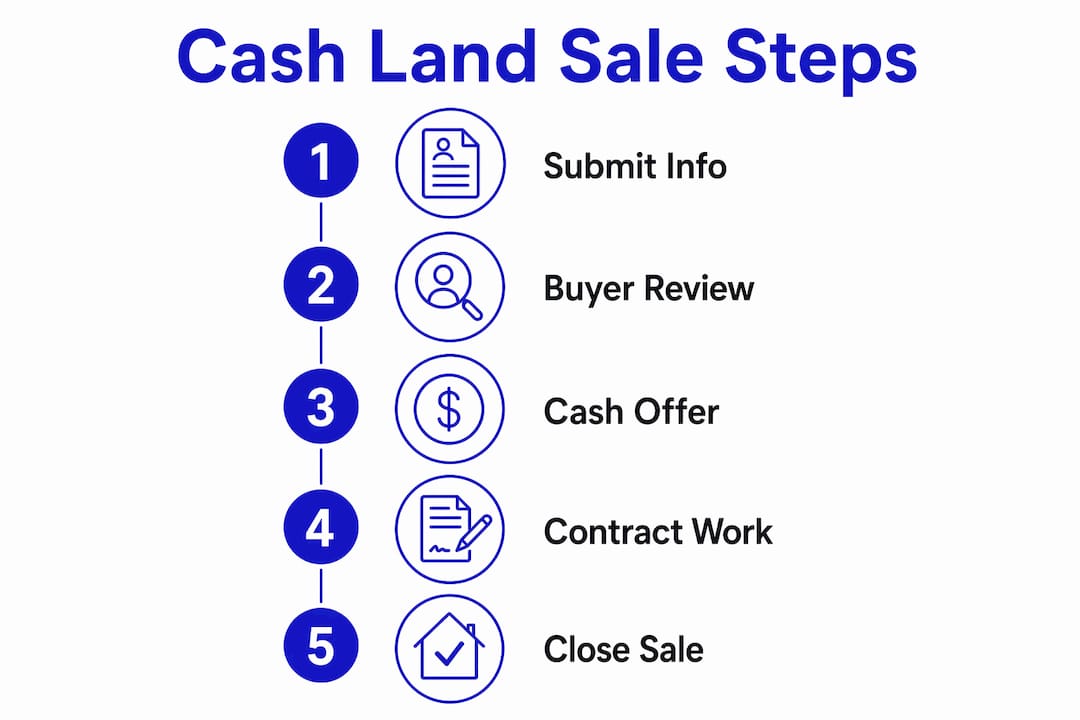
Step 3: Written cash offer. The buyer presents a net written offer, typically within 24–48 hours after receiving your property details. A legitimate offer states the exact dollar amount you will receive after any agreed payoffs, with no vague language about “estimated” proceeds.
Step 4: Contract and title work. Once you accept, the buyer sends the contract to a licensed title company or real estate attorney. That party handles the title search, resolves any recorded issues, and prepares closing documents. This phase commonly takes 7–21 days depending on title complexity.
Step 5: Close and receive funds. At closing, funds are delivered by wire transfer or check. For out-of-state sellers, remote closing options include overnighted documents or a mobile notary who meets you locally.
| Stage | Who Acts | Typical Timeframe |
|---|---|---|
| Property submission | Seller | Same day |
| Due diligence and offer | Buyer | 24–48 hours |
| Contract to title company | Buyer | 1–3 days after acceptance |
| Title search and clearance | Title company / attorney | 7–14 days |
| Closing and funding | Title company | 1–2 days after clearance |
Who actually buys land for cash, and what will they purchase?
Not every cash buyer accepts every type of parcel. Knowing which buyer category fits your property saves time and sets realistic price expectations.
Institutional and professional cash buyers are companies that purchase land at scale. They accept vacant, overgrown, inherited, landlocked, and tax-delinquent parcels. These buyers handle title work, negotiate lien payoffs, and typically cover standard closing costs. They are the most practical option for sellers with complicated title histories or back taxes.
Individual investor buyers tend to focus on smaller parcels with clear road access and straightforward title. They may offer competitive prices on clean properties but often lack the infrastructure to resolve complex title problems independently.
Local developers and flippers prefer larger parcels with development potential, proximity to utilities, and zoning that supports residential or commercial use. Their offers can be strong for the right property, but they are selective and may require a longer due-diligence period.
Niche buyers such as timber companies, mineral rights investors, and conservation land trusts purchase only properties that match very specific criteria. Timber buyers want acreage with merchantable timber. Conservation groups need parcels that qualify for easements or habitat programs. These buyers rarely advertise broadly.
- Professional buyers: handle back taxes, liens, and title issues at closing; cover many standard closing costs
- Individual investors: best for clean, small parcels; limited ability to resolve title problems
- Developers: highest offers for development-ready land; slower process and stricter criteria
- Niche buyers: narrow criteria; strong prices when the property qualifies
What factors determine your cash offer amount?
Cash offers on raw land are almost always below retail market value. That gap exists for specific, calculable reasons, and understanding them helps sellers evaluate whether an offer is fair.

Comparable sales (comps) are the starting point. Buyers pull recent sales of similar parcels in the same county or region. Sparse comp data in rural areas increases the buyer’s uncertainty and typically widens the discount.
Zoning and permitted use directly affect resale potential. Agricultural-only zoning limits the buyer pool. Residential or mixed-use zoning expands it, which supports a higher offer.
Road access is one of the most consequential factors. A landlocked parcel with no legal access easement can lose a significant portion of its value because the buyer must either negotiate access or accept a smaller resale market.
Utilities and topography matter for development-oriented buyers. Flat land near water and power hookups commands more than steep, remote acreage with no utility infrastructure.
Carrying costs reduce every offer. Buyers factor in property taxes, insurance, marketing costs, and the time they expect to hold the parcel before resale. A parcel that might sit on the market for 12 months accumulates real costs that come out of the offer price.
Title issues and liens are deducted from proceeds. If a parcel carries $8,000 in back taxes, a professional buyer will typically calculate that payoff into the offer and handle it at closing, rather than asking the seller to clear it beforehand.
Pro Tip: Clearing physical access to your property before requesting an offer, even just marking a driveway path or confirming a recorded easement, can increase your offer more than the cost of the work. Buyers price access risk heavily.
How do you choose a reputable cash land buyer?
The cash land buying market includes professional companies with documented track records and, unfortunately, less credible operators. A structured vetting process protects sellers.
The checklist every seller should use
- Request a written net offer that states your exact proceeds after payoffs.
- Confirm in writing who pays closing costs: title search, title insurance, recording fees, and transfer taxes.
- Ask for the name of the title company or closing attorney the buyer uses.
- Request proof of funds or a bank letter confirming the buyer can close without financing.
- Review earnest deposit terms: how much, when it is paid, and what triggers a refund.
- Ask for documented case examples or references from past sellers.
Questions to ask before signing anything
- How do you handle back taxes or recorded liens at closing?
- Will you provide a written timeline with specific milestone dates?
- Who coordinates with the title company, and will I receive copies of all title documents?
- What happens if the title search uncovers an issue you did not anticipate?
Red flags that signal a problematic buyer
- Vague verbal offers with no written documentation
- Requests for upfront fees before closing
- Pressure to sign quickly without time to review the contract
- Insistence on using an escrow arrangement outside a licensed title company or attorney
- No verifiable business presence, reviews, or case examples
Pro Tip: Ask the buyer to itemize closing costs in the offer letter itself: which costs they cover and which, if any, fall to you. A buyer who refuses to put that in writing is a buyer worth walking away from.
What documents and title issues should you prepare for?
Preparation shortens the closing timeline. Sellers who gather key documents before requesting an offer give buyers what they need to move quickly.
Documents to collect
- Current deed (warranty deed, quitclaim deed, or executor’s deed for inherited land)
- Most recent property tax bill (confirms APN and tax status)
- Mortgage statements, if any balance remains
- Recorded easements or right-of-way documents
- Survey, if one exists
- For inherited land: death certificate, probate court order or letters testamentary, and any recorded affidavit of heirship
Common title issues that slow closings
- Undisclosed heirs: multiple potential owners from an estate that was never formally probated
- Unpaid property taxes: accumulate interest and penalties; must be resolved before or at closing
- Judgment liens: creditor claims recorded against the owner that attach to the property
- Unclear legal description: outdated metes-and-bounds descriptions that do not match current county records
- Missing or broken chain of title: gaps in recorded ownership history that require a quiet title action
Professional buyers who handle tax-delinquent properties routinely calculate back-tax payoffs into the offer and clear those balances at closing. Sellers do not need to raise cash to clear title before the sale. That payoff is simply deducted from proceeds.
| Closing Cost Item | Typically Paid By |
|---|---|
| Title search | Buyer (in most cash sales) |
| Owner’s title insurance | Negotiated; often buyer |
| Recording fees | Buyer or split |
| Transfer taxes | Varies by state and county |
| Back-tax payoffs | Deducted from seller proceeds at closing |
| Realtor commissions | None in a direct cash sale |
What are the alternatives to a direct cash sale?
A cash sale is not the only path. Each alternative involves a different tradeoff between net proceeds, time, and complexity.
- Traditional agent listing: likely produces a higher gross sale price, but realtor commissions on land typically run 6–10%, and land listings often sit on the market for six months or longer. Carrying costs accumulate throughout.
- Owner financing / land contract: the seller acts as the lender, collecting monthly payments from the buyer. This can increase total proceeds and generate income, but it creates borrower-default risk and requires the seller to manage collections.
- Auction: fast, but net proceeds are unpredictable. Reserve prices are not guaranteed, and auction fees reduce the final amount. Tax sales in particular often produce below-market results.
- Installment sale / seller carry-back: similar to owner financing; useful for sellers who want income spread over time, but it ties up capital and exposes the seller to buyer credit risk.
A direct cash sale fits best when speed matters more than maximizing gross proceeds, when the property has title or tax problems that would deter financed buyers, or when the seller simply wants a clean, documented transaction without managing a listing.
Why do cash buyers exist for land at all?
Banks and conventional lenders treat raw land as a high-risk asset. Without a structure on the property, there is no rental income to service a loan and limited collateral certainty. Appraisals on vacant land are harder to substantiate, and resale timelines are unpredictable. As a result, most lenders either refuse land loans outright or require large down payments and short terms that most buyers cannot meet.
That financing scarcity shrinks the pool of eligible buyers dramatically. Fewer buyers means longer time on market, which raises carrying costs for sellers. Cash buyers step into that gap. They accept the liquidity risk and the holding-period uncertainty in exchange for a purchase price below retail. The seller trades some net proceeds for speed, certainty, and the elimination of commissions and carrying costs. For sellers with vacant land in Georgia carrying back taxes or title complications, that tradeoff is often the most practical available.
Professional buyers who advertise written cash offers within 24–48 hours and closings in 7–14 days are pricing that certainty into their model. The offer reflects their cost to carry, market, and resell the parcel, plus a margin for resale risk.
Key Takeaways
Selling land for cash is a straightforward process when sellers know what to ask for, what to prepare, and how to vet the buyer before signing.
| Point | Details |
|---|---|
| Get a written net offer | Confirm your exact proceeds after payoffs; never accept a verbal or estimated figure. |
| Verify buyer credentials | Check proof of funds, the title company they use, and documented case examples before signing. |
| Back taxes and liens | Professional buyers typically handle payoffs at closing; confirm this in writing before you agree. |
| Cash vs. listing tradeoff | A cash sale saves commissions and carrying costs; weigh that against a potentially higher retail price. |
| Atlantalandbuyers | Purchases vacant, inherited, and tax-delinquent land in Georgia with written offers in 24–48 hours and closings as fast as 7–14 days. |
Why sellers should demand more from cash buyers
The cash land sale market has matured, but it still rewards sellers who ask the right questions. The most common mistake sellers make is treating a fast offer as a good offer without verifying what that offer actually nets them. A buyer who advertises a $40,000 offer but deducts $6,000 in “processing fees” at closing is not offering $40,000. A written net offer eliminates that ambiguity entirely.
Inherited and out-of-state sellers face an additional layer of complexity. Probate requirements, multiple heirs, and unfamiliar county tax systems can make a property feel unsellable. The reality is that professional buyers handle these situations regularly. Remote closings, mobile notaries, and overnighted documents mean a seller in another state can complete the entire transaction without traveling. What matters is choosing a buyer with documented experience in those specific scenarios, not just one who claims to handle them.
Documented testimonials and real case examples are not marketing extras. They are evidence that a buyer has navigated the exact type of title or tax problem a seller is facing. Request them before signing. A buyer with nothing to show has not done the work.
Atlantalandbuyers serves Georgia sellers with a clear, direct process
Georgia landowners dealing with vacant parcels, inherited lots, or properties carrying back taxes have a direct option in Atlantalandbuyers. The company purchases land across Georgia as-is, with no repair requirements and no realtor commissions. Written cash offers arrive within 24–48 hours of submission, and closings typically complete in 7–14 days.
Atlantalandbuyers handles title work, coordinates with a local title company, and pays off back taxes or liens directly at closing, deducting those amounts from proceeds rather than requiring sellers to clear them in advance. That process covers markets across Georgia, including Roswell and Sandy Springs, with the same remote-closing capability for out-of-state owners. Out-of-state sellers can complete the entire transaction by mail or through a mobile notary, without a single trip to Georgia.
To get started, submit your property’s address, APN, and county through the Georgia land sale page. A written offer follows within 24–48 hours.
Sources and where to check next
Sellers can verify property details, tax status, and title records through several authoritative channels before or during the sale process.
Where to pull APN, tax history, and recorded documents
- County assessor’s office: confirms APN, current assessed value, and ownership records
- County recorder or registrar of deeds: provides recorded deeds, easements, liens, and judgment records
- County tax commissioner or treasurer: shows current tax balance, penalties, and payment history
- USDA Farm Service Agency (FSA): relevant for agricultural parcels; confirms farm program eligibility and acreage data
- USDA Natural Resources Conservation Service (NRCS): soil maps and conservation program data for rural land
Internal pages for next steps
- How to sell land without a real estate agent in Atlanta, Georgia — step-by-step guidance for sellers avoiding commissions
- Who buys vacant land with back taxes in Atlanta? — explains how buyers handle tax payoffs at closing
- Land buyers in Georgia: how to sell your land fast — quick-sale strategies and what professional buyers look for
- Out-of-state seller guidance — remote closing options, mobile notary, and document delivery
This article is general information, not legal or financial advice. Tax rules, title requirements, and closing-cost responsibilities vary by state and county. Confirm current rules with your county recorder, a licensed real estate attorney, or a qualified professional for your specific situation.