Blog

  • Why Do I Keep Getting Letters to Buy My House?

    Buy My House

    You keep finding them in the mailbox. Handwritten-looking envelopes. Yellow letters. Postcards that say “I want to buy your house is what you’re supposed to be thinking by the time you finish reading them. Some are addressed to you by name. Some are addressed to a relative who died years ago.

    The question most Atlanta homeowners ask first is the one that matters: how did these people get my information?

    The answer is simpler and less sinister than it feels. Nothing was leaked. Nothing was hacked. Your name and address were pulled from public records that anyone in the country can access — and there is a whole industry built on doing exactly that.

    Here is how it works, who is actually sending them, how to tell a legitimate buyer from a predator, and one thing worth checking if the letters suddenly spiked.

    Where They Got Your Information

    Georgia property records are public by law. So are court filings. Data companies pull those records continuously, cross-reference them, and sell the resulting lists to anyone with a credit card.

    Here is what is publicly visible about your property right now:

    • Your deed and ownership history — recorded with the county and searchable statewide through the Georgia Superior Court Clerks’ Cooperative Authority. Anyone can look up when you bought, what you paid, and who held the mortgage.
    • Your assessed value and tax status — published by the Fulton County Board of Assessors and every other county assessor in Georgia.
    • Your mailing address — and critically, whether it matches the property address. A mismatch flags you as an absentee or out-of-state owner, which is one of the most valuable signals a list buyer can get.
    • Any recorded lien — including a tax execution, a Fi.Fa., code enforcement liens, HOA assessments, and judgments.
    • Probate filings — when an estate is opened in Probate Court, that becomes a public record, which is why letters sometimes arrive addressed to someone who has passed away.
    • How long you have owned it — combined with what you paid, this lets anyone estimate your equity without ever seeing the inside of your house.

    Data vendors monitor these filings daily. When something changes — a new lien, a probate case, a transfer — the affected addresses land on a list within days. That list gets sold, often to dozens of buyers at once. Then twelve different companies mail you in the same month.

    That is the entire mechanism. It feels invasive because nobody explains it, but no rule was broken.

    The Signals That Put You on a List

    You are not receiving mail at random. Something about your property matched a filter. The most common in metro Atlanta:

    Long ownership with low assessed value

    If you bought in Grant Park, West End, Kirkwood, East Point, or College Park twenty years ago, the gap between what you paid and what the property is worth today is enormous — and entirely visible in public records. Long-tenure owners in appreciating neighborhoods are the single most targeted group in Atlanta.

    An out-of-state or mismatched mailing address

    If your tax bill goes somewhere other than the property, you get flagged as an absentee owner. The assumption is that you are less attached to the property and more likely to sell. See how out-of-state ownership works if that describes you.

    A recorded tax lien

    This one produces the biggest surge. The moment a Fi.Fa. is recorded against your property, it becomes public — and delinquency lists are among the most heavily purchased data in the industry.

    An open probate case

    Inherited property is a major target, partly because heirs often live elsewhere and partly because estates frequently want a fast resolution. If you inherited a property, see selling inherited property and probate real estate in Atlanta.

    Signs of vacancy or deferred maintenance

    Code enforcement citations, utility disconnections, and USPS vacancy flags all feed lists. So does a lot that is visibly overgrown — some buyers literally drive neighborhoods looking.

    Divorce, bankruptcy, or a judgment

    All are public filings, and all suggest a possible sale.

    If the Letters Just Spiked, Check This

    Here is the practical warning worth taking from all of this.

    A sudden surge in letters often means something new was recorded against your property. The most common trigger is a tax execution — a Fi.Fa. — which the county files when property taxes go unpaid. Some homeowners learn about a lien from their mailbox before they learn about it from the county, particularly if tax notices are going to an old address.

    If the volume jumped recently and you are not certain your taxes are current, spend ten minutes verifying:

    • Fulton County — check your balance at fultoncountytaxes.org or call 404-613-6100. Owners outside the City of Atlanta face an October 15 deadline, not the December 20 date used in many Georgia counties.
    • DeKalb County — check at DeKalbTaxGA.gov or call 404-298-4000. DeKalb bills in two installments, due September 30 and November 15, and missing either triggers a 5% penalty immediately.
    • Any recorded lien — search your parcel through the GSCCCA lien index.

    Our guide to searching county property records walks through the tools. If you do find a balance, how many years you can be behind on property taxes in Georgia explains the timeline, and Fulton vs. DeKalb property taxes covers the county differences.

    The letters themselves are harmless. What they may be telling you is not.

    Who Is Actually Sending These

    They are not all the same, and the differences matter.

    Direct buyers

    Companies buying with their own funds, intending to renovate, rent, or resell. They can actually close because the money exists. This is the category we fall into, and we will come back to that honestly below.

    Wholesalers

    They put your property under contract, then assign that contract to an actual buyer for a fee. Legal in Georgia when disclosed. The risk is that a wholesaler who cannot find an end buyer may renegotiate late or walk, after you have already stopped considering other options.

    Institutional buyers

    Large firms buying rental inventory at scale. Very active across metro Atlanta. Their offers are algorithmic and their terms are rarely negotiable.

    Agents prospecting

    Some letters that look like offers are really listing pitches. That is not deceptive in itself, but read carefully — “I have a buyer for your home” and “I want to buy your home” are very different sentences.

    Bad actors

    A small minority, but the damage they do is severe. Covered next.

    We Buy Houses

    How to Tell a Legitimate Buyer From a Predator

    Use criteria, not instinct. These are the ones that reliably separate the two.

    Warning signs

    • Any request for money upfront. Application fees, processing fees, deposits, “title search costs.” A legitimate buyer never asks a seller to pay anything before an offer. This is the clearest single indicator.
    • Pressure to sign immediately. “This offer expires tonight.” Real buyers can wait a week. Manufactured urgency exists to prevent you from getting a second opinion.
    • Wanting the deed before closing. Never sign a deed outside a closing. This is how deed theft happens, and metro Atlanta has seen real cases of it — often targeting elderly owners and heirs of long-held family property.
    • No title company or closing attorney. Every legitimate Georgia real estate transaction closes through one. A buyer who wants to “handle the paperwork ourselves” is a hard no.
    • No verifiable address or business identity. A P.O. box, a cell number, and nothing else is not a company.
    • An offer made without seeing anything. A number quoted before anyone has looked at the property or checked what is owed is a placeholder designed to start a conversation, and it will drop later.
    • Vague on liens and taxes. A serious buyer verifies your exact payoff with the county before offering. One who does not will “discover” it mid-closing and renegotiate.

    Good signs

    • They tell you what they do not know and go find out.
    • They put the offer in writing with clear terms.
    • They name the title company or closing attorney.
    • They encourage you to compare, or to talk to an attorney.
    • They will tell you when selling is not your best move.

    That last one is the real test. Anyone unwilling to talk you out of a sale is not advising you.

    Why Atlanta Gets So Much of This

    Metro Atlanta receives disproportionate volume, for reasons that are structural rather than personal.

    The region has grown fast and appreciated hard, which means a large number of long-tenure owners are sitting on equity that is fully visible in public records. Neighborhoods that were affordable in 2005 are not now, and every one of those transitions is documented.

    There is also a significant concentration of heirs’ property — homes and land bought by Black families in the 1960s through 1980s that passed to multiple descendants without formal probate. This is especially common in south Atlanta, south Fulton, and south DeKalb around Lithonia and Stonecrest. These properties are heavily targeted precisely because ownership is fragmented and taxes often fall behind. If this describes your family’s property, what happens if you inherit land in Georgia is worth reading before you respond to anyone.

    Add a large investor population and cheap access to county data, and the mail volume follows.

    What You Should Actually Do

    If you have no interest in selling

    Recycle them. You are under no obligation to respond, and not responding has no consequence. To reduce the volume:

    • Register with DMAchoice, the Data & Marketing Association’s mail preference service.
    • Opt out of the major data brokers individually — tedious, but it works.
    • Make sure your mailing address at the county assessor is current. An outdated one keeps you flagged as absentee.

    Realistically, you will not stop it entirely. Public records are public.

    If you are curious what the property is worth

    Do your own research before engaging. Check the assessor’s record, look at recent comparable sales, and remember that Georgia assesses at 40% of fair market value — so the assessed figure is not what the property would sell for.

    If you are actually considering selling

    Then the letters are an opportunity rather than a nuisance. Talk to more than one buyer. Ask each how they arrived at their number. Ask who is funding the purchase and where it will close. And ask what happens to any liens or back taxes — the answer should be that they are paid from the proceeds at closing, not by you beforehand.

    Frequently Asked Questions

    How did they get my name and address?

    From public records — county deed and tax records, court filings, and probate filings — compiled and resold by data vendors. Nothing private was accessed.

    Is it a scam?

    Most are legitimate businesses. A minority are not. The reliable test is whether anyone asks you for money upfront or wants a deed signed outside a closing. Either one means stop.

    Why am I getting letters addressed to a dead relative?

    Because the deed still shows their name, or a probate case was filed. This is extremely common with inherited property and usually means the estate was never fully settled. See selling inherited property.

    Does getting letters mean my house is in foreclosure?

    Not necessarily. But a sudden increase can mean a lien was recently recorded. Verify your tax status directly with the county before assuming either way. If you are behind on a mortgage rather than taxes, can I sell my house if it’s in foreclosure covers that situation.

    Do I have to respond?

    No. There is no obligation of any kind, and ignoring them carries no consequence.

    Are cash offers always lower than market value?

    Usually, yes — that is the trade. You give up some price in exchange for speed, certainty, no repairs, no showings, and no commissions. Whether that trade is worth it depends entirely on your situation. For a property needing significant work, the gap is often smaller than expected once repair costs and carrying time are accounted for.

    Can I sell if I owe back taxes?

    Yes, and you do not pay them first. The balance is settled from the sale proceeds at closing. This works even after a Fi.Fa. is recorded. See selling tax-delinquent property.

    What if my property already went to a tax sale?

    You likely still have rights, including a redemption period, and there may be surplus money owed to you. See Fulton County excess funds or DeKalb County excess funds.

    What about HOA dues I have not paid?

    HOA liens are recorded and searchable, and they are a common list trigger. They also carry real risk — an HOA can foreclose even on a fully paid-off home.

    Is it worth responding to just one to see what happens?

    It is reasonable, as long as you treat it as information gathering. Get the number in writing, do not sign anything at a first meeting, and do not let anyone rush you.

    Our Own Position on This

    We should be straightforward: we are one of the companies that reaches out to property owners. It would be strange to write this article and pretend otherwise.

    What we can tell you is how we operate. We research the parcel, the title, and the actual tax payoff with the county before making an offer, rather than quoting a number and adjusting it later. We never ask for money upfront. We close through a Georgia title company. And when someone would be better served paying the balance, appealing an assessment, or listing conventionally, we say so — that happens regularly.

    We buy vacant land, houses that need work, and mobile and trailer homes across Fulton, DeKalb, and surrounding counties.

    If You Want a Real Number

    Whether you throw the letters away or decide it is time to move on from a property, the useful thing is having accurate information rather than guessing.

    If you want to know what your property is genuinely worth to a cash buyer — with no pressure and no obligation — we will look at it and tell you. If a different path serves you better, you will hear that instead.

    Call (404) 913-7086 or request a no-obligation offer.

    No fees, no commissions, no obligation to accept. We pay any back taxes directly at closing, buy as-is with no repairs or cleanup required, and most closings run 7 to 14 days.

    Questions about your specific property? Contact us or learn about our team first.

    Helpful Resources

    Atlanta, Georgia, 30307
  • My House Was Sold at Auction — Can I Still Live There?

    My house was old at auction

    If your house was sold at auction and you are wondering whether you have to leave tonight, here is the short answer: if it was a tax sale, you almost certainly do not.

    Under Georgia law, the person who bought your property at a tax auction does not get to move in, change the locks, collect rent from you, or evict you. Not the day of the sale, and not for a long time afterward. In most cases the earliest anyone can lawfully take physical control is more than a year later — and only after following a strict notice process that gives you a final chance to get the property back.

    This page explains exactly where you stand, what the buyer can and cannot do, and what to do next.

    First: Which Kind of Auction Was It?

    This matters more than anything else on this page, because the two situations have very different answers.

    A tax sale

    Held because property taxes went unpaid. In Fulton County these are conducted by the Sheriff’s Office, generally on the first Tuesday of the month at the courthouse. If you received notices from the Fulton County Tax Commissioner, saw a Fi.Fa. recorded against your property, or got a notice of levy, this is what happened.

    Georgia gives you strong protections after a tax sale, described in detail below.

    A mortgage foreclosure sale

    Held because mortgage payments went unpaid, conducted by the lender or its attorney. If you were dealing with a loan servicer, received acceleration letters, or the notices came from a law firm on behalf of a bank, this is likely what happened.

    The protections are very different. Georgia does not provide a statutory right of redemption after a non-judicial mortgage foreclosure. Once the sale is complete and the deed under power is recorded, the new owner can generally pursue possession relatively quickly through dispossessory proceedings. If this is your situation, speak with an attorney immediately — see can I sell my house if it’s in foreclosure and contact Atlanta Legal Aid Society today.

    Not sure which one happened? Call the Fulton County Tax Commissioner at 404-613-6100 and ask whether your parcel was sold at a tax sale. It is a simple question and they can answer it. Everything below assumes the answer is yes.

    What the Buyer Actually Got

    Georgia is a redeemable deed state. That is an unusual category, and it is the reason you have protections that homeowners in many other states do not.

    The purchaser at a Fulton County tax sale received a tax deed. That sounds final. It is not. What they hold is a defeasible interest — conditional ownership that can be undone. Until they complete a formal legal process called barment, their deed functions much more like a lien against your property than like ownership of it.

    Your name may still appear in county records. You may still receive tax bills. Neither of those is a mistake — they reflect the fact that the transfer is not yet final.

    What the Purchaser Cannot Do During the Redemption Period

    This is the part nobody explains to homeowners, and it is the part that matters most tonight.

    During the redemption period, a Georgia tax deed purchaser cannot:

    • Take actual possession of the property. They cannot move in, and they cannot put you out.
    • Collect rent from you — or from anyone else living there. They are not authorized to receive rents.
    • Make improvements to the structure or grade the lot.
    • Change the locks, remove your belongings, or shut off utilities. None of that is theirs to do.
    • File a dispossessory (eviction) action against you. They do not yet hold the possessory rights that would support one.

    The Georgia Supreme Court reinforced this in Blizzard v. Moniz, 271 Ga. 50 (1999), holding that actual possession of the property is necessary for a tax deed to convey fee simple title absent the process of barring or foreclosing the right of redemption. A tax deed alone is not enough.

    There is a second signal written directly into the statute. O.C.G.A. § 48-4-45 requires that before foreclosing your right of redemption, the purchaser must serve notice on the defendant in the tax execution, on everyone with a recorded interest, and on “the occupant, if any” of the property.

    Georgia law expressly contemplates that someone may still be occupying the home after a tax sale — and requires that person to be notified before their rights can be cut off. The statute is not written around an empty house.

    The Real Timeline: More Than a Year

    Here is what actually has to happen before anyone can lawfully take physical control:

    • Twelve months must pass from the sale date. Under O.C.G.A. § 48-4-40, you and anyone else with an interest may redeem during this period. The purchaser cannot begin barment before it ends.
    • Then notice must be served on you, on the occupant, and on all parties with a recorded interest — by personal service, certified mail, or statutory overnight delivery.
    • Then publication in the county’s legal organ newspaper, once a week for four consecutive weeks.
    • Then a 30-day window during which you can still redeem.

    Only after all of that is your right of redemption foreclosed. In practice, a minimum of about one year and forty-five days elapses between the tax sale and the purchaser’s right to physical control — and that assumes they move immediately and execute every step correctly.

    Georgia courts require strict compliance with those notice requirements. A defective barment — wrong parties, improper service, a missed lienholder — can invalidate the whole thing and leave your right to redeem intact even after the purchaser thought it was finished.

    Important: Redemption Does Not Automatically End at 12 Months

    This is widely misunderstood, and the misunderstanding costs people their homes.

    The 12-month redemption period is the earliest the purchaser may begin barment — not an automatic expiration of your rights. If they never send notice, your right to redeem continues. Many purchasers wait, and some never complete the process at all.

    What ends your right is proper notice followed by 30 days. That document — usually titled a Notice of Foreclosure of the Right to Redeem — is your real deadline. If one arrives, act immediately and get an attorney.

    What to Do This Week

    1. Confirm what actually happened. Call the Fulton County Tax Commissioner at 404-613-6100. Ask whether the parcel sold, on what date, and for how much. The sale date starts every clock that matters.
    2. Find out who bought it. The tax deed is recorded. Search the GSCCCA index or check the Fulton County Board of Assessors record. Our guide to searching Fulton County property records walks through the tools.
    3. Keep every document and keep living there. Do not move out because someone told you to. Save all correspondence, note dates, and photograph anything posted on the property.
    4. Do not sign anything. Not a deed, not a quitclaim, not a “release,” not an agreement to vacate. Signing away your redemption rights is exactly what some purchasers hope you will do out of fear.
    5. Talk to an attorney. This is one of the situations where legal advice genuinely matters. If cost is a barrier, contact Atlanta Legal Aid Society or Georgia Legal Aid.

    Your Three Options

    Option 1: Redeem the property

    Redeeming means paying the purchaser to undo the sale and return title to you. Under O.C.G.A. § 48-4-42, the redemption price is:

    • The amount paid at the tax sale, as recited in the tax deed
    • Plus any taxes the purchaser has paid since the sale
    • Plus any special assessments
    • Plus a premium of 20% for the first year or fraction of a year, and 10% for each year or fraction thereafter
    • Plus sheriff’s and publication costs if you redeem more than 30 days after a § 48-4-45 notice was given

    A worked example. You owed $6,000 in back taxes. A bidder won your house at $15,000. Redeeming eight months later costs the $15,000 plus a 20% premium of $3,000 — roughly $18,000, plus any taxes they have paid since. Note that you pay their bid, not your original tax debt.

    When you redeem, O.C.G.A. § 48-4-44 requires the purchaser to give you a quitclaim deed. Title returns to you subject to any liens that existed at the time of the sale — redemption undoes the tax sale, not everything else.

    One useful provision: a creditor or anyone else with an interest may also redeem, and the amount they spend becomes a first lien on the property. A family member can redeem on your behalf.

    Option 2: Sell before your rights expire

    If you cannot raise the redemption amount, you may still have value to recover rather than losing everything. Depending on how much of the window remains, some buyers will purchase your right of redemption, or fund the redemption and buy the property from you immediately after.

    This is time-sensitive. The closer you get to a barment deadline, the fewer options exist and the less anyone will pay. If you are considering it, start now rather than in the final weeks.

    Option 3: Let it go — but claim what you are owed

    If the house sold for more than you owed, the surplus is excess funds, and it belongs to you and others with a recorded interest — not to the county. Many former owners never claim it because nobody tells them it exists.

    In our example above, a $15,000 sale against a $6,000 debt leaves roughly $9,000 in surplus after costs. See how Fulton County excess funds work. Georgia gives you five years from the sale date to claim before the funds transfer to the state.

    When Someone Is Bluffing

    Tax deed purchasers sometimes contact former owners with more confidence than the law supports. Treat these as warning signs:

    • “You need to be out by Friday.” Not during the redemption period, and not without a court order.
    • “I own it now, so you owe me rent.” A tax deed purchaser is not authorized to collect rents before their right to possession vests.
    • “Sign this and I’ll give you moving money.” Do not sign away redemption rights without an attorney reviewing the document.
    • Changed locks, removed belongings, or shut-off utilities. These may be unlawful. Document everything and call a lawyer.
    • “Your 12 months are up, it’s over.” Only if proper notice was served and 30 days passed. Ask to see the notice and proof of service.

    A legitimate purchaser follows the statute. One rushing you is often hoping you do not know it.

    Frequently Asked Questions

    Can the tax sale buyer evict me right after the auction?

    No. During the redemption period they cannot take actual possession or bring a dispossessory action. They must wait at least 12 months, then complete the statutory notice and publication process, then wait 30 more days.

    Do I have to pay rent to the person who bought my house?

    No. A tax deed purchaser is not authorized to receive rents during the redemption period. If someone is demanding rent, get legal advice before paying anything.

    How long do I really have?

    At minimum, about one year and forty-five days from the sale — and potentially much longer, because the clock on the final 30 days only starts when the purchaser serves proper notice. Some never do.

    What is a barment notice?

    The Notice of Foreclosure of the Right to Redeem under O.C.G.A. § 48-4-45. It is the purchaser’s formal step to end your redemption rights, and it must be served on you, on the occupant, and on all parties of record, plus published for four consecutive weeks. You have 30 days from proper notice. If you receive one, treat it as urgent and call an attorney.

    Can the buyer make repairs or renovate while I’m still there?

    No. They are not authorized to make improvements to the structure or grade the lot during the redemption period.

    Why am I still getting tax bills for a house that sold?

    Because the transfer is not final until redemption is foreclosed. County records may still reflect you during that window. Do not ignore the bills — bring them to whoever is advising you, since unpaid taxes accruing after the sale get added to your redemption cost.

    Can a family member redeem for me?

    Yes. Any person with an interest in the property, including a creditor, may redeem, and the amount they spend becomes a first lien on the property.

    If I redeem, do all my old liens come back?

    Yes. Redemption restores title subject to the liens that existed at the time of the tax sale. It undoes the tax sale, not your other obligations.

    What if the buyer refuses to tell me the redemption amount?

    This happens, and Georgia law anticipates it. O.C.G.A. § 48-4-47 addresses tender of the redemption price before an action to cancel a tax deed. Do not let a stalling purchaser run out your clock — this is a situation for an attorney.

    Does this apply to a mortgage foreclosure too?

    No. There is no comparable statutory redemption right after a non-judicial mortgage foreclosure in Georgia, and possession can be pursued much faster. If your sale was a mortgage foreclosure, get legal advice immediately.

    My property was vacant land, not a house. Does any of this change?

    The redemption framework is the same. See selling tax-delinquent land in Georgia and how many years you can be behind on property taxes.

    I inherited this house and didn’t know taxes were unpaid. Now what?

    Common, and heirs may redeem. If probate was never opened, that likely needs to happen. See inherited property and probate real estate in Atlanta.

    Fulton County Resources

    You Have More Time Than You Think — But Not Unlimited Time

    If you take one thing from this page: do not move out because someone told you to. Confirm what happened, find out who bought it, keep every document, and get advice before signing anything.

    Then decide with real information. Redeeming may be affordable, especially with family help. Selling your interest before the window closes may recover value that would otherwise be lost. And if the property sold for more than you owed, there may be money waiting for you regardless of what you decide.

    If you want a straight assessment of where you stand and what your parcel is realistically worth, we will look at it. We buy property throughout Fulton County — including during redemption periods — but we will tell you plainly if redeeming or getting an attorney serves you better. Often it does.

    Call (404) 913-7086 or contact us. No fees, no obligation, and no pressure. If you would rather start with numbers, request a no-obligation offer.

    Related: how Fulton County tax sales work · Fulton County excess funds · who buys property with back taxes · about our team

    Atlanta, Georgia, 30307

  • Land Buyers Near Me in Atlanta, GA: Sell Inherited, Tax Delinquent & Unwanted Land

    land in east point in Fulton County

    When you search “land buyers near me,” you are usually not shopping around casually. Something has prompted it — a notice from the county, an estate that needs settling, or a parcel you have been carrying for years that has finally become more burden than asset.

    Atlanta LandBuyers buys vacant, inherited, and tax-delinquent land throughout metro Atlanta. We pay cash, buy as-is, and settle any back taxes directly at closing. Most closings run 7 to 14 days.

    Call (404) 913-7086 or request a no-obligation offer. Below is what actually matters when choosing who to sell to — particularly if a tax sale date is involved.

    What “Near Me” Should Actually Mean

    Plenty of companies will buy land in Atlanta from an office three states away. Distance alone is not the problem. The problem is what a distant buyer does not know.

    Metro Atlanta is not one tax jurisdiction. It is a patchwork, and the details differ in ways that determine whether your sale closes before a deadline or after it:

    • Fulton County bills once a year, due October 15 for owners outside the City of Atlanta. Properties inside city limits are billed separately by Atlanta on its own schedule.
    • DeKalb County bills in two installments — September 30 and November 15. Paying in full still requires payment by September 30. A 5% penalty attaches immediately on either missed installment.
    • Cities inside those counties levy their own taxes on top. A parcel in Roswell, Decatur, or Stonecrest can be current with the county and delinquent with the city at the same time.
    • Fulton tax sales are conducted by the Sheriff’s Office. In DeKalb, the Tax Commissioner serves as Ex Officio Sheriff and handles both the sales and the surplus funds afterward.

    A buyer who assumes “Georgia property taxes are due December 20” — the statewide default that applies to neither Fulton nor DeKalb — will confirm your payoff against the wrong deadline. When you are counting weeks until a sale date, that is not a small error.

    That is what local should mean: knowing which office to call, what your actual deadline is, and how much time you really have. We break the county differences down in Fulton vs. DeKalb property taxes.

    If You Are Headed Toward a Tax Sale, Read This First

    This is the situation where the stakes are highest and the misinformation is thickest. Here is what is actually true.

    The timeline is more predictable than the notices suggest

    • You miss the due date. Interest begins. Georgia sets it at the federal prime rate plus 3%, accruing monthly — 9.75% annually for 2026, roughly 0.8125% per month. If you have read that Georgia charges a flat 1% per month, that rule was replaced in 2016.
    • Day 120. A 5% penalty is added, with another 5% every additional 120 days, capped at 20% of the original principal.
    • A Fi.Fa. is recorded. A tax execution — fieri facias — becomes a lien against your title. This is the pivot point. Nothing has been taken from you, but the debt is now public and the county has legal standing to proceed.
    • Levy and advertisement. The parcel is seized for sale and advertised. Title research, advertising, and administrative costs get added to your balance.
    • Tax sale. Generally the first Tuesday of the month.

    You probably have more time than you fear — and less than you think

    Both are true, and the distinction matters.

    Georgia gives counties seven years to enforce a tax execution, and that clock can be restarted by a new entry on the execution. DeKalb’s April 2026 tax sale included parcels with delinquencies reaching back to 2005. So the panic framing — “you will lose your land within a year” — is simply wrong.

    But that is not permission to wait, because the costs compound the entire time and the balance never stands still. See how many years you can be behind on property taxes in Georgia for the full statutory picture.

    What waiting until after the sale actually costs

    Georgia is a redeemable deed state, not a tax lien state. The county sells an actual tax deed, but you keep a right of redemption for at least 12 months. That sounds reassuring until you look at the arithmetic.

    Say you owe $5,000 and a bidder wins the parcel at $8,000. Redeeming costs you the full $8,000 — not your original $5,000 — plus any taxes the purchaser has paid since, plus a statutory premium of roughly 20%, plus costs. Realistically over $10,000 to reclaim land you could have kept for half that.

    Selling before the sale means the balance comes out of your proceeds and you keep the difference. Letting it go to auction means paying a premium to get back what was already yours.

    The signals worth acting on

    • A recorded Fi.Fa. — the debt is now attached to your title
    • A notice of levy — the property has been formally seized for sale
    • An advertisement of sale — weeks, not months
    • Certified funds requirements — once a parcel is scheduled, counties typically stop accepting personal checks, money orders, and cards, taking only cash, cashier’s checks, or wires

    That last one strands people. They arrive with the wrong payment instrument and lose the window.

    What most owners do not realize

    You do not have to pay off the taxes before you can sell. In a normal closing, the delinquent balance is paid from the sale proceeds before anything reaches you. The debt clears at the closing table, not out of your pocket — and this works even after a Fi.Fa. is recorded, the same way a mortgage payoff does.

    If your parcel already sold at auction, there may still be money owed to you. When a property sells for more than was owed, the surplus — excess funds — belongs to you, not the county. See Fulton County excess funds or DeKalb County excess funds.

    Vacant land in Atlanta Georgia

    Who We Buy From

    Inherited land

    The most common situation we see. Property taxes do not pause during probate, and parcels routinely fall behind while an estate works through court — especially vacant land where nobody is monitoring the mail.

    The executor or administrator can generally sell once the Probate Court grants formal authority. If probate was never opened, that usually comes first. See selling inherited land, what happens if you inherit land in Georgia, and probate real estate in Atlanta. On the tax side, capital gains on inherited property covers the stepped-up basis rule, which usually works in your favor.

    Tax-delinquent land

    Behind on Fulton, DeKalb, or any metro county bill, with or without a Fi.Fa. filed. We confirm the exact payoff with the county — and with your city, if you are inside one — factor it into the offer, and settle it at closing. See selling tax-delinquent land.

    Unwanted or unusable vacant land

    Parcels people hold without a plan: land locked lots with no road frontage, wooded acreage nobody visits, odd-shaped remnants left from old subdivisions, or lots bought decades ago for a house that never got built.

    Worth knowing if you own vacant land: it does not qualify for homestead exemption. Neither does rental or commercial property. There is no relief program that lowers a vacant land bill the way homestead lowers a residence, which is part of why these parcels quietly become expensive. See vacant land we buy and who buys vacant land with back taxes in Atlanta.

    Out-of-state owners

    Distance is exactly how a parcel goes unwatched for years — notices go to an address you no longer use, and nobody is there to notice. The entire process, including closing, can be handled remotely. See how we work with out-of-state owners.

    Where We Buy

    We buy throughout metro Atlanta:

    • Fulton County — including Roswell, Alpharetta, Johns Creek, Sandy Springs, Milton, Atlanta, East Point, College Park, Hapeville, Union City, Fairburn, Palmetto, Chattahoochee Hills, and the City of South Fulton
    • DeKalb County — Decatur, Stone Mountain, Lithonia, Stonecrest, Tucker, Clarkston, Avondale Estates, Chamblee, Doraville, Dunwoody, Brookhaven, Pine Lake, and unincorporated areas
    • Henry County, Cobb, Gwinnett, Clayton, and Douglas

    We also buy mobile and trailer homes and houses in poor condition. More broadly, we work as Georgia land buyers across the state.

    How the Process Works

    1.  Tell us about the parcel. Address or parcel ID is enough to start. If you do not have either, our guide to searching county property records walks through finding it.

    2.  We research it. We pull the parcel record, verify the tax balance with the county and any city, and check what liens are recorded — code enforcement, HOA assessments, judgments. We do this before making an offer, not halfway through closing.

    3.  You get an offer. Usually within a day or two, with the tax payoff already accounted for. No obligation.

    4.  You decide. Take time. Compare. Ask questions. If a different path serves you better, we will say so.

    5.  We close. Through a Georgia title company, with taxes and liens paid at closing. Typically 7 to 14 days.

    How to Judge Any Land Buyer

    Distress attracts opportunists, so use criteria rather than instinct:

    • Nobody legitimate asks for money upfront. No application fees, deposits, or processing costs before an offer. This is the clearest warning sign there is.
    • The offer should account for your actual tax payoff. If a buyer has not confirmed the balance with the county, they are guessing — and the number will change later.
    • Closing goes through a title company or attorney. Not a private handoff of a signed deed.
    • Pressure is a signal. Real deadlines come from the county, not the buyer. Anyone manufacturing urgency beyond your actual sale date is selling you something.
    • Be careful with Powers of Attorney. This matters especially for excess funds. DeKalb County, for one, does not accept POA filings on excess funds claims at all — only the entitled party or a Georgia-licensed attorney may file. Firms holding a POA cannot file your claim there.
    • An honest buyer will tell you not to sell. If paying the balance, appealing an assessment, or listing conventionally serves you better, you should hear that.

    You can learn about who we are before contacting us.

    Frequently Asked Questions

    Do you buy land with back taxes owed?

    Yes — most of the land we buy has some tax balance attached. You do not pay it first. We confirm the payoff with the county, factor it into the offer, and settle it at closing from the proceeds.

    Can I still sell if a Fi.Fa. has been filed?

    Yes. A Fi.Fa. is a lien, not a transfer of ownership. It gets paid and released at closing, exactly like a mortgage payoff. The only situation needing extra planning is when total liens exceed the property’s value.

    How fast can you close?

    Most straightforward closings run 7 to 14 days, driven mainly by how quickly the title company confirms ownership and obtains written payoffs. Multiple heirs, an open probate, or additional liens add steps but rarely make a sale impossible.

    What if my property is already scheduled for a tax sale?

    Tell us the date immediately — it determines everything about the timeline. Parcels are pulled from sale lists regularly when balances are resolved beforehand. Also confirm with your county what payment they will accept at that stage, since certified funds are usually required once a sale is scheduled.

    Do you charge fees or commissions?

    No. No fees, no commissions, no closing costs to you, and no obligation to accept an offer.

    How do you decide what to offer?

    Comparable land sales in the immediate area, parcel size and shape, zoning and buildable status, road access, and the total of taxes and liens that have to be cleared. Access matters enormously — a parcel without legal road frontage is valued very differently from one with it.

    Will you buy land I cannot access?

    Yes. Land locked parcels with no road frontage are one of the situations we handle regularly. Georgia law provides several routes to access, including a statutory right to petition Superior Court for a private way, so these parcels are often more solvable than owners assume.

    I inherited land with multiple siblings. Can we sell?

    Usually, though every co-owner with a recorded interest generally needs to sign, or the estate representative needs court authority. If probate was never opened, that step comes first. Heirs’ property with several owners is common in metro Atlanta and it is workable — it just takes coordination.

    What if I owe both county and city taxes?

    We check both. Incorporated cities bill separately from the county on their own schedules, so a parcel can be current with one and delinquent with the other. This is one of the most common gaps we find, and it is exactly the kind of thing a non-local buyer misses.

    Does an assessment appeal stop a tax sale?

    No. An appeal addresses your valuation and future bills — it does not pause collection on arrears already owed. If a sale date is approaching, treat that as the urgent matter. See how property tax appeals work.

    What if there are liens besides taxes?

    Code enforcement liens, HOA assessments, and judgments all need clearing at closing. HOA liens surprise people most — an HOA can foreclose even on a fully paid-off property. We research every recorded lien before offering.

    I live out of state and cannot travel. Is that a problem?

    No. The full process including closing can be handled remotely through a Georgia title company.

    What if selling is not my best option?

    Then we will tell you. Sometimes paying the balance, requesting a county payment arrangement, or listing conventionally serves you better. We would rather give you an accurate answer than a sale you regret.

    Ready to Talk?

    If a sale date is on your calendar, that date sets your timeline — not us. The earlier you start, the more options remain open. And if there is no deadline and you simply want a parcel off your hands, there is no rush at all.

    Either way, you will get a straight answer about what your land is worth and what your realistic choices are.

    Call (404) 913-7086 or request your free cash offer.

    No fees. No commissions. No obligation. We buy as-is — no clearing, no survey required from you, no repairs — and pay your back taxes directly at closing.

    Questions about a specific parcel? Contact us and we will look at it.

    Helpful County Resources

    Atlanta, Georgia, 30307

    Ready To Sell Your Land? Start Here…

    We are direct land buyers. There are no commissions or fees and no obligation whatsoever. Start below by sharing where your property is and where we can send your offer…

    "*" indicates required fields

    Name*
    This field is for validation purposes and should be left unchanged.

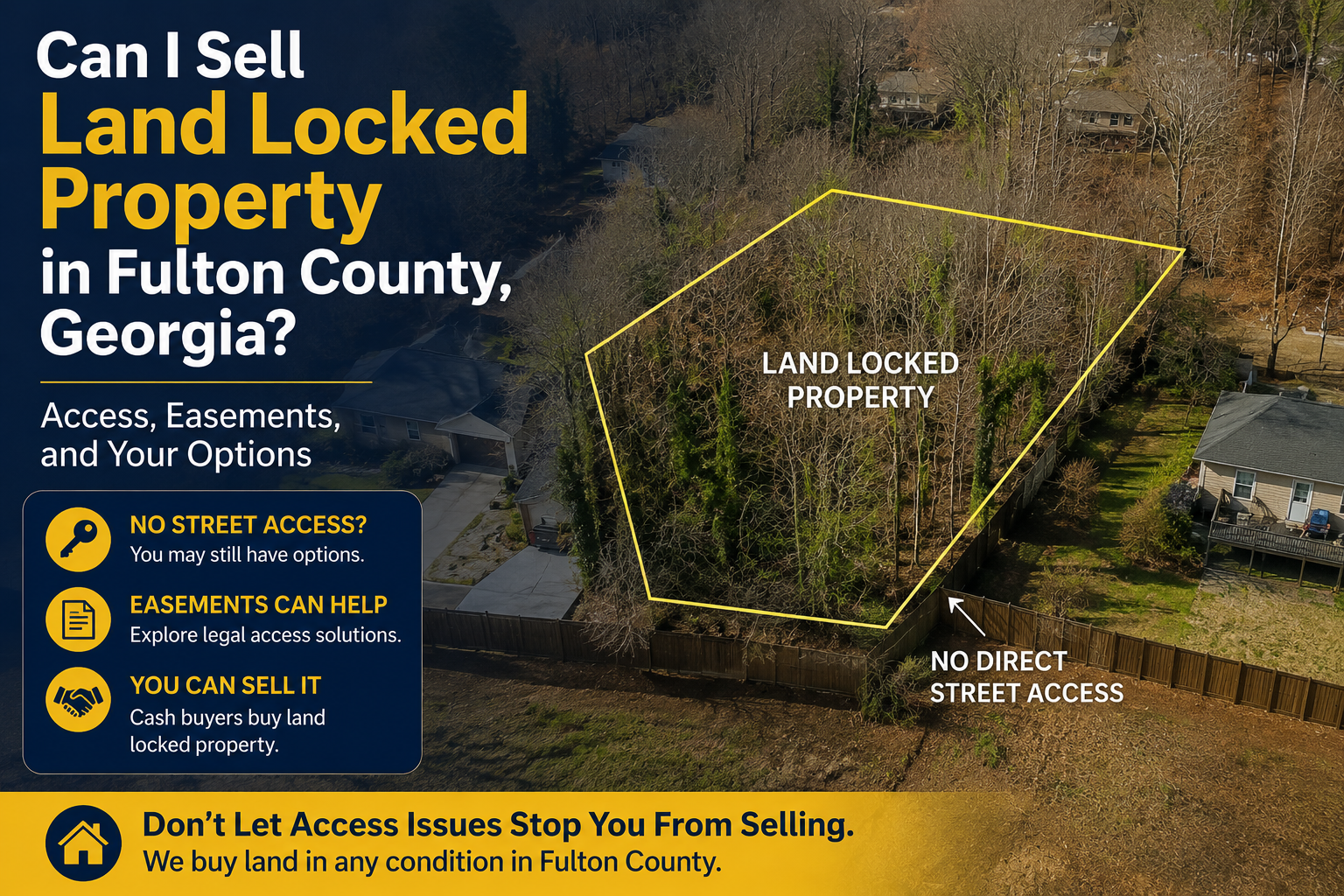
  • Can I Sell Land Locked Property in Fulton County, Georgia? Access, Easements, and Your Options

    Can I Sell Land Locked Property in Fulton County, Georgia

    Yes. You can sell land locked property in Fulton County, and people do it every month. Nothing in Georgia law prevents the sale of a parcel without road access.

    What changes is who will buy it, what they will pay, and how long it takes. A land locked parcel is not unsellable — it is a parcel with a solvable problem, and how solvable that problem is determines almost everything about its value.

    This guide explains what makes a property land locked, what Georgia law actually gives you as remedies (including one statutory right most owners have never heard of), what it does to value, and the realistic paths to selling.

    What Does “Land Locked” Actually Mean?

    A land locked property is a parcel with no legal right of access to a public road. Every route to it crosses land somebody else owns.

    The distinction that matters most: physical access and legal access are not the same thing. Plenty of Fulton County parcels have a gravel drive or worn track leading to them that the owner has used for years. If there is no recorded easement giving the right to use it, the parcel is still legally land locked — and the neighbor can close it tomorrow.

    Three situations get confused with each other:

    • Truly land locked — no legal access of any kind. The hardest case, and the one with the strongest legal remedies.
    • Access by permission only — a neighbor lets you cross. Permission can be revoked, does not transfer with a sale, and — importantly — permission actively defeats a prescriptive easement claim. Owners in this situation often think they are fine.
    • Legal access that is unusable — a recorded easement exists but crosses a creek, a ravine, or terrain that makes a driveway impractical. Legally sound, practically difficult, and this affects value too.

    A Hypothetical: The Miller Family Lot in South Fulton

    Here is how this happens in practice, drawn from the pattern we see most often.

    In 1968, a man buys 12 acres in south Fulton County fronting a two-lane county road. He farms part of it and leaves the back wooded.

    He dies in 1994 without a will. His three children inherit jointly. To divide things “fairly,” they informally split the land into three roughly equal strips and record deeds — but they split it front to back rather than side to side. The oldest son takes the front four acres with all the road frontage. The daughter takes the middle four. The youngest son takes the rear four acres, deep in the trees.

    Nobody records an easement. Nobody thinks to. It is family land, and everyone drives across everyone else’s piece without a second thought.

    Thirty years pass. The oldest son sells his front parcel to a developer in 2019. The developer builds houses, fences the boundary, and gates the old farm track. The daughter’s middle parcel goes to a tax sale after she dies and her heirs never probate the estate.

    Now the youngest son’s daughter inherits the rear four acres. She pulls the record and finds:

    • Her parcel touches no public road at any point
    • No easement was ever recorded in her favor
    • The front parcel is owned by a developer with no interest in granting access
    • The middle parcel is owned by a tax deed purchaser she cannot easily identify
    • Property taxes have been accruing the entire time — nobody stopped billing just because nobody could reach it

    She owns four acres in a county where land is genuinely valuable, and she cannot legally drive to it, build on it, finance it, or sell it to a conventional buyer.

    Every element of that is common: heirs dividing land without easements, a subsequent sale to a party with no family loyalty, decades of unrecorded permissive use, and taxes quietly accumulating. If you are reading this, some version of it probably happened to your parcel.

    How Land Locked Parcels Happen in Fulton County

    • Heirs’ property divisions. By far the most common. Families split land informally without recording access rights, which is especially widespread in south Fulton where parcels have passed through two or three generations.
    • Road realignment or abandonment. A county road gets rerouted or closed, and a parcel that had frontage in 1955 does not today.
    • Subdivision without proper platting. Someone carves off a back lot and sells it without recording an easement across the front.
    • Tax sales. When a parcel is sold for taxes, the buyer gets what the deed describes — and if the deed never included access, neither does the purchaser. If your parcel came through a tax sale, see our guide to the Fulton County tax sale process.
    • Condemnation for infrastructure. Highway, rail, or utility takings that sever a parcel from its frontage.
    • Water boundaries. Parcels along the Chattahoochee where the only approach is across a neighbor’s land.

    What Georgia Law Gives You: Five Routes to Access

    Georgia is more favorable to land locked owners than many states. There are real remedies here — including a statutory one that surprises most people.

    1. Express easement — negotiate and record it

    The cleanest path. You approach the neighbor whose land you need to cross and negotiate a written, recorded easement, usually in exchange for payment.

    Advantages: fastest, cheapest, no litigation. It runs with the land, so it survives when either property sells. Get it drafted by a Georgia real estate attorney and recorded — a handshake or a letter is not an easement.

    The obstacle is leverage. A neighbor who knows you have no access knows exactly how much you need them.

    2. Easement by necessity

    Where a single parcel was divided and the division is what created the land locked condition, Georgia courts may find an implied easement by necessity across the retained land.

    The key requirement is common ownership at the time of severance — the parcels must have been one property under one owner, and the split must be what cut off access. In the Miller hypothetical, this is exactly the theory the granddaughter would pursue, because the 1994 division created the problem.

    3. Private way by prescription — seven years, not twenty

    Under O.C.G.A. § 44-9-1, Georgia recognizes private ways acquired by prescription after seven years of uninterrupted adverse use. That is a notably shorter period than the twenty-year rule people often assume from adverse possession.

    The fatal condition: use by permission never ripens into prescription. If the neighbor said “sure, go ahead,” decades of driving across their land builds no legal right at all. This is why “we’ve always used that road” is one of the most dangerous assumptions in Georgia land law.

    If a prescriptive way exists and someone blocks it, O.C.G.A. § 44-9-59 provides an action to have the obstruction removed.

    4. Condemning a private way — the remedy most owners don’t know exists

    This is the significant one, and most articles about land locked property skip it entirely.

    Under O.C.G.A. § 44-9-40, a Georgia property owner with no means of access, ingress, and egress may petition the Superior Court of the county with jurisdiction to condemn an easement across a private neighbor’s land.

    The specifics:

    • The easement may not exceed 20 feet in width, and the court may grant less if less is reasonably necessary.
    • Filing the petition is itself the declaration of necessity — you do not have to separately prove necessity as a threshold matter.
    • The court can enjoin the proceeding if you already own access over another route of at least 20 feet that provides reasonable means of access, or if the judge finds the condemnation otherwise unreasonable.
    • You compensate the burdened landowner for the taking.
    • You must keep the private way open and in repair — an ongoing obligation that passes to your successors in title.

    In plain terms: a genuinely land locked Fulton County owner has a statutory path to court-ordered access, filed in Fulton County Superior Court. It costs money and takes time, and you want a Georgia attorney handling it. But “the neighbor said no” is not the end of the analysis, and knowing that changes your negotiating position considerably.

    5. Buy a strip, or sell to the neighbor

    Sometimes the simplest answer is a transaction rather than a legal theory. Buy a 20-foot strip from the adjoining owner and connect to the road. Or recognize that the person for whom your parcel is worth the most is the neighbor who already has frontage — to them, your land is not land locked at all.

    Access Is Not the Same as Buildable

    An important distinction that catches people out. Winning legal access does not automatically mean you can build.

    • Frontage requirements. Fulton County contains fifteen municipalities, and each sets its own zoning code. Alpharetta’s requirements are not Roswell’s, which are not the City of South Fulton’s. A 20-foot condemned easement may satisfy access without satisfying a minimum frontage requirement for a building permit. Confirm with the specific city, not “Fulton County” generally.
    • Septic approval. Parcels without sewer need onsite sewage approval from the Fulton County Board of Health, which depends on soil conditions, parcel size, and setbacks — independent of access.
    • Driveway and curb-cut permits. Connecting to a public road requires approval from whichever authority maintains it.
    • Utility easements. Power and water need their own access, which may or may not follow your driveway easement.

    A parcel with legal access but no path to a septic permit is still difficult land — just difficult for a different reason. Understand which problem you actually have before spending money solving the wrong one.

    What Land Locked Status Does to Value and Desirability

    Being direct about this, because vague reassurance does not help you make a decision.

    The discount is real

    Land locked parcels sell at a substantial discount to comparable land with frontage. How substantial depends almost entirely on how solvable the access problem looks: a parcel with a cooperative neighbor and a clear easement-by-necessity argument trades much closer to market than one surrounded by a hostile developer with no legal theory available.

    Conventional financing largely disappears

    This is the mechanism behind most of the discount. Lenders require insurable title with legal access. Without it, title insurers exclude coverage, and most banks will not lend at all. That removes nearly every retail buyer from your pool and leaves cash buyers — a much smaller, more price-sensitive group.

    The buyer pool narrows to three types

    • Adjoining landowners, for whom access is not a problem and your acreage is an addition to theirs. Frequently the highest bidder.
    • Cash land buyers who understand access problems and price the risk in.
    • Speculators betting on future assemblage or road development.

    The carrying costs do not pause

    Here is what makes land locked parcels especially punishing: the tax bill arrives whether or not you can reach the property. Fulton assesses and bills regardless of access. Owners outside the City of Atlanta face an October 15 deadline, with interest at prime plus 3% — 9.75% for 2026 — plus penalties of 5% at 120 days, recurring to a 20% cap.

    Land locked parcels fall behind on taxes at a high rate for exactly this reason: nobody visits, mail goes to an old address, and the parcel produces no income to offset the bill. If yours is behind, see selling tax-delinquent land in Georgia and how many years you can be behind before the county acts.

    What raises the value

    • A recorded easement, even a narrow one
    • A documented history of adverse (not permissive) use approaching or exceeding seven years
    • Common ownership history supporting an easement by necessity
    • A cooperative or motivated adjoining owner
    • Buildable soil and a plausible septic path
    • Size — larger acreage justifies the cost of pursuing access
    • Current taxes and clean title

    Your Realistic Options

    Option 1: Solve access, then sell

    Highest potential return, longest timeline, real upfront cost. Makes sense on larger or higher-value parcels where the spend is justified by the lift. Budget for a survey, title work, an attorney, and payment to the burdened owner.

    Option 2: Sell to an adjoining owner

    Often the best price available, because to them the access problem does not exist. The catch is that they may know your position and negotiate accordingly. Approach more than one neighbor if more than one adjoins you.

    Option 3: Sell as-is to a cash buyer

    Fastest and most certain. You accept a lower number in exchange for not funding litigation, not waiting years, and not carrying taxes while it plays out. Reasonable when the parcel is small, the access path is genuinely unclear, taxes are mounting, or you simply want it resolved.

    Option 4: Hold

    Only makes sense if you can comfortably carry the taxes and have a specific reason to expect change — a planned road, nearby development, an aging neighbor whose heirs may be more willing to deal. Holding without a thesis just means paying taxes on land you cannot use.

    How to Investigate Your Parcel

    1.  Pull the deed and legal description. Search the GSCCCA lien and deed index for the recorded deed and any easements. Read the description carefully — access rights are often buried in it.

    2.  Map it. The Fulton County Property Map Viewer shows parcel boundaries against roads and adjoining parcels. This is usually where owners first see the problem clearly.

    3.  Confirm ownership and value. Check the Fulton County Board of Assessors record, and identify who owns each adjoining parcel. Our guide to searching Fulton County property records walks through the tools.

    4.  Check the tax balance. Land locked parcels are disproportionately delinquent. Confirm with the Fulton County Tax Commissioner at 404-613-6100.

    5.  Trace the chain of title. When was the parcel severed from a larger tract, and who owned both pieces at the time? That answer determines whether an easement by necessity is available.

    6.  Order a survey. A licensed Georgia surveyor establishes exactly where boundaries sit and whether any existing route could be formalized. Do this before serious negotiation.

    Frequently Asked Questions

    Can I legally sell a land locked property in Georgia?

    Yes. There is no legal prohibition on selling a parcel without access. You must disclose the access situation honestly, and the buyer pool will be limited to cash purchasers, but the sale itself is entirely lawful.

    Can a neighbor be forced to give me access in Georgia?

    In effect, yes — through the courts. Under O.C.G.A. § 44-9-40, an owner with no means of access may petition Superior Court to condemn a private way up to 20 feet wide across a neighbor’s land, with compensation paid to that neighbor. The court can block the petition if you already have reasonable access by another route of at least 20 feet, or if it finds the condemnation unreasonable. This is a legal proceeding, so involve a Georgia attorney.

    How long does it take to get a prescriptive easement in Georgia?

    Seven years of uninterrupted adverse use under O.C.G.A. § 44-9-1 — shorter than the twenty years many people assume. The critical limit is that permissive use does not count. If the neighbor gave permission, no prescriptive right accrues no matter how long you have used the route.

    We’ve driven across that land for 40 years. Doesn’t that give us rights?

    Possibly, but only if the use was adverse rather than permissive. Family arrangements and neighborly courtesy are usually permissive, which defeats the claim. Documentation of the nature of that use — who said what, and when — matters more than the number of years.

    Does land locked property still get taxed?

    Yes. Fulton assesses and bills without regard to access, and no exemption applies. Interest accrues monthly at prime plus 3% — 9.75% for 2026 — with penalties of 5% at 120 days past due, recurring to a 20% cap. Vacant land also does not qualify for homestead exemption.

    Can I get a mortgage on land locked property?

    Almost never. Lenders require insurable title with legal access, and title insurers typically exclude coverage where none exists. This is why the buyer pool is essentially cash-only, and why the discount is what it is.

    Is a driveway I’ve always used the same as an easement?

    No, and this is the single most common misunderstanding on this topic. Physical use is not a legal right. Unless an easement is recorded, or you can establish prescription or necessity, the owner of that land can close the route at any time — and a new owner certainly can.

    What if I inherited land locked property?

    Very common, since informal family divisions are a leading cause. The executor or administrator can generally sell once the Probate Court grants authority. If probate was never opened, that typically comes first. See selling inherited land, what happens if you inherit land in Georgia, and probate real estate in Atlanta.

    Should I sue my neighbor or just sell?

    It depends on the math. Litigation costs real money and takes time, during which taxes keep accruing. On a large or valuable parcel with a strong legal theory, pursuing access can pay for itself several times over. On a small parcel with a weak theory, the litigation can cost more than the resulting value increase. Get a candid assessment from a Georgia real estate attorney before committing either way.

    Do you buy land locked property?

    Yes. We buy land locked parcels throughout Fulton County as-is, including parcels with back taxes or a recorded Fi.Fa. We research access, title, and liens before making an offer rather than discovering problems midway through and renegotiating.

    I live out of state. Can I handle this remotely?

    Yes — including closing. Out-of-state owners are heavily represented among land locked parcels, since distance is exactly how a parcel goes unvisited for decades. See how we work with out-of-state owners.

    Fulton County Resources

    Ready to Deal With It?

    Land locked property is one of those problems that quietly gets worse. Taxes accrue, heirs multiply, adjoining owners change, and the memory of who used which road fades with the people who remember it. The parcel does not improve by being ignored.

    If you own a land locked parcel in Fulton County — inherited, tax-delinquent, or simply forgotten — we will look at it and give you a straight answer. Sometimes that answer is “pursue an easement, it’s worth it.” Sometimes it is a cash offer. We will tell you which we think it is.

    Call (404) 913-7086 or request a no-obligation cash offer.

    We buy vacant land across metro Atlanta as-is — no survey required from you, no clearing, no fees, no commissions. We handle the title work and pay any tax balance at closing. Most closings run 7 to 14 days. See also who buys vacant land with back taxes in Atlanta, or contact us with questions about your specific parcel.

    Related: Georgia land buyers · researching mineral rights ownership · about our team

    Fulton County, GA, USA

    Ready To Sell Your Land? Start Here…

    We are direct land buyers. There are no commissions or fees and no obligation whatsoever. Start below by sharing where your property is and where we can send your offer…

    "*" indicates required fields

    Name*
    This field is for validation purposes and should be left unchanged.

  • What to Do When the Government Wants Your Land

    A Fulton County, Georgia Guide to Eminent Domain, Tax Sales, and Protecting What’s Yours

    A letter shows up. It’s on official letterhead, it uses words like “condemnation” or “tax execution,” and somewhere in there is a sentence that makes your stomach drop: the government wants your land. Whether it’s GDOT widening a road, Fulton County pursuing unpaid taxes, or a utility company seeking an easement, the feeling is the same, a sense that a decision about your property is being made without you.

    Here’s what matters most: you have rights in every one of these situations, and the process, while intimidating, follows rules the government has to follow too. This guide walks through the two most common ways Fulton County landowners find themselves facing a government claim on their property, eminent domain and delinquent tax enforcement, and what to do at each stage to protect your interests.

    fulton county vacant land

    Two Ways the Government Can Come After Your Fulton County Land

    When people say “the government wants my land,” they’re usually describing one of two very different legal processes, and it’s worth understanding which one you’re actually facing before you do anything else.

    Eminent Domain (Condemnation)

    This is when a government agency, or a utility company authorized to act like one, takes private property for a public use, such as a road widening, a transit line, or a utility corridor. The government must pay you just compensation, but it can legally take the property even if you disagree with the price. In Fulton County, this most often shows up as a GDOT road project, a MARTA transit expansion, or a utility company seeking a permanent or temporary easement across part of your land for pipelines, power lines, or drainage work.

    Tax Sale for Unpaid Property Taxes

    This is a different process entirely. Fulton County doesn’t take your land directly for unpaid taxes, but it can file a tax execution against the property and eventually sell it at public auction to recover the debt. Unlike eminent domain, this process is triggered by nonpayment, and in most cases it can be stopped simply by paying what’s owed before the sale.

    The rest of this guide covers both processes in detail, since Fulton County landowners run into either one, and sometimes both at the same time.

    Understanding Eminent Domain in Fulton County

    Eminent domain is written into both the U.S. Constitution and the Georgia Constitution. Under Article I, Section III of Georgia’s constitution, private property cannot be taken or damaged for public use without just and adequate compensation. In Fulton County, the most common condemning authorities are the Georgia Department of Transportation for road projects, MARTA for transit expansion, and utility companies exercising delegated condemnation authority for pipelines, power lines, or drainage easements.

    What Triggers a Condemnation Notice

    The process typically starts long before any legal filing. A project is planned, engineers determine which parcels are affected, and the condemning authority sends a notice of intent to acquire, followed by an appraisal of your property to establish what the agency believes is fair market value.

    Your Rights Under Georgia’s Landowner’s Bill of Rights

    Georgia’s Landowner’s Bill of Rights and Private Property Protection Act, passed in 2006, requires the condemning authority to notify you in writing before filing a condemnation petition and to provide you with a written copy of your rights as a property owner. It also requires that any taking be for a genuine public use, and if the land is acquired for redevelopment purposes, it narrows what counts as public use considerably. If the condemning authority skips these procedural steps, that failure can itself be grounds to challenge the case.

    The Good-Faith Offer and Just Compensation

    Before filing suit, the condemning authority is required to make a good-faith offer based on an appraisal. That appraisal is not something you’re automatically shown in detail, and the first number offered is rarely the final word. You have the right to get your own independent appraisal, negotiate for a higher amount, and if necessary, let a jury decide what constitutes just compensation.

    What Happens If You Reject the Offer

    If you don’t accept the offer, the condemning authority can file a condemnation action in Fulton County Superior Court. In many cases, once the authority deposits its offer amount with the court, it can take possession of the property even while the compensation dispute continues. That doesn’t mean the fight is over, it means the compensation question moves into a legal proceeding where you can still argue for more, typically with the help of an attorney experienced in eminent domain.

    Fee Simple, Permanent Easements, and Temporary Easements

    Not every taking looks the same, and the type matters a great deal for what happens to your property afterward. A fee simple taking means the government acquires full ownership and you retain no rights to that portion of land. A permanent easement lets the government use part of your property indefinitely, often for utilities, drainage, or slopes, while you keep ownership but usually can’t build on that section. A temporary easement gives short-term access, typically for construction staging, and your full use of the property returns once the work is done. Because easements are limited in scope, compensation is often calculated as a percentage of full land value, but the practical effect on how you can use your property can still be substantial.

    Understanding Fulton County Tax Sales: When Delinquent Taxes Put Your Land at Risk

    The other, more common way Fulton County landowners lose land to government action isn’t a condemnation notice, it’s a stack of unpaid tax bills. Unlike eminent domain, this process is entirely within your control to stop, right up until the final steps.

    The Fi.Fa. and Tax Execution Process

    When property taxes go unpaid past the due date, interest begins accruing at 1% per month. If the balance stays unresolved, Fulton County can issue a Fi.Fa., a tax execution, which is recorded against the property and creates a lien. From there, the county can advertise the property for a public tax sale.

    The Auction and Redemption Period

    Tax sales in Fulton County are typically held on the courthouse steps on the first Tuesday of the month. If your property is sold, Georgia law gives you a redemption period, commonly 12 months, to reclaim it by paying the buyer’s bid amount, any additional taxes they paid, and a statutory penalty, often around 20 percent, plus costs. Miss that window, and the buyer can move to foreclose your right of redemption permanently.

    What to Do If You Receive a Condemnation Notice

    • Don’t sign anything or accept the first offer before you understand what it’s based on.
    • Get your own independent appraisal. The government’s number reflects their interest, not necessarily the property’s full value.
    • Review the notice carefully for compliance with the Landowner’s Bill of Rights. Procedural mistakes by the condemning authority can matter.
    • Consult an attorney who handles eminent domain cases specifically, ideally before you respond to the initial offer, not after.
    • Understand what’s being taken, fee simple ownership, a permanent easement, or a temporary easement, since each has very different long-term effects on your property.

    What to Do If You’re Facing a Fulton County Tax Sale

    • Call the Fulton County Tax Commissioner’s office immediately and get your exact current payoff amount, including interest and fees.
    • Pay the balance before the sale date if you’re able to. This is almost always the simplest, least expensive way to resolve it.
    • Ask about payment plans or installment arrangements if you can’t pay the full balance at once.
    • Consider selling the property before the auction date if you don’t want to keep it, so the tax debt is settled directly from the proceeds at closing.
    • If the property has already been sold, act quickly. You’re now in a redemption period with real financial and time pressure, and the cost to reclaim it only grows the longer you wait.

    Common Mistakes Landowners Make in Both Situations

    Whether you’re dealing with a condemning authority or a delinquent tax balance, the same handful of mistakes tend to make things worse. Waiting to respond, assuming the first offer or bill is final, and trying to handle a legal notice without asking questions all shrink your options over time. In eminent domain cases specifically, accepting a first offer without an independent appraisal is one of the most common ways landowners leave real money on the table. In tax delinquency cases, ignoring notices because the amount feels too big to deal with is what turns a manageable bill into a lost property.

    A Real Example: A Fulton County Landowner Facing Both Issues

    A landowner in South Fulton received a GDOT notice that a road-widening project would require a permanent easement across the front third of his lot, along with a good-faith offer for the taking. At the same time, he was two years behind on property taxes on the same parcel, unrelated to the GDOT project. He got an independent appraisal that valued the easement significantly higher than GDOT’s initial offer and negotiated a revised settlement before any condemnation action was filed. Separately, he called the Fulton County Tax Commissioner, confirmed his payoff amount, and paid off the back taxes using part of the eminent domain settlement once it closed. Handling both issues in parallel, rather than letting either one sit, kept him from losing ground on either front.

    Frequently Asked Questions

    Can the government just take my land in Fulton County?

    Only for a legitimate public use, and only with just compensation. The condemning authority has to follow the notice and procedural requirements in Georgia’s Landowner’s Bill of Rights, and you have the right to challenge both the taking itself and the amount offered.

    Do I have to accept the government’s first offer?

    No. The initial offer is a starting point, not a final number. Getting an independent appraisal and, if needed, legal representation, is a normal and often effective part of the process.

    Is a tax sale the same thing as eminent domain?

    No. Eminent domain is a taking for public use with required compensation. A tax sale is a debt-collection process triggered by unpaid taxes, and in most cases it can be stopped entirely by paying the balance before the sale date.

    What if I can’t afford to fight a condemnation case or pay off delinquent taxes?

    For eminent domain cases, many attorneys work on contingency, meaning they’re paid from any increase they secure over the government’s original offer. For tax debt, selling the property before the sale date lets you resolve the balance directly from the proceeds without paying out of pocket.

    How much time do I actually have once I get a notice?

    It varies by process and by project, but in both eminent domain and tax delinquency cases, the earlier you act, the more options you have. Waiting rarely improves your position in either scenario.

    Summary and Next Steps

    Whether the government wants your Fulton County land through eminent domain or is moving toward a tax sale over unpaid taxes, you have real options and real rights at every stage. Read every notice carefully, get an independent read on your property’s value or your tax payoff amount, and don’t let a deadline pass in silence. The earlier you respond, the more control you keep over the outcome.

    Dealing With Delinquent Taxes on Fulton County Land?

    If back taxes are part of what you’re facing and keeping the land isn’t the priority it once was, we can help you resolve it without the stress of an approaching sale date.

    Call (404) 913-7086 or request a no-obligation cash offer at AtlantaLandBuyers.com. We buy Fulton County land as-is, including parcels with back taxes or a recorded lien, and can often close in 7–14 days.

    Helpful Fulton County Resources

    Georgia DOT Office of Right of Way

    Fulton County Government Official Website

    Fulton County Tax Commissioner

    State Bar of Georgia Lawyer Referral Service

    Official Code of Georgia, Title 22 — Eminent Domain

    Ready To Sell Your Land? Start Here…

    We are direct land buyers. There are no commissions or fees and no obligation whatsoever. Start below by sharing where your property is and where we can send your offer…

    "*" indicates required fields

    Name*
    This field is for validation purposes and should be left unchanged.

  • Fulton County vs Dekalb County Property Taxes, What’s the difference?

    Ever wondered why homes just miles apart have different yearly costs? In Georgia, it’s all about the local tax systems. Knowing the Fulton County vs Dekalb County property taxes is key for smart real estate moves.

    Fairburn Georgia land

    Where you live greatly affects your tax bill. Each area has its own way of figuring out property values and taxes. Understanding these differences helps you plan your finances better and find ways to save.

    Key Takeaways

    • Location significantly dictates your annual real estate financial obligations in Georgia.
    • Assessment methods vary between major jurisdictions, impacting final bill amounts.
    • Millage rates are not uniform and change based on local government needs.
    • Homeowners should investigate specific relief programs to lower their annual burden.
    • Strategic planning helps investors navigate the complexities of regional fiscal policies.

    Understanding the Fundamentals of Fulton County vs Dekalb County Property Taxes

    When comparing fulton county vs dekalb county property taxes, it’s key to understand Georgia’s laws. State law sets the rules for taxes, but each county has its own rules that affect your bill.

    The fair market value and assessed value are crucial. The fair market value is what your home could sell for. In Georgia, the assessed value is 40% of that.

    The tax bill is found by multiplying the assessed value by the local millage rate. Since rates differ by school board and county commission, the total tax can change a lot. Understanding these mechanics helps explain why your neighbor might pay differently.

    Homeowners often notice differences in taxes due to exemptions and reassessments. Knowing these basics helps you get ready for your taxes each year. It lets you keep an eye on your property’s value and make sure it’s fair.

    The Role of Tax Assessors in Fulton and Dekalb Counties

    In Fulton and Dekalb counties, the local tax assessor is key in setting your annual tax bill. They identify, map, and value all taxable property. This ensures the property tax assessment is fair for everyone.

    How Property Valuation Works in Georgia

    Georgia law says property should be assessed at 40% of its fair market value. Assessors use a method to value many properties at once. This keeps values consistent across different areas.

    Even with a standard method, tax assessment differences can happen. This is due to local market data and when properties are inspected. Assessors look at recent sales to set your property’s value. They try to match the current market as closely as they can.

    The Appeal Process for Property Tax Assessments

    If you think your valuation is off, you can appeal it. The process starts with your annual assessment notice. You have 45 days to file a written appeal.

    After filing, the county will check your property data. If there’s still an issue, your case might go to a hearing. Having evidence like recent appraisals or photos can help your case.

    Appeal StageAction RequiredExpected Outcome
    Initial FilingSubmit written appealReview by assessor
    County ReviewProvide supporting evidenceValue adjustment or denial
    Board HearingPresent case to boardFinal valuation decision

    Knowing these steps helps you manage your taxes better. Proactive communication with the assessor can fix small issues before they become big problems. Always save copies of your communications.

    Analyzing Millage Rates and Their Impact on Homeowners

    The millage rate is key in figuring out your yearly property tax. It’s the tax rate applied to your home’s value to fund local services. Knowing these county tax rates is crucial for budget planning.

    Defining Millage Rates and Local Government Funding

    Local governments use millage rates to fund public services. These funds help with road upkeep and emergency services like police and fire. It’s essential for the community’s well-being.

    A mill is one dollar for every thousand dollars of property value. When more money is needed for schools or community programs, rates can change. This affects your budget, so it’s important to watch county tax rates closely.

    Brookhaven property tax jumps 40 percent | FOX 5 News

    Comparing Current Millage Rate Trends in Fulton and Dekalb

    Fulton and Dekalb counties face different challenges that shape their budgets. They balance public service needs with keeping housing affordable. This can lead to changes in your tax bill.

    Both areas adjust their tax rates for market changes and infrastructure needs. One might focus on schools, while the other on public safety. Keeping up with these changes helps you plan your finances better.

    Utilizing a Fulton County GA Property Tax Calculator

    Homeowners often look for a simple way to predict their yearly property tax obligations. By using a fulton county ga property tax calculator, you can gain a clearer picture of your financial commitments before the official bill arrives. These digital resources serve as a helpful starting point for your annual budget planning.

    Where to Find Official County Assessment Tools

    The most reliable data comes directly from the source. You should visit the official Fulton County Tax Commissioner’s website or the Board of Assessors portal to access property records. These platforms provide the most accurate assessment values for your specific parcel.

    Once you locate your property record, you can view the current assessed value and historical tax data. While the county may not always provide a single “calculator” button, the public access portals allow you to apply current millage rates to your assessed value. This manual calculation often yields the most precise estimate available to the public.

    Limitations of Online Tax Estimation Tools

    It is important to remember that any fulton county ga property tax calculator has inherent limitations. These tools often rely on data that may not reflect the most recent legislative changes or assessment appeals. Because property values fluctuate, an online estimate should never be viewed as a final or binding tax bill.

    Several factors can cause discrepancies between an online estimate and your actual tax statement. For instance, changes in local school district millage rates or the application of specific homestead exemptions can significantly alter the final amount. Always treat these digital tools as a guide rather than a definitive financial document.

    FeatureOfficial PortalThird-Party Calculator
    Data AccuracyHigh (Real-time)Variable (Delayed)
    Exemption SupportComprehensiveLimited
    Millage Rate UpdatesAutomaticManual/Outdated
    Primary UseOfficial RecordsQuick Estimates

    Ultimately, verifying your information through official channels ensures you are prepared for your tax obligations. Using a fulton county ga property tax calculator is a smart step, but cross-referencing that data with your official assessment notice remains the best practice for homeowners.

    Navigating the Dekalb County Property Tax Calculator

    If you own property in Dekalb County, learning the online tax portal is key for planning your finances. The dekalb county property tax calculator is a main tool for those who want to manage their housing costs. It helps you understand your financial obligations before the bills come.

    Key Inputs Required for Accurate Estimates

    To get a good estimate, you need to input certain data. The most important thing is your Property Identification Number (PIN). This connects the calculator to your property records.

    Also, have your latest assessment notice ready. It shows your home’s fair market and assessed values. Putting these numbers in correctly helps the dekalb county property tax calculator give you a fair tax estimate.

    Interpreting Results from the Dekalb Tax Portal

    After you enter your info, the portal shows a detailed tax estimate. It’s crucial to check how exemptions, like the homestead exemption, affect your total. These can greatly reduce your bill, so make sure they’re applied right.

    The table below shows the main data points you’ll see when using the portal to plan your property taxes.

    Input CategoryData RequiredPurpose of Data
    Property IdentificationPIN or AddressLocates specific parcel records
    Valuation DataAssessed ValueBasis for tax calculation
    Exemption StatusHomestead/SeniorReduces taxable amount
    Output ResultEstimated Total TaxProvides annual budget forecast

    By checking these results often, you can adjust your budget for tax changes. Knowing these numbers helps you make smart choices about your real estate all year.

    Homestead Exemptions and Tax Relief Programs

    Homeowners in Georgia can lower their taxes with special programs. These homestead exemptions can cut down your tax bill a lot. Make sure to apply before the local deadline.

    vacant land in fulton county

    Available Exemptions for Fulton County Residents

    Fulton County has many exemptions to help with housing costs. The basic homestead exemption is for your main home. There are also floating homestead exemptions to protect against value increases.

    To qualify, you must live in Fulton County by January 1st of the tax year. Apply through the Fulton County Tax Commissioner’s office. Timely filing is key to get your savings on the current bill.

    Available Exemptions for Dekalb County Residents

    Dekalb County offers a lot of help for property owners. There’s more than just the basic homestead exemption. They also have special tax relief for school taxes.

    Check your eligibility on the Dekalb County Tax Commissioner’s portal. Many find big savings by using multiple exemptions. Keep an eye out for new local rules that might add more benefits.

    Senior Citizen Tax Relief Programs

    Senior citizens get extra tax help in both counties. They often get a freeze on their home’s value if they meet certain age and income rules. This helps keep their finances stable.

    Disabled Veteran and Surviving Spouse Exemptions

    There are special rules for disabled veterans and their surviving spouses. These exemptions can waive or reduce property taxes. You’ll need to show proof of service-connected disability to apply.

    Exemption TypeFulton CountyDekalb County
    Basic HomesteadAvailableAvailable
    Senior FreezeIncome-basedAge/Income-based
    Disabled VeteranFull/PartialFull/Partial
    Surviving SpouseEligibleEligible

    Property Tax Assessment Differences and Market Volatility

    Changes in local property values can greatly affect your taxes in Fulton and Dekalb. When the real estate market rises quickly, the property tax assessment process may lag behind. This creates a challenge for homeowners who see their home value increase but face higher taxes.

    How Rapid Market Appreciation Affects Tax Bills

    Market appreciation happens when homes sell for more than their previous values. Tax offices use these sales to update the taxable value of similar homes. If your home value goes up a lot, your taxes will likely increase too, unless you get certain exemptions.

    There’s usually a delay between when market values rise and when tax offices update values. This delay can cause big tax bill increases when the county finally updates values. Knowing about these tax assessment differences helps you get ready for possible financial changes.

    Frequency of Reassessments in Both Counties

    Fulton and Dekalb counties have different schedules for checking property values. Fulton County reviews values more often to keep taxes in line with the market. This helps avoid big, sudden tax increases for homeowners.

    Dekalb County also watches market trends, but their reassessment cycle might be different. Homeowners should check their county’s website to find out when their property will be reviewed. Keeping up with your property tax assessment cycle is key to managing your budget in a changing economy.

    Impact of School District Taxes on Total Tax Burden

    Local school districts have a big impact on your property taxes. For many homeowners, the biggest part of their tax bill goes to schools. These county tax rates change to fit the needs of local schools.

    Fulton County School District Funding Requirements

    Fulton County has a complex school funding system. It has both independent city schools and the main county district. Each sets its own tax rate based on student numbers, building upkeep, and teacher pay.

    This means people in different parts of Fulton County pay different amounts in taxes. The school board sets these needs every year. They make sure schools can run smoothly. When property values go up, they have to find a balance between getting more money and not overloading taxpayers.

    Dekalb County School District Funding Requirements

    In Dekalb County, schools get most of their money from property taxes. They have a lot of students, so they need to spend a lot on new buildings and fixing old ones. The board sets the tax rate each year based on these needs.

    Homeowners’ taxes help pay for things like classroom tech and sports programs. Because Dekalb County wants high standards in schools, their county tax rates often go up. Here’s how these things affect your money planning.

    FactorFulton County ImpactDekalb County Impact
    Primary Funding SourceProperty TaxesProperty Taxes
    Budget DriversDistrict-specific needsStudent population growth
    Rate VariabilityHigh (due to city systems)Moderate (centralized)

    Knowing how your local school board handles its budget can help you plan for tax changes. By keeping up with public meetings and budget reports, you can see how county tax rates might change.

    Investment Property Considerations for Real Estate Investors

    Investors often miss the tax differences between Fulton and Dekalb counties. A clear strategy for investment property taxes is key to making money in the long run. Knowing how these places tax non-owner-occupied assets helps landlords plan their yearly costs.

    Tax Implications for Rental Properties in Fulton

    In Fulton County, rental property taxes are often higher than for homes. This is because rental properties don’t get the same tax breaks as primary homes. Investors need to include these costs in their profit calculations.

    Managing a rental property in Fulton requires careful budgeting. Tax assessments can change with the market. Owners should check their tax notices every year. This helps keep the valuation fair compared to other similar properties.

    Tax Implications for Rental Properties in Dekalb

    Handling rental property taxes in Dekalb County means dealing with local rules. Since rental units don’t get homestead exemptions, the tax bill is higher. Investors should plan more carefully for any new property.

    When looking at the Dekalb County rental yield, investors must consider specific tax rates. Staying on top of these rates helps with accurate financial planning. Successful investors in Dekalb focus on keeping taxes low to increase their profits.

    Comparing Tax Comparison Tool Effectiveness

    Today, we have many ways to figure out our taxes. But not all tools are the same. When you do a property tax comparison, the quality of your data matters a lot. A good tax comparison tool can save you a lot of time and effort.

    Best Practices for Using Third-Party Tax Comparison Tools

    First, make sure your data is up to date. Whether you’re using a fulton county ga property tax calculator or another tool, check your property value. It’s smart to compare results from different tools to spot big differences.

    Look for tools that let you make detailed adjustments, like for homestead exemptions. A top-notch tax comparison tool should explain how it figures out its estimates clearly. Transparency shows it’s a reliable platform.

    “In God we trust, all others must bring data.”

    W. Edwards Deming

    Verifying Data Accuracy Against Official County Records

    Third-party sites are handy, but they’re not always right. Always check your findings against the official dekalb county property tax calculator or your area’s portal. Official records give you the most accurate tax info.

    Only using unofficial estimates can mess up your budget. If a third-party site and official records don’t match, go with the official data. Using a fulton county ga property tax calculator with official tax bills gives you a full picture. This way, you can manage your investments and finances well.

    Also, remember that tax rates can change every year. It’s smart to check the official dekalb county property tax calculator often. This keeps you from being surprised by your tax bill.

    Strategic Planning for Future Property Tax Liabilities

    Planning ahead is key to handling property taxes in Fulton and Dekalb counties. Knowing how your taxes might change helps you stay stable, even when the market does. By regularly comparing your taxes to others, you can see if your home is fairly assessed.

    Budgeting for Annual Tax Increases

    Many homeowners face surprise tax hikes. To avoid this, save a bit each month in a special account. This way, you’ll have money ready if your taxes go up.

    Keep an eye on local news about tax rate changes. When you compare your taxes, watch for trends in your area. This helps you adjust your budget before taxes are due.

    When to Consult a Property Tax Professional

    Some homeowners handle their taxes themselves, but others need help. If your home’s value seems too high compared to others, get a professional. They can help prove your home’s value in an appeal.

    Appeals can be complex, needing deep knowledge of local tax laws. If you’re lost in the paperwork or legal steps, a pro can guide you. Getting help early can lead to better outcomes than waiting for the last minute.

    Conclusion

    Managing property taxes in Fulton County or Dekalb County needs a proactive approach. You now know how to handle assessment notices, millage rates, and exemption programs confidently.

    Using an official tax comparison tool is the best way to check your specific taxes. These tools give you the clear information you need to plan for changes in your local tax burden each year.

    Always trust data from the Fulton County Board of Assessors or the Dekalb County Tax Commissioner. Checking these records helps make sure your budget is accurate for your home.

    Staying informed about local government funding changes helps protect your finances. Use this knowledge to keep an eye on your property’s value and claim all the exemptions you’re eligible for.

    By taking charge of your taxes, you secure your real estate investments for the long term. Start using these strategies today to keep a clear view of your financial future in Georgia.

    FAQ

    What is the primary difference in fulton county vs dekalb county property taxes?

    The main difference is in the millage rates set by local authorities. Fulton and Dekalb also offer different homestead exemptions. Both counties assess properties based on fair market value, but the tax bill varies. This is due to school funding, municipal bonds, and how often assessments are updated.

    How can I estimate my annual bill using a fulton county ga property tax calculator?

    Visit the Fulton County Board of Assessors website for an estimate. The calculator needs your property’s value and exemption status. Remember, these estimates are based on current rates and don’t include future changes.

    Where can I access a dekalb county property tax calculator for my home?

    Dekalb County’s Tax Commissioner has an online calculator. Just enter your Parcel ID or address to see your taxes. This tool helps understand how the E-HOST credit lowers Dekalb homeowners’ taxes.

    What are the major tax assessment differences between residential and investment properties?

    Residential properties can get homestead exemptions, lowering their taxable value. Investment properties don’t qualify, leading to higher taxes for investors.

    How do county tax rates and millage rates impact my total payment?

    Tax rates are in mills, where one mill is $1 for every $1,000 assessed value. Your bill is the assessed value times the millage rates. Changes in these rates affect your annual taxes.

    Can I use a third-party tax comparison tool to evaluate different neighborhoods?

    Yes, tools can compare taxes in different areas. They show how taxes might differ on similar homes in Fulton and Dekalb. Always check the data against official records for the most up-to-date rates.

    What property tax assessment relief is available for seniors and veterans?

    Fulton and Dekalb offer relief for seniors and veterans. Seniors in Fulton may get exemptions that cap assessment increases. Dekalb has similar programs based on income and age. Georgia also has a statewide exemption for disabled veterans and surviving spouses.

    How does rapid market appreciation affect a property tax comparison between these counties?

    Quick property value increases can lead to higher taxes, even with stable millage rates. It’s crucial to know how often each county reassesses properties. Frequent reassessments in areas like Atlanta or Decatur can cause more volatile taxes.

    What is the process for appealing a property tax assessment in Georgia?

    If you think your assessment is too high, you have 45 days to appeal. File a “PT-311A” form with the county board. You can appeal based on value, uniformity, or exemptions. Providing local sales data is often key to a successful appeal.

    Why do school district taxes make up such a large portion of my bill?

    School funding is the biggest part of your tax bill in Fulton and Dekalb. These funds support teachers, infrastructure, and programs. The school millage rate is a big factor in which county has higher taxes.

    Atlanta, Georgia, 30307
  • How to File a Fulton County Georgia Property Tax Appeal

    Ever thought your home might be overvalued, making you pay too much? Many homeowners feel stuck when they get their annual assessment notice. But, they don’t know they can fight these high numbers.

    Knowing how the local system works is key to protecting your money. By being proactive, you can make sure your home’s value matches the market, not some high guess.

    fulton county georgia property tax appeal

    To start a fulton county georgia property tax appeal, you need to get ready and know the rules. This guide will show you how to go through the process with ease. By presenting your case well, you could save a lot on your taxes every year.

    Key Takeaways

    • Review your assessment notice immediately upon arrival.
    • Gather comparable sales data to support your valuation claim.
    • Understand the specific deadlines for filing your formal challenge.
    • Prepare clear documentation to present during the review process.
    • Stay informed about local regulations to protect your long-term equity.

    Understanding the Fulton County Property Tax Assessment Process

    To win a fulton county tax appeal, you must understand how your property’s value is set. Local officials use a detailed process to value every home and business. This ensures fairness in the tax system.

    Knowing how values are set helps protect your money. It’s crucial for homeowners to check if their taxes are fair.

    The Role of the Fulton County Tax Assessor

    The Tax Assessor is key in keeping property records up to date. They make sure all taxable properties are fairly valued. This helps keep taxes fair for everyone.

    They don’t set tax rates but do determine your home’s fair market value. If you think your value is off, start with the Tax Assessor for your fulton county tax appeal.

    How Property Values Are Determined

    Assessors look at many things to value your property. They check recent sales, construction costs, and market trends. This helps them estimate your property’s worth.

    The table below shows what affects your property’s value each year:

    Assessment FactorData SourceImpact on Value
    Comparable SalesReal Estate RecordsHigh
    Property ConditionSite InspectionsModerate
    Square FootageBuilding PermitsHigh
    Neighborhood TrendsMarket AnalysisModerate

    The Importance of the Annual Notice of Assessment

    Every year, you get a notice about your property’s value. This tells you the current value of your land and buildings.

    It’s important to check this notice right away. Look for mistakes like wrong square footage or old property details. If you find errors, you can appeal your taxes within a short time.

    Preparing for Your Fulton County Georgia Property Tax Appeal

    Getting ready is key to a successful appeal in Fulton County, Georgia. Organizing your info early makes a strong case. This careful approach boosts your chances of a fair outcome.

    Reviewing Your Property Record Card

    Start by getting your property record card. This card shows how the county figures out your taxes. You can find it on the county assessor’s website.

    Go over the card’s details carefully. Accuracy is crucial to ensure the county has your home’s info right. If they don’t, your tax could be too high.

    Identifying Discrepancies in Property Data

    Compare the card’s info with your home’s real features. Look at square footage, bedrooms, and lot size. Small mistakes can mean a higher tax bill.

    Check for old or wrong info on building features or renovations. If you spot an error, document it well. This proof is vital for your appeal.

    Gathering Necessary Documentation

    Good evidence is essential for winning. Start with recent appraisals that show your home’s real value. These give a clear view of your property’s worth.

    Include repair estimates for any big issues that lower your home’s value. Photos of damage or old systems are also strong evidence. Having this ready will strengthen your appeal.

    Utilizing the Fulton County Tax Assessor Property Search Tool

    Getting accurate market data is key to a successful property tax appeal in Fulton County. The fulton county tax assessor property search tool is your main tool to see how your home compares to others. It helps you gather evidence to prove your home is overvalued.

    How to FILL OUT Georgia Tax Appeal Form in 10 Minutes!  PT-311-A (2023) @TaxFreezeCommand

    Navigating the Online Portal

    To start, go to the official website and find the property search feature. You’ll need your parcel ID or address to find your record. Once you’re in, explore the tabs for tax history and assessment details.

    The fulton county tax assessor property search portal is easy to use but needs patience. Save or print important pages for your records. Having this info ready will help a lot.

    Analyzing Comparable Sales Data

    After getting your data, look for recent sales of similar homes. The fulton county tax assessor property search tool shows sales history for nearby homes. Look for sales from the last year for the most accurate market data.

    Check the sale price per square foot to see if your assessment is fair. If your home is valued much higher than recent sales, you have a strong appeal case. Consistency in your analysis is crucial for a strong argument.

    Identifying Similar Properties in Your Neighborhood

    To find good comparisons, filter your search by specific criteria. Look for homes with similar features to yours for a fair comparison. The table below shows key features to evaluate when choosing comparable properties.

    FeatureWhy It MattersComparison Goal
    Square FootageDetermines base valueWithin 10-15% of your size
    Year BuiltReflects construction ageWithin 5-10 years of your home
    Lot SizeImpacts land valuationSimilar acreage or dimensions
    Bed/Bath CountMajor value driversMatch your exact configuration

    By focusing on these metrics, you can find properties that truly match yours. This targeted approach helps you avoid irrelevant data and strengthens your case. The goal is to show your assessment doesn’t reflect the fair market value of your home.

    Determining the Grounds for Your Appeal

    To learn how to appeal property tax in Fulton County Georgia, you need to know the legal reasons. Not every tax assessment can be appealed. You must find the right legal reason for your appeal to make a strong case.

    Choosing the right reason for your appeal helps you focus your evidence. This increases your chances of winning your appeal.

    Appealing Based on Fair Market Value

    The most common reason for an appeal is a disagreement over your property’s value. If you think the tax assessor overvalued your home, this is your main argument. You should show recent sales of similar homes to prove the value is too high.

    Appealing Based on Uniformity of Assessment

    Even if your property’s value is correct, it might not match your neighbors’. This is called a lack of uniformity. When you learn how to appeal property tax in Fulton County Georgia, compare your property’s value to your neighbors’. If they pay less for similar homes, you have a strong case for a lower tax bill.

    Appealing Based on Taxability and Exemptions

    You can also appeal if there are errors in your property’s taxability or if you’re missing out on exemptions. For example, you might be eligible for a homestead exemption or a senior discount. Checking your status ensures you’re not paying too much in taxes.

    Grounds for AppealPrimary FocusRequired Evidence
    Fair Market ValueOvervaluationRecent comparable sales
    UniformityEquity/FairnessNeighboring assessment data
    TaxabilityExemption statusLegal documentation/ID

    It’s crucial to understand these categories when you research how to appeal property tax in Fulton County Georgia. By picking the right path, you build a solid case for the board. Make sure your evidence matches the grounds you’ve chosen for your appeal.

    Filing Your Formal Appeal

    Knowing how to file is key for anyone looking to appeal property tax in Fulton County Georgia. This step turns your research into a formal challenge against the county’s valuation. It’s crucial to be precise, as any mistake could lead to your appeal being rejected.

    Deadlines and Submission Requirements

    The Fulton County Board of Assessors has strict filing deadlines. You must appeal within 45 days of the notice date. Missing this deadline means you can’t contest the valuation for the current year.

    Your appeal must include important details. Make sure to list your property ID, the tax year, and your reason for appealing. Also, include your contact info and a brief explanation of your appeal.

    Methods for Submitting Your Appeal

    There are several ways to submit your appeal. Choose what works best for you, whether it’s online or in person. Here’s a table showing the main options:

    Submission MethodPrimary BenefitProcessing Speed
    Online PortalInstant confirmationFastest
    Certified MailPhysical proof of deliveryModerate
    In-Person DeliveryImmediate receipt stampFast

    Most people find the online portal the most efficient. It lets you upload documents directly. If you prefer mail, use certified mail to track your submission.

    Confirming Receipt of Your Appeal

    Getting proof of receipt is crucial. If you appeal online, you’ll get a confirmation number or email right away. Keep this safe, as it proves your appeal was filed on time.

    For mail or in-person submissions, ask for a stamped copy or keep your certified mail receipt. If you don’t get confirmation, contact the Tax Assessor’s office. Proactive communication helps keep your appeal moving forward.

    The Tax Appeal Process in Fulton County Georgia

    Going through the tax appeal process in Fulton County Georgia takes time. Your documents go through several steps before a decision is made. This is important for homeowners who think their property value is too high.

    Review by the Board of Assessors

    The Board of Assessors checks the value of all properties in the county. When you appeal, they first check if you followed the rules. They make sure your appeal is complete and correct.

    This step helps keep the tax system fair. The board doesn’t check every property itself. Instead, their experts review your appeal carefully.

    tax appeal process in fulton county georgia

    The Role of the Property Appraisal Staff

    The appraisal staff is key in the tax appeal process. They look at your evidence to see if your property value should change. They compare your data with sales records and neighborhood trends.

    They focus on several important things:

    • The accuracy of your property record card data.
    • Recent sales of comparable properties in your immediate vicinity.
    • Evidence of physical damage or deferred maintenance affecting value.
    • Uniformity of assessments compared to similar homes in the area.

    Careful preparation of your evidence is crucial. The staff uses this data to decide if your value should be lower. If they agree, they might offer a settlement to avoid further steps.

    Receiving the Notice of Decision

    After the review, you’ll get a formal notice of decision. This tells you the county’s final decision on your property value. It marks the end of the first review phase.

    If the county lowers your value, the notice will show the new amount. If they don’t agree, it will explain your options for further action. Knowing this helps you plan for what’s next if you’re not happy with the decision.

    Preparing for a Hearing with the Board of Equalization

    When initial reviews don’t meet your expectations, the Board of Equalization offers a chance for your fulton tax appeal. They act as a neutral third party. They review the arguments from both sides to ensure the valuation is fair.

    Understanding the Board of Equalization

    The Board of Equalization is made up of local citizens who handle property tax disputes. They work independently to keep things fair during the fulton tax appeal process. They look at the evidence to see if the county’s assessment is fair.

    Organizing Your Evidence for Presentation

    Success here depends on how well you organize your evidence. A messy presentation can hurt your case. Keep your documents clear and easy to follow. Organize them into categories like:

    • Recent sales data of similar properties nearby.
    • Photos showing damage or needed repairs.
    • Official records of recent permits or zoning changes.
    • A summary sheet of the main points of your fulton tax appeal.

    Selecting Witnesses and Expert Appraisals

    At times, you need more than just papers to win your case. A professional appraiser can give an unbiased valuation. Make sure they know local market trends and fulton tax appeal specifics.

    Consider inviting witnesses who know your property well. Whether it’s a professional appraiser or a contractor, their testimony should be based on facts. Clear, evidence-based testimony is key to sway the board’s decision.

    Navigating the Hearing Experience

    Handling the hearing experience needs a mix of being professional and clear. Even though it feels formal, staying calm helps you focus on your goal during your fulton tax appeal.

    What to Expect During the Proceedings

    The hearing has a set format. It lets both sides share their findings. You’ll start with a statement, then present your evidence, and the assessor’s office will respond.

    Then, the board will listen and ask questions. Knowing this helps you manage your time and highlight your key points.

    Presenting Your Case Effectively

    To win your fulton tax appeal, be clear and organized. Focus on the most important data, like recent sales or property issues.

    Don’t read long scripts. Use bulleted notes instead. Visual aids like photos or maps can also help the board understand your concerns.

    Responding to Questions from the Board

    Take time to think before answering questions. If unsure, it’s better to say so than guess.

    Keep your tone respectful, even if questions get tough. Your goal is to give clear, factual info that backs your valuation.

    Preparation StepHearing GoalExpected Outcome
    Evidence ReviewIdentify Value GapsStronger Argument
    Professional ToneBuild CredibilityBoard Engagement
    Concise SummaryClarify PositionEfficient Review
    Data OrganizationSupport ValuationClearer Decision

    Being well-prepared and professional boosts your chances of success in your fulton tax appeal. The board aims to review the facts. Your job is to present them clearly.

    Exploring Alternative Dispute Resolution Options

    When dealing with the tax appeal process in fulton county georgia, you might look beyond the usual board hearing. If you’re not happy with the first decision, don’t worry. There are other ways to get a fair property value.

    tax appeal process in fulton county georgia

    Binding Arbitration Explained

    Binding arbitration is a legal way to settle valuation disputes. Once you pick this option, the arbitrator’s decision is usually final. You’ll need to present your case to a neutral third party who will decide based on your evidence and the county’s assessment.

    This choice comes with filing fees and possible costs for appraisals. Since the decision is binding, make sure you’re ready with strong evidence before you start.

    Hearing Officer Appeals

    A hearing officer appeal is an alternative to the Board of Equalization. It’s often chosen for a quicker, more specialized review. Hearing officers are certified appraisers who know local market trends well.

    • They focus strictly on technical valuation data.
    • The process is often faster than standard board hearings.
    • It requires a clear, evidence-based argument regarding fair market value.

    Weighing the Costs and Benefits of Further Appeals

    Choosing to continue the tax appeal process in fulton county georgia needs careful thought. Think about the tax savings against the costs of experts or filing fees. If the tax savings are small, the effort and money might not be worth it.

    But for big valuation differences, these options can work well. Always talk to a professional to see if your case is strong enough before taking more legal steps.

    Common Mistakes to Avoid During the Appeal

    When you appeal your taxes in Fulton County, you must be very careful. Many people make mistakes that hurt their case. Knowing these common errors can help you avoid them and increase your chances of winning.

    Missing Critical Filing Deadlines

    One big mistake is missing the filing deadline. Fulton County has strict rules for when you can submit your appeal. Being on time is crucial to get your case heard.

    Failing to Provide Sufficient Evidence

    To win your appeal, you need solid evidence, not just your opinion. Many people lose because they don’t have enough proof. You need things like recent appraisals or photos to show your property is worth less.

    “The strength of your appeal is directly proportional to the quality of the evidence you present to the board.”

    — Property Tax Consultant

    Ignoring Comparable Property Data

    Not using data from similar homes is a big mistake. Your property’s value should be compared to others nearby. Without this data, your case is weaker.

    Common MistakePotential ImpactRecommended Action
    Missing DeadlinesAutomatic RejectionSet early reminders
    Insufficient EvidenceDenied Valuation ChangeGather professional reports
    Ignoring CompsWeak ArgumentAnalyze local market data

    By avoiding these mistakes, you can make your appeal stronger. Make sure your files are in order and all dates are correct before you submit. Being well-prepared is your best defense against unfair taxes.

    Professional Assistance for Your Fulton County Tax Appeal

    Handling a fulton county real estate tax appeal can be tough. While some homeowners tackle simple issues on their own, complex cases need expert help. An expert can help you get a fair assessment.

    When to Hire a Property Tax Consultant

    If your home is very valuable or you’re short on time, a property tax consultant is a good choice. They know the local tax laws well and spot mistakes you might miss. They only get paid if they save you money.

    Working with Real Estate Appraisers

    Independent real estate appraisers give you the facts you need to dispute an assessment. By hiring one, you get a report that’s very important. This report is key when you’re trying to show your property is worth less than the county says.

    Legal Representation for Complex Appeals

    For big commercial properties or legal fights, getting an attorney is smart. Lawyers know the tax laws and fight for you in hearings. They make sure you follow all the rules and protect your rights during the fulton county real estate tax appeal.

    Conclusion

    Understanding local rules and being accurate is key to managing property taxes. A successful appeal in Fulton County needs solid data and well-kept records. This is crucial throughout the appeal process.

    Being proactive can really help homeowners protect their money. You can challenge unfair assessments that don’t match your area’s market. This is your chance to make a difference.

    Getting involved early can save you stress and avoid mistakes. Your hard work in collecting evidence is the base for a fair appeal. This is how you fight for what’s right in your fulton county real estate tax appeal.

    Check your assessment notices every year to keep your property info up to date. Knowing your rights as a taxpayer helps you speak up for yourself. Take control of your property taxes today. Make sure you only pay what’s fair.

    FAQ

    How do I begin the process of how to appeal property tax in fulton county georgia?

    Start by getting your Annual Notice of Assessment. You have 45 days to file an appeal. First, check your property record card at the Fulton County Tax Assessor’s office. Make sure your home’s details are correct.

    What is the most effective way to use the fulton county tax assessor property search tool?

    Use the tool to find “comps” or similar sales. Look for homes like yours in your area. This helps show if your tax is fair compared to others.

    What are the primary grounds for filing a fulton county georgia property tax appeal?

    You can appeal based on Value, Uniformity, or Taxability. Knowing why you’re appealing helps you prepare your evidence.

    What documents are necessary to support a fulton county real estate tax appeal?

    You’ll need a recent appraisal, photos of property issues, repair estimates, and closing statements. These documents help prove your case.

    How can I submit my formal fulton county tax appeal?

    File online, by mail, or in person. If mailing, use certified mail to prove you filed on time.

    What happens during the tax appeal process in fulton county georgia after I file?

    The appraisal staff will review your documents. They might offer a new value. If not, your case goes to the Board of Equalization for a hearing.

    Is it necessary to hire a professional for a fulton county real estate tax appeal?

    You can appeal on your own, but a professional can help with complex cases. They know the process well and can provide expert testimony.

    What is binding arbitration in the fulton county tax appeal process?

    Binding arbitration is a final decision on fair market value appeals. It’s a final step with no further appeals. Consider the costs and potential savings before choosing this path.

    Ready To Sell Your Land? Start Here…

    We are direct land buyers. There are no commissions or fees and no obligation whatsoever. Start below by sharing where your property is and where we can send your offer…

    "*" indicates required fields

    Name*
    This field is for validation purposes and should be left unchanged.

  • Can I Sell My House If Its In Foreclosure?

    Have you ever wondered if you still hold the power to change your financial destiny once the bank starts the legal process of taking your property? Many homeowners feel trapped when they fall behind on mortgage payments, yet taking immediate action remains your best defense against losing everything.

    Can I Sell My House If Its In Foreclosure

    Understanding your rights is the first step toward regaining control. While the situation feels overwhelming, you are not powerless. You can sell your property to settle debts and protect your credit score before the bank completes the auction process.

    This guide provides a clear roadmap to help you navigate these difficult waters. By acting quickly, you open doors to legal and financial solutions that mitigate long-term damage. You deserve to move forward with confidence rather than succumbing to panic.

    Key Takeaways

    • Acting fast is essential to stop the legal process and save your credit.
    • Selling the property remains a viable option even after receiving official notices.
    • Consulting with real estate experts helps you understand your specific equity position.
    • Communication with your lender often reveals alternative repayment plans or grace periods.
    • Prioritizing a quick sale prevents the devastating impact of a completed bank auction.

    Understanding the Foreclosure Process

    Navigating the complexities of home ownership requires a clear understanding of what happens when mortgage payments stop. The path toward mortgage default is a structured legal journey that every homeowner should understand to protect their interests. By demystifying these legal milestones, you can identify exactly where you stand and what options remain available to you.

    The Timeline of Default

    The process typically begins after a single missed payment, though lenders rarely initiate formal action immediately. Most mortgage agreements include a grace period, usually lasting 15 days, before a late fee is applied. If the account remains unpaid for 30 to 90 days, the lender will send formal notices to alert you of the delinquency.

    Once the account is significantly past due, the lender issues a Notice of Default (NOD). This document is a public record that officially signals the start of the foreclosure process. It serves as a formal warning that the lender intends to pursue legal action if the debt is not satisfied or a repayment plan is not established.

    Distinguishing Between Pre-Foreclosure and Active Foreclosure

    It is vital to recognize the difference between the pre-foreclosure phase and active foreclosure. During pre-foreclosure, you still hold the legal title to your home. This window provides a critical opportunity to sell the property, negotiate with your lender, or seek financial assistance before the bank takes further action.

    In contrast, active foreclosure often involves court intervention or a scheduled auction date. Once the process moves into this stage, the lender is actively working to reclaim the property through legal channels. Understanding this distinction is essential for any homeowner looking to sell before the bank takes possession of the property.

    FeaturePre-ForeclosureActive Foreclosure
    Homeowner StatusRetains legal titleTitle transfer in progress
    Legal StandingDelinquent but manageableCourt or auction proceedings
    Selling OptionsHigh flexibilityLimited and time-sensitive
    Primary GoalAvoid public auctionMitigate credit damage

    Can I Sell My House If Its In Foreclosure?

    You might be surprised to learn that selling your home during the foreclosure process is a viable option. Many homeowners mistakenly believe that once a notice is filed, they have lost all control over their property. In reality, selling your home can often be the best way to protect your financial future and avoid the long-term damage of a completed foreclosure.

    Can I Sell My Home if It Is in Foreclosure?

    If you are asking, “can i sell my house if its in foreclosure,” the answer is yes, provided you act quickly and maintain open communication with your lender. Banks are generally not in the business of owning homes; they are in the business of lending money. Therefore, they are often willing to work with you to find a solution that avoids the expense of a public auction.

    The Reality of Selling with a Lis Pendens

    When a lender begins the legal process, they typically file a lis pendens. This is a public notice that a lawsuit is pending against your property. It serves as a warning to potential buyers and title companies that the property is currently involved in legal action.

    Dealing with a lis pendens can complicate the closing process, as it creates a cloud on the title. However, it does not make a sale impossible. You must work closely with a title company to ensure that the proceeds from the sale are used to satisfy the outstanding debt, which will then allow the lender to release the lien.

    “Communication is the bridge between a potential foreclosure and a successful property sale. Lenders are often more flexible than you think if you present a clear plan.”

    — Real Estate Financial Advisor

    Why Lenders May Allow a Sale

    Lenders often prefer a voluntary sale over the costly and time-consuming process of a formal foreclosure auction. When you ask, “can you sell your house while in foreclosure,” you are essentially proposing a path that saves the bank significant resources. The bank avoids the costs of property maintenance, legal fees, and the uncertainty of an auction sale.

    The following table highlights why a voluntary sale is often mutually beneficial for both the homeowner and the mortgage servicer:

    FeatureVoluntary SaleForeclosure Auction
    Cost to LenderMinimalHigh (Legal/Maintenance)
    TimeframeControlledLengthy/Uncertain
    Credit ImpactLess SevereSevere Damage
    OutcomeDebt SatisfiedPotential Deficiency

    By aligning your goals with those of the bank, you can often secure the time needed to list your home on the open market. Proactive engagement is the key to turning a difficult situation into a manageable transaction.

    Selling a Home in Pre-Foreclosure

    Selling a home in pre-foreclosure requires a proactive approach to avoid the devastating impact of an auction. When you face the possibility of losing your property, time becomes your most valuable asset. Taking decisive steps early can help you navigate this difficult period with more control.

    Advantages of Acting Before the Auction

    The primary benefit of initiating a sale early is the preservation of equity. Once a property reaches the auction block, the sale price is often dictated by the lender’s debt rather than the actual market value. By selling on your own terms, you are more likely to walk away with a portion of your investment intact.

    Furthermore, acting quickly helps protect your credit score from the severe damage associated with a formal foreclosure filing. A voluntary sale is viewed much more favorably by future lenders than a completed foreclosure. Taking control of the process allows you to move forward with your financial life much sooner.

    Preparing Your Home for a Quick Sale

    When you are selling a home in pre-foreclosure, speed is the most critical factor. You must make your property stand out to potential buyers who are looking for a smooth transaction. Efficiency in your preparation can be the difference between a successful closing and a missed deadline.

    Staging for Speed

    You do not need a massive budget to make your home look appealing. Focus on decluttering every room to create a sense of space and cleanliness. Use neutral paint colors to help buyers visualize themselves living in the home, which often leads to faster offers.

    Pricing Strategies for Distressed Properties

    Setting the right price is a delicate balance between your need for a quick exit and the desire to maximize value. Research comparable sales in your neighborhood to ensure your listing is competitive. Pricing your home slightly below market value can generate immediate interest and potentially spark a bidding war, which is ideal when time is of the essence.

    Legal and Financial Implications of Selling During Foreclosure

    When you decide on selling property in the foreclosure process, understanding your financial standing is the first step. The financial landscape can feel overwhelming, but breaking it down into manageable parts helps you maintain control. You must look closely at your current mortgage balance and the total amount required to satisfy the lender.

    Understanding Equity and Mortgage Payoffs

    Calculating your actual equity is not as simple as subtracting your loan balance from the sale price. You must account for the total mortgage payoff, which includes the principal balance, accrued interest, and any late fees. Furthermore, lenders often add legal costs and administrative fees incurred during the default period to the final payoff amount.

    It is vital to request a formal payoff statement from your lender early in the process. This document provides a clear picture of the exact funds needed to clear the debt and release the lien on your property. Knowing these numbers allows you to determine if you have enough equity to cover the sale costs and potentially walk away with some funds.

    The Role of Title Companies and Liens

    A successful transfer of ownership requires a clean title, which is where title companies become essential. When you are selling property in the foreclosure process, the title company performs a thorough search to identify any outstanding liens. These might include tax liens, contractor claims, or secondary mortgages that could block the sale.

    The title company acts as a neutral third party to ensure all financial obligations are settled before the deed changes hands. They work to clear these clouds on the title, ensuring that the buyer receives a clear and marketable property. By coordinating with your lender and the title company, you can navigate these financial hurdles and ensure the sale proceeds are handled legally and efficiently.

    How Do I Stop a Foreclosure on My Home?

    If you are wondering how do i stop a foreclosure on my home, the first step is to take immediate, decisive action. Ignoring notices from your lender will only accelerate the legal process and limit your available options. By engaging early, you demonstrate a commitment to resolving the debt, which can often lead to more favorable outcomes.

    Communication Strategies with Your Mortgage Servicer

    The most critical step in this process is maintaining open and honest communication with your mortgage servicer. Do not wait until you have missed multiple payments to reach out. Contact their loss mitigation department as soon as you realize you are facing financial hardship.

    When you speak with a representative, be prepared to explain your situation clearly. Provide documentation regarding your income, expenses, and the specific event that caused your financial setback. This transparency helps the lender understand your unique circumstances and may help you determine how do i save my home from foreclosure more effectively.

    Utilizing Grace Periods and Forbearance

    Many lenders offer temporary relief programs designed to help homeowners get back on their feet. A forbearance agreement allows you to pause or reduce your monthly mortgage payments for a set period. This is not a permanent solution, but it provides the necessary breathing room to stabilize your finances or prepare your home for a sale.

    Understanding the difference between various relief options is essential for making an informed decision. The following table outlines common methods used to manage mortgage distress:

    OptionPrimary BenefitBest For
    ForbearanceTemporary payment pauseShort-term financial hardship
    Loan ModificationPermanent rate or term changeLong-term affordability issues
    Repayment PlanCatch up on missed paymentsTemporary income disruption

    By utilizing these tools, you can effectively halt the momentum of the foreclosure process. Taking these steps creates a vital window of opportunity to either catch up on your obligations or successfully list your property on the market. Always ensure that any agreement reached with your lender is provided in writing to protect your interests.

    Working with Real Estate Professionals

    When your property faces foreclosure, the right real estate professional becomes your most valuable asset. Selling a home under financial pressure involves complex legal and financial hurdles that standard agents may not be equipped to handle. Hiring an expert who understands the nuances of distressed properties can significantly improve your chances of a successful sale.

    Working with real estate professionals during foreclosure

    Finding Agents Experienced in Distressed Sales

    You should look for agents who specifically advertise experience with short sales and pre-foreclosure listings. These professionals understand how to communicate effectively with mortgage servicers and can often expedite the approval process for a sale. Their familiarity with the local market and the specific requirements of lenders is crucial for protecting your interests.

    Ask potential candidates about their track record with similar cases in your area. A qualified agent will have a network of contacts, including title companies and legal experts, who can help navigate the unique challenges of your situation. Do not hesitate to request references or examples of how they have managed distressed transactions in the past.

    Disclosing the Foreclosure Status to Potential Buyers

    Transparency is a fundamental requirement when selling a home in any stage of default. You must be honest about the foreclosure status to avoid future legal complications and to maintain the integrity of the transaction. Full disclosure helps build trust with potential buyers, which is essential when time is of the essence.

    Your real estate agent will guide you on how to properly document these disclosures according to state laws. By being upfront, you prevent misunderstandings that could cause a buyer to walk away at the last minute. Clear communication ensures that all parties are aware of the timeline and the specific conditions of the sale, leading to a smoother closing process.

    Exploring Alternatives to a Traditional Sale

    When you are searching for answers on how can i save my home from foreclosure, it is important to realize that a standard market listing is not your only path. Sometimes, the timeline or the financial gap between your debt and the home value makes a traditional sale impossible. In these cases, lenders may be willing to discuss specific settlement programs that prevent the long-term damage of a formal foreclosure.

    Understanding Short Sales

    A short sale occurs when your mortgage lender agrees to accept a payoff amount that is less than the total balance remaining on your loan. This process is often a strategic move for both parties. It allows the lender to avoid the high costs of the legal foreclosure process while giving you a way to exit your mortgage without a total loss of credit standing.

    To qualify for a short sale, you must typically prove financial hardship. You will need to provide documentation showing that you can no longer afford the monthly payments. Once approved, the property is sold to a third party, and the proceeds are paid directly to the lender to satisfy the debt.

    The Mechanics of a Deed in Lieu of Foreclosure

    If a sale is not possible, a Deed in Lieu of Foreclosure serves as a voluntary alternative. In this scenario, you agree to transfer the property title directly to your lender. By doing so, you effectively hand over the keys to satisfy the outstanding mortgage debt in full.

    This option is often faster than a traditional foreclosure and can be less damaging to your credit report. Consider these key differences when evaluating your options:

    • Short Sale: Requires finding a buyer and navigating the real estate market.
    • Deed in Lieu: Involves a direct transfer of ownership to the bank.
    • Credit Impact: Both options are generally viewed more favorably than a completed foreclosure.

    Ultimately, knowing how can i save my home from foreclosure involves proactive communication with your financial institution. Whether you choose a short sale or a deed in lieu, taking action early is the best way to protect your financial future.

    Managing Your Credit During the Foreclosure Process

    While the threat of losing a home is overwhelming, understanding the long-term credit implications is essential for your future. Financial stability often feels out of reach during a housing crisis, but proactive management can make a significant difference. By taking control of your financial narrative now, you can lay the groundwork for a faster recovery later.

    The Impact of Foreclosure on Credit Scores

    A foreclosure is one of the most damaging events that can appear on your credit report. It typically results in a substantial drop in your credit score, often ranging from 100 to 200 points depending on your previous history. This negative mark signals to future lenders that you have defaulted on a major financial obligation.

    The consequences of this record extend far beyond your mortgage. You may find it difficult to secure new housing, obtain credit cards, or even qualify for auto loans at reasonable interest rates. This impact can linger on your credit report for up to seven years, making it a hurdle that requires patience and discipline to overcome.

    Managing your credit score during the foreclosure process

    Steps to Mitigate Long-Term Credit Damage

    Although the damage to your credit can be severe, you are not entirely powerless. Taking specific, calculated steps can help you limit the long-term fallout and begin rebuilding your financial health sooner rather than later.

    Consider these strategies to protect your credit standing during this difficult transition:

    • Communicate with your creditors: Reach out to other lenders to explain your situation before you miss payments, as they may offer temporary relief.
    • Ensure accurate reporting: If you sell your home, verify that the sale is reported correctly to the credit bureaus as “paid in full” or “settled” rather than a foreclosure.
    • Monitor your credit reports: Regularly check your reports from Equifax, Experian, and TransUnion to ensure no errors are compounding the damage.
    • Prioritize essential bills: Even if you are struggling with your mortgage, try to keep other accounts current to maintain a positive payment history elsewhere.

    Consistency is key when you are working to repair your financial reputation. By staying organized and keeping a close eye on your credit activity, you can navigate this transition with a clearer path toward future stability.

    Negotiating with Your Lender

    If you are wondering how do I stop foreclosure on my house, the answer often lies in proactive and transparent negotiation. Lenders generally prefer to avoid the lengthy and costly process of taking back a property through legal channels. By demonstrating a clear intent to sell, you can often align your goals with those of your mortgage servicer.

    Establishing a line of communication early is essential for success. When you approach your lender with a professional attitude, you show that you are taking responsibility for the situation. This can lead to more favorable outcomes as you work toward a resolution.

    Requesting a Payoff Statement

    A formal payoff statement is a critical document that outlines the exact amount required to satisfy your mortgage debt. You must request this from your lender as soon as you decide to list your home. This document provides the precise figures needed for your title company to calculate net proceeds accurately.

    Without an updated payoff statement, you risk delays that could jeopardize your sale. Ensure that the statement includes all interest, late fees, and legal costs associated with the default. Having this information ready allows you to be fully transparent with potential buyers and their agents.

    Seeking Extensions to Facilitate a Sale

    If you have a serious buyer in the pipeline, you may need more time to close the deal. You can formally request an extension from your lender to pause the foreclosure timeline. Lenders are often willing to grant these extensions if they see a signed purchase agreement and proof of a pending closing date.

    When asking for more time, provide your lender with consistent updates regarding the status of the sale. Showing that you are actively working to resolve the debt is the best way to learn how do I stop foreclosure on my house effectively. Persistence and documentation are your strongest tools during these negotiations.

    Common Pitfalls to Avoid When Selling

    Selling your property under duress is a high-stakes process that demands vigilance against common pitfalls. When you are facing the pressure of a looming deadline, it is easy to feel overwhelmed by the complexity of the situation. Taking a moment to understand the risks can help you protect your remaining equity and your financial future.

    Avoiding Foreclosure Rescue Scams

    Financial distress often makes homeowners vulnerable to predatory actors who promise miracle solutions. These scammers frequently reach out with unsolicited offers to “save” your home from the auction block. They may claim to have special relationships with lenders or offer to pay off your mortgage in exchange for an upfront fee.

    You should be extremely wary of anyone who asks for payment before providing services or requests that you sign over the deed to your property. Legitimate professionals will never ask you to transfer your title to them as a condition of assistance. Always verify the credentials of any company or individual offering help by checking with the Better Business Bureau or your state’s attorney general office.

    The Dangers of Underpricing Your Property

    The urgency to stop a foreclosure often leads homeowners to accept the first offer they receive, regardless of the price. While a quick sale is a common goal, rushing the process can result in a significant loss of hard-earned equity. Accepting an offer that is far below market value may leave you with little to no funds after your mortgage balance and closing costs are paid.

    It is vital to obtain a professional comparative market analysis to understand the true value of your home. Even in a distressed situation, pricing your home competitively ensures that you maximize your return. Do not let the fear of the auction process force you into a decision that leaves you in a worse financial position than when you started.

    Conclusion

    Facing a potential loss of your home requires immediate action and a clear strategy. You hold the power to influence the outcome by staying informed and engaging with your lender early.

    Whether you choose a traditional sale, a short sale, or a deed in lieu of foreclosure, your proactive approach protects your long-term interests. Each path offers a way to minimize credit damage and regain your financial footing.

    Seek guidance from trusted real estate professionals who understand the complexities of distressed properties. These experts help you navigate the legal landscape while keeping your goals at the forefront.

    Your commitment to resolving this situation marks the first step toward stability. Stay focused on the facts and maintain open lines of communication with your mortgage servicer. Taking control today creates a path toward a more secure tomorrow.

    FAQ

    Can I sell my house if its in foreclosure?

    Yes, you absolutely can. Until the property is officially sold at an auction or the title is transferred via a court order, you remain the legal owner of the home. Selling a home in pre-foreclosure is often the most effective way to pay off your mortgage balance, stop the legal proceedings, and potentially walk away with any remaining equity before the bank takes possession.

    How do I save my home from foreclosure if I am behind on payments?

    To save your home from foreclosure, the first step is to open a line of communication with your mortgage servicer, such as Wells Fargo or Bank of America. You can request a loan modification, enter a forbearance agreement, or set up a repayment plan. If keeping the home is not financially feasible, selling the property quickly to a traditional buyer or an investor is a common strategy to settle the debt.

    What are the primary benefits of selling a home in pre-foreclosure?

    The main advantage is control. By selling a home in pre-foreclosure, you avoid the severe credit damage that follows a final foreclosure judgment. It also allows you to manage the marketing and pricing of your home, rather than leaving it to the uncertainties of a public auction where the property often sells for much less than its market value.

    Can you sell your house while in foreclosure if a lis pendens has been filed?

    Yes, you can. A lis pendens is a public notice that a lawsuit is pending against the property. While this can complicate the closing process, it does not prevent a sale. You will need to work with a title company to ensure the sale proceeds are sufficient to satisfy the mortgage, legal fees, and any other liens so that a clear title can be passed to the new buyer.

    How do I stop a foreclosure on my home through a short sale?

    If you owe more on your mortgage than the home is currently worth, you may need to pursue a short sale. This is where the lender agrees to accept a payoff amount that is less than the total balance owed. While this process requires lender approval, it is a viable way to stop a foreclosure on my home and move forward without the long-term stigma of a foreclosure on your record.

    How do I stop foreclosure on my house by negotiating with the bank?

    You can stop foreclosure on my house by requesting a formal payoff statement and asking for an extension of the foreclosure deadline. If you can prove that you have a viable listing and a potential buyer, many lenders are willing to delay the auction. Banks generally prefer a voluntary sale over the costly and time-consuming process of seizing and maintaining a property.

    What should I consider when selling property in foreclosure process regarding my credit?

    When selling property in foreclosure process, your goal should be to mitigate credit damage. A completed foreclosure can stay on your credit report for seven years and drop your score by hundreds of points. By completing a successful sale or a deed in lieu of foreclosure, you can often reduce the recovery time for your credit score and become eligible for a new mortgage much sooner.

    How can I save my home from foreclosure and avoid predatory scams?

    To save my home from foreclosure safely, always verify the credentials of anyone offering help. Avoid “foreclosure rescue” companies that demand upfront fees or advise you to stop talking to your lender. Instead, consult with a HUD-approved housing counselor or a real estate agent who specializes in distressed properties to ensure your interests are protected during the sale.

    Why is pricing strategy so important when selling a distressed property?

    Speed is the most critical factor when facing an auction deadline. While you want to maximize your equity, pricing your home competitively is essential to attract a buyer quickly. An experienced agent will help you balance the need for a rapid exit with the goal of covering your mortgage balance and legal costs, ensuring you don’t lose the home to the bank because the listing sat on the market too long.

    What is the role of a title company when selling a home in foreclosure?

    The title company is responsible for identifying all outstanding debts attached to the property, including the primary mortgage, second liens, and delinquent taxes. They coordinate with the lender to ensure the mortgage payoff is handled correctly during closing. This ensures that the new owner receives a “clean” title, which is necessary for any traditional real estate transaction to finalize.

    Ready To Sell Your Land? Start Here…

    We are direct land buyers. There are no commissions or fees and no obligation whatsoever. Start below by sharing where your property is and where we can send your offer…

    "*" indicates required fields

    Name*
    This field is for validation purposes and should be left unchanged.

  • What Happens If You Don’t Pay Property Taxes on Land in Georgia?

    vacant land in Georgia

    Short answer: the county treats land exactly like a house — same lien, same auction, same first Tuesday of the month. What is different is everything around it. Land has no mortgage servicer quietly paying the tax to protect its collateral, no homestead exemption, and nobody living on it to open the mail. That combination is why vacant and inherited parcels are wildly overrepresented on every metro Atlanta delinquent list, and why land owners are the ones most likely to find out too late.

    If you are asking what will happen if you do not pay property taxes on your land, you have probably already read the generic answer: a lien, then penalties, then a tax sale. That is true, and it applies to land the same way it applies to a three-bedroom ranch in Decatur.

    But it is not the useful answer, because it does not explain why land owners lose property at such disproportionate rates. This guide covers what is specifically different about land — vacant lots, raw acreage, inherited parcels, commercial sites — and what those differences mean for you.

    If what you actually want is the timeline and the arithmetic — how many years you can be behind, what the interest rate is, when the penalties post, and what redemption costs — that is covered in full in our companion guide on how many years you can be behind on property taxes in Georgia. This article assumes you have that and focuses on the land side.

    Why Land Falls Behind Far More Often Than Houses

    This is not carelessness on the part of land owners. It is structural, and understanding why matters because every one of these causes has a fix.

    There is no escrow account paying it for you

    On a mortgaged house, the servicer collects taxes monthly and pays the county on your behalf. You never see the deadline because someone else is watching it. Most land is owned free and clear — bought with cash, inherited, or long since paid off — so there is no servicer, no escrow, and no automatic payment. The entire responsibility sits with you, and nothing reminds you.

    This also removes a protection people do not know they have. When a mortgaged homeowner falls behind on taxes, the lender will typically advance the payment to protect its collateral and add the amount to the loan balance. It is expensive, but it stops a tax sale. Nobody performs that function for a vacant parcel. There is no backstop.

    Nobody lives there to notice

    A homeowner sees the bill arrive, sees the second notice, and eventually sees the certified letter. A vacant parcel generates the same mail, sent to whatever address the county has on file. If you moved, if the owner of record died, if the mail went to a relative’s house in 2014 — none of that stops the process. It just means you find out later, when your options are worse.

    The bill feels small until it is not

    Annual taxes on an unimproved lot can be a few hundred dollars. It is easy to defer a small bill for a year, and then another. But small balances are exactly the ones counties clear efficiently, because the enforcement cost is the same whether the debt is $400 or $40,000. A modest tax bill is not protection.

    Ownership is often unresolved

    An enormous share of delinquent land in metro Atlanta is inherited property where the estate was never probated. Nobody has clear authority to pay, sell, or decide, so the taxes accrue while the family works out what to do. See what happens if you inherit land in Georgia.

    Five Things That Are Different When It’s Land

    1. No homestead exemption applies

    Homestead exemptions — including Georgia’s senior exemptions, which can be substantial — apply only to your primary residence. Vacant land, second parcels, rental land, and investment acreage get none of it. Georgia assesses property at 40 percent of fair market value, and on land that full assessment applies without the relief a homeowner receives. The parcel you never visit is taxed without a discount.

    2. Vacant land is the preferred target at a tax sale

    Investors bidding at Georgia tax sales generally prefer vacant parcels over occupied houses, and the reasons are practical. There is no occupant to deal with. There is no structure that might have a failing roof or an unpermitted addition. The opening bid is usually low because it reflects the tax debt rather than the value. And a vacant lot requires no maintenance while the redemption period runs.

    The consequence for you is uncomfortable but worth knowing: your parcel is more likely to actually attract a bidder and sell than an equivalent house would be. Delinquent land does not sit unsold as often as owners assume.

    3. Code enforcement runs on a separate track

    This is the cost that catches vacant lot owners completely off guard. Cities across metro Atlanta cite overgrown, unsecured, or debris-filled lots. If you do not respond, the city can abate the nuisance itself — mow it, clear it, board it — and attach the cost to the property as a lien.

    Those liens are separate from your tax debt, accrue on their own schedule, and do not go away because you eventually pay the taxes. On a neglected lot in an incorporated city, abatement liens can eventually exceed the original tax balance. See can I sell property with a lien on it in Georgia.

    4. HOA and POA dues keep running on platted lots

    If your parcel is a lot in a platted subdivision, the association’s assessments usually continue indefinitely whether or not anything was ever built. Unpaid dues become a lien, and a Georgia HOA can pursue foreclosure over assessments entirely independently of the county. See HOA foreclosure.

    5. You carry liability on land you never visit

    Trespassing, ATV use, illegal dumping, and injuries on unposted land are genuine exposures for absentee owners. Vacant land insurance is inexpensive, and most owners of neglected parcels do not carry it. This rarely causes the tax problem, but it frequently compounds it.

    east point land in Fulton County

    What Happens to Different Kinds of Land

    The legal process is identical. The practical picture is not.

    Type of landWhy it goes delinquentWhat is distinctive about the outcome
    Vacant residential lotSmall annual bill, no escrow, often held for a build that never happenedHighly attractive to tax sale bidders. Code enforcement and HOA liens frequently stack on top.
    Raw acreage or timberlandAbsentee ownership, family land, no income from the parcelA conservation use covenant can add a recapture penalty on top of the tax debt if it is breached.
    Inherited landEstate never probated; no heir has authority to pay or sellThe hardest to resolve quickly, because authority to sell must be established before any closing can fund.
    Commercial or development parcelDeal fell through, financing changed, entitlement stalledTax bills are substantially larger, so balances compound faster and draw county attention sooner.
    Landlocked or unbuildableOwner concluded the parcel is worthless and stopped payingStill fully taxable. Often has real value to an adjoining owner even when it has none to you.
    Mobile home lotLand and the home are frequently taxed and titled separatelyTwo separate obligations. Owners routinely resolve one and remain delinquent on the other.

    Inherited land deserves extra attention

    Property taxes do not pause during probate. That single fact costs Georgia families more land than any other misunderstanding. An estate can spend two years in Fulton County Probate Court while the parcel quietly accrues taxes, penalties, and eventually a recorded execution.

    Where a parcel has passed down through several generations without wills, you may have heirs property — fractured title shared among many descendants, sometimes dozens. Every co-owner has an interest, no single heir can act alone, and the property becomes nearly impossible to sell, insure, or borrow against. The Georgia Heirs Property Law Center is a nonprofit law firm that does exactly this work, with offices including Atlanta and targeted outreach in Atlanta’s Westside neighborhoods. If your family land has a tangled deed, start there. Also see probate real estate in Atlanta and how to sell inherited land.

    Acreage under a conservation use covenant

    If your acreage is enrolled in Georgia’s Conservation Use Valuation Assessment program, you agreed to a ten-year covenant in exchange for being taxed on current use value rather than fair market value — often cutting the bill substantially. Breaching that covenant triggers a recapture penalty. County materials commonly describe it as roughly twice the tax savings received over the life of the covenant, plus interest, though the exact formula and the treatment of specific circumstances vary.

    Two things matter here. A new owner generally must agree to continue the covenant or become responsible for the penalty, which affects who can buy your land and at what price. And the penalty is calculated against savings you have already banked, so it grows the longer the covenant has run. Confirm your covenant status with your county board of tax assessors before you market the parcel — see the state’s CUVA fact sheet and Cobb County’s CUVA rules summary.

    How to Check Exactly Where Your Parcel Stands

    Most land owners are operating on a guess. You can replace it with facts in about thirty minutes.

    1. Find the parcel ID. Search your county’s parcel viewer — qPublic for Fulton County is the starting point for Fulton parcels, and the Fulton County Board of Assessors confirms the valuation and the owner of record.
    2. Confirm the owner of record is who you think it is. If it still shows a deceased relative, that is your first problem and it takes longest to fix.
    3. Get the tax balance in writing from the county tax commissioner, good through a specific date, and ask whether an execution has been issued.
    4. Search recorded liens through the GSCCCA lien index. This is where you will find tax executions, judgments, HOA liens, and code enforcement liens you did not know about.
    5. Call the city, not just the county, if the parcel sits inside an incorporated city. City taxes, city code enforcement, and county taxes are three separate ledgers, and being current on one says nothing about the others.
    6. Update your mailing address with the board of assessors while you are at it. On land, this is the single highest-value five-minute task on this page.

    One question worth asking directly: is this parcel currently scheduled for a tax sale, and if not, is it in the levy queue? Write down who answered and when. Counties do not warn you when a parcel enters the queue, and the four-week newspaper advertisement is often the first unmistakable signal — see our guide to the Fulton County tax sale process.

    Your Options for Land You No Longer Want

    Owners tend to see two choices, keep paying or lose it. There are more than that, and several are land-specific.

    Bring it current and keep it

    If the parcel has a real future — you plan to build, it is appreciating, it adjoins something you own — clearing the balance is the cheapest outcome available, and it gets cheaper the earlier you do it. Ask about partial payments while you assemble the money.

    Sell it to the neighbor

    Genuinely underrated for small, landlocked, or oddly shaped parcels. Land that is worthless on the open market can be worth real money to the person whose property it touches, because it solves an access problem, squares a boundary, or adds buffer. A quarter-acre strip nobody would build on can be the most valuable quarter acre on the block to exactly one buyer.

    Donate it to a land trust or qualified charity

    For acreage with conservation value, a properly structured donation can produce a charitable deduction rather than a continuing expense. Appraisal requirements are strict and the organization has to want the parcel, so this takes lead time — but it is a real exit for land that will never be developed.

    List it with a land agent

    If the parcel is clean, buildable, well located, and the taxes are current or nearly so, listing has the highest ceiling. Be realistic about timeline: land commissions typically run higher than residential precisely because marketing periods are longer. Our guide to selling vacant land in Atlanta compares the routes side by side.

    Sell it as-is to a direct buyer

    You do not need to pay the taxes before you can sell. In a Georgia closing the delinquent balance is paid from the sale proceeds and the lien released afterward — this works even after an execution has been recorded, the same way a mortgage payoff does. Most land owners do not know this, and it is the reason many of them wait far longer than they needed to.

    The trade-off is price: a cash buyer absorbs the tax payoff, the title risk, and a long resale timeline, and the offer reflects that. What you get is speed and certainty. Our guide to cash buyers for tax-delinquent land in Atlanta explains how offers are calculated so you can judge whether one is fair, and selling tax-delinquent land covers the process.

    One comparison worth running before you decide anything: a tax sale clears for little more than the debt owed, which wipes out equity a normal sale would have preserved. Selling ahead of the auction, even at a discount, almost always leaves you with more than the courthouse steps will.

    east point ga vacant land

    Questions and Answers About Unpaid Property Taxes on Land

    Do you have to pay property taxes on vacant land in Georgia?

    Yes, every year, indefinitely. Owning land free and clear does not end the obligation, and there is no point at which an unimproved parcel stops being taxable. Limited exemptions exist for certain agricultural, conservation, and nonprofit uses, but they reduce the bill rather than eliminate it.

    Can I lose my land for unpaid property taxes?

    Yes. Vacant land is sold through the same process as any other Georgia property, and in practice it is a more attractive target for bidders because there is no occupant and no structure to manage. Delinquent land does not sit unsold as often as owners expect.

    Does inherited land still owe property taxes during probate?

    Yes. Taxes continue accruing regardless of whether the estate has been opened, whether an executor has been appointed, or whether the heirs have agreed on anything. This is one of the most common ways Georgia families lose land.

    What happens to land taxes if the owner died and nobody probated the estate?

    The bill keeps coming, addressed to a person who cannot pay it, and often to an address nobody checks. The county proceeds normally. Before the parcel can be sold or cleanly resolved, someone generally needs legal authority from probate court — which is why acting early matters so much here. The Georgia Heirs Property Law Center and Georgia Legal Aid both work on exactly this.

    Is unbuildable or landlocked land still taxable?

    Yes. Assessed value should reflect the limitations, and if it does not you can appeal — but no parcel becomes tax-exempt because it is difficult to use. Landlocked and unbuildable parcels often still have value to an adjoining owner, which is worth exploring before you walk away.

    Can I just abandon land I don’t want?

    Not really. Georgia has no mechanism for simply walking away from real property. The tax obligation stays attached to the parcel and to you as the owner of record until title transfers to somebody else, whether by sale, gift, donation, or tax sale. Abandoning it in practice means waiting for the county to take it, which is the outcome that costs you the most.

    What happens if I don’t pay property taxes on commercial land?

    The same process, on a larger balance. Commercial and development parcels carry higher tax bills, so arrears compound faster and reach a level that attracts county attention sooner. An outstanding execution also complicates future financing and entitlement work, which frequently matters more to a developer than the debt itself.

    Do I owe taxes separately on the land and a mobile home sitting on it?

    Usually yes. In Georgia, land and a manufactured home are typically taxed and titled separately unless the home has been permanently affixed and the title retired. Owners regularly clear one obligation and remain delinquent on the other without realizing it. We also buy trailer and mobile homes on land.

    Can I sell land that has back taxes owed on it?

    Yes, and you do not need to pay the taxes first. The balance is paid out of the sale proceeds at closing and the lien released afterward. This works even after a tax execution has been recorded. The one situation requiring careful planning is when total liens exceed the parcel’s value.

    What if the taxes are more than the land is worth?

    It happens, particularly on small lots with years of arrears plus code enforcement liens. Options narrow but do not disappear: a negotiated resolution, a sale to an adjoining owner who values it differently, or a donation. Talk to a Georgia attorney before concluding the parcel is unsalvageable, because the arithmetic is often less bad than it looks once you see the actual payoff figures.

    Will code enforcement liens go away when I pay the taxes?

    No. Code enforcement and nuisance abatement liens are separate obligations recorded by the city, on their own schedule. Paying the county tax balance does nothing to them. Search the GSCCCA lien index to see everything recorded against your parcel rather than assuming taxes are the whole picture.

    How many years can I be behind on land taxes before something happens?

    That question is answered in detail, with the statute and the metro Atlanta timeline, in our companion guide on how many years you can be behind on property taxes in Georgia. The short version for land owners specifically: the absence of an occupant and an escrow account means the process usually progresses further before you notice it.

    Local Resources for Georgia Land Owners

    The Bottom Line

    What happens if you do not pay property taxes on land in Georgia is procedurally the same as what happens with a house. What is different is that nearly every safeguard a homeowner has by default is missing. No servicer is paying the bill for you. No exemption is reducing it. Nobody is standing on the property to notice the certified letter. And when the parcel does reach an auction, it is the kind of property bidders most want.

    That is not a reason to panic — it is a reason to look. Pull the parcel record, get the balance in writing, search the lien index, and confirm the mailing address the county has for you. Land owners lose property to inattention far more often than to insolvency, and the fix for inattention costs nothing but an afternoon.

    Own land in metro Atlanta with taxes attached? Atlanta Landbuyers buys vacant land, inherited parcels, raw acreage, and commercial lots across Fulton County and Georgia as-is — including parcels with an execution already recorded, code enforcement liens, or unresolved heirs. We confirm the payoff with the county, factor it into the offer, and pay it at closing through a Georgia closing attorney. No fees, no commissions. Call or text (404) 913-7086 or request a no-obligation cash offer. If keeping the land is the better move, we will tell you that.

    Related: how many years you can be behind on property taxes · selling inherited land · out-of-state owners · DeKalb County · about our team

    Ready To Sell Your Land? Start Here…

    We are direct land buyers. There are no commissions or fees and no obligation whatsoever. Start below by sharing where your property is and where we can send your offer…

    "*" indicates required fields

    Name*
    This field is for validation purposes and should be left unchanged.

  • Cash Buyers for Tax-Delinquent Land in Atlanta

    A Practical Guide to Selling Vacant, Inherited, or Tax-Delinquent Land Quickly and Safely

    Maybe there’s a tax execution notice sitting on your kitchen counter that you’ve read three times without fully absorbing. Maybe you inherited a lot from a relative and have no idea what to do with it beyond paying a tax bill you didn’t budget for. Or maybe you’ve owned a vacant parcel for years, watched the taxes creep up every season, and finally decided enough is enough. Whatever brought you here, you’ve probably typed some version of “cash buyers for tax-delinquent land in Atlanta” into a search bar, hoping there’s a real, honest way out.

    There is. Cash land buyers are a legitimate, well-established part of the Atlanta real estate market, and for people dealing with back taxes, an unwanted inheritance, or a lot that’s simply become a burden, they can be the fastest and simplest way to walk away with money in hand instead of a growing debt. This guide explains exactly how that process works, how to evaluate whether an offer is fair, what to watch out for, and how it compares to your other options.

    Cash Buyers for Tax-Delinquent Land in Atlanta

    What Is a Cash Buyer for Tax-Delinquent Land, Exactly?

    A cash land buyer is an individual or company that purchases property directly from the owner, using their own funds, without financing the purchase through a bank. For tax-delinquent land specifically, that usually means the buyer factors your unpaid tax balance into the offer and pays it off directly at closing, so you never have to come up with that money yourself.

    How This Differs From Listing With an Agent

    When you list land with a real estate agent, you’re marketing the property to the general public and waiting for a qualified buyer to come along, negotiate, secure financing if needed, and eventually close. That process can take months, sometimes longer for vacant or oddly shaped lots that don’t move as quickly as houses. A cash buyer skips that entire search-and-wait cycle. They evaluate your property directly, make an offer based on its current condition and any debts attached to it, and if you accept, move straight to closing.

    Why This Matters When Taxes Are Involved

    Time is the biggest factor when a property is behind on taxes. Every month that passes usually means more interest, and if a lien has already been filed, an approaching auction date. A cash sale that closes in one to two weeks can be the difference between resolving the debt on your terms and losing the decision to a courthouse auction entirely.

    Where to Sell Unwanted Land Quickly in Atlanta

    If you’re specifically looking for where to sell unwanted land quickly in Atlanta, you generally have three realistic paths: a local cash land-buying company, a real estate investor who buys land directly, or an online land marketplace aimed at investors. Local companies that specialize specifically in Atlanta and Fulton or DeKalb County land tend to move faster and understand the local tax process better than a national platform that treats every state the same.

    Why Local Knowledge Matters

    Georgia’s tax execution and redemption process, and specifically Fulton and DeKalb County’s procedures, isn’t the same as what happens in other states. A buyer who regularly works in metro Atlanta will already understand Fi.Fa. filings, redemption periods, and how to structure a closing that pays off a lien correctly. That local knowledge often means a smoother, faster transaction than working with a buyer unfamiliar with Georgia’s specific rules.

    Understanding Atlanta’s Tax-Delinquency Timeline

    Before deciding how to sell, it helps to understand exactly where your property sits in the process, since Atlanta property can fall under either Fulton or DeKalb County depending on the exact location.

    How Delinquency Escalates

    • Property taxes become delinquent shortly after the due date, and interest begins accruing at 1% per month.
    • If the balance remains unpaid, the county can file a tax execution, known as a Fi.Fa., which is recorded against the property.
    • The county can then advertise the property and schedule a public tax sale, typically the first Tuesday of the month.
    • If the property sells at auction, a redemption period, commonly 12 months, gives you a window to reclaim it by paying the buyer’s bid plus penalties and costs.

    You can check your exact balance and delinquency status directly through the Fulton County Tax Commissioner if your property falls in Fulton County, or the DeKalb County Tax Commissioner if it falls on the DeKalb side of the city.

    Why Selling Before the Sale Date Is Almost Always Better

    Once a property is sold at a tax auction, reclaiming it costs far more than the original delinquent balance, since you’d owe the winning bidder’s full bid amount plus a statutory penalty, often around 20 percent, plus any additional taxes they paid. Selling to a cash buyer before that point means the debt is resolved at the original, much smaller balance, and you keep whatever equity remains after that debt is paid.

    Best Buyers for Vacant Land With Unpaid Taxes in Atlanta: What to Look For

    Not every cash buyer is equipped to handle a tax-delinquent situation well. Some companies specialize almost entirely in houses and treat vacant or delinquent land as an afterthought. Here’s what actually separates a strong buyer from a mediocre one for this specific situation.

    Experience With Tax-Delinquent Closings Specifically

    A buyer who regularly handles delinquent land should be able to explain, clearly and specifically, how they’ll verify your exact payoff amount, coordinate with the county, and structure the closing so the debt is paid correctly and the lien is released. If a buyer seems vague or unfamiliar with this process, that’s worth noticing.

    A Real, Verifiable Local Presence

    Look for a company with a real local phone number, a physical or registered business address, and a track record you can verify independently rather than just testimonials on their own website.

    No Upfront Fees or Pressure Tactics

    A legitimate cash buyer doesn’t ask you to pay anything upfront, and they shouldn’t pressure you to sign quickly without giving you time to review the offer. If something feels rushed in a way that doesn’t match the seriousness of the decision, slow down.

    How Cash Offers Are Actually Calculated

    Understanding how a buyer arrives at a number helps you judge whether an offer is reasonable, rather than just accepting or rejecting it on gut feeling.

    Starting Point: Comparable Land Value

    A serious buyer starts by researching what similar vacant parcels in your specific area, similar size, similar zoning, similar location, have recently sold for. Land values vary significantly block to block in a city as large as Atlanta, so this isn’t a generic per-acre number pulled from a spreadsheet.

    Subtracting the Tax Debt and Any Liens

    Whatever the delinquent tax balance and any recorded liens amount to gets subtracted from that comparable value, since the buyer is taking on the responsibility of clearing that debt as part of the purchase.

    Accounting for Speed, Certainty, and As-Is Condition

    The remaining figure is typically discounted further to reflect what you’re gaining in exchange: a fast, certain closing with no listing period, no agent commission, no repairs, and no risk of the deal falling through. This is the tradeoff at the center of every cash sale, a lower number than a fully marketed listing might eventually fetch, in exchange for speed and certainty. A transparent buyer should be willing to walk you through this math in plain terms rather than just handing you a number.

    atlanta georgia commercial land

    Companies That Buy Inherited Land Fast in Atlanta

    Inherited land brings its own complications on top of any back taxes, unclear title, multiple heirs, and sometimes a property nobody in the family has actually visited in years. The right buyer for this situation should be comfortable working through those complications rather than treating them as dealbreakers.

    What a Good Inherited-Land Buyer Does Differently

    • Understands that probate may still be in progress and can often work with an administrator or executor who has legal authority, even before the estate is fully closed.
    • Is comfortable coordinating with multiple heirs and their individual timelines, rather than requiring a single point of contact to sort everything out first.
    • Can help identify whether the property has a clear title or whether additional steps are needed before a sale can close.
    • Doesn’t require you to visit the property in person, since many heirs live out of state or simply haven’t been to a lot they inherited.

    When Multiple Heirs Are Involved

    It’s common for inherited land to be owned jointly by siblings or other family members as tenants in common, meaning everyone with an interest in the property generally needs to agree before a sale can close. A good buyer will work patiently with everyone involved, sometimes over phone or email across several states, rather than pushing for a single decision-maker to force things along. If heirs disagree about whether to sell at all, that’s a conversation worth having honestly before involving a buyer, since no purchase can move forward without agreement from everyone with a legal interest in the property.

    Fast Buying Services for Atlanta Landowners With Tax Issues: What the Process Actually Looks Like

    Here’s a realistic, step-by-step walkthrough of what selling to a legitimate cash buyer typically involves, from the first phone call to the money in your account.

    1. Initial contact. You call or fill out a short online form with basic property details, address, parcel ID if you have it, and a general sense of the tax situation.

    2. Research. The buyer looks into the parcel, confirms the current tax balance with the county, checks for any recorded liens, and reviews comparable land values in the area.

    3. Offer. Within a day or two, you receive a cash offer that already accounts for the tax payoff, so the number you’re shown is generally what you’d walk away with after the debt is settled.

    4. Review period. A legitimate buyer gives you time to review the offer, ask questions, and decide without pressure. There’s no obligation to accept.

    5. Title and closing preparation. If you accept, the buyer typically works with a title company or attorney to verify ownership, resolve the tax lien, and prepare closing documents.

    6. Closing. You sign the necessary paperwork, the tax debt is paid directly from the transaction, and you receive the remaining proceeds, often within 7 to 14 days of accepting the offer.

    Questions to Ask Before You Accept a Cash Offer

    A few direct questions can tell you a lot about whether you’re dealing with a serious, trustworthy buyer.

    • How did you arrive at this offer, and can you show me comparable land sales nearby?
    • Exactly how will the back taxes or lien be paid, and who confirms the final payoff amount with the county?
    • Who handles the closing, a title company or a real estate attorney, and can I choose or verify that party independently?
    • What happens if the county’s payoff amount changes slightly between now and closing?
    • Is there any cost to me if I decide not to move forward after getting an offer?

    A buyer with nothing to hide will answer all of these clearly and without hesitation. Hesitation, vague answers, or redirecting the conversation away from specifics are worth paying attention to.

    Red Flags That Signal a Buyer Isn’t Trustworthy

    • They ask you to pay an upfront fee, deposit, or “processing cost” before they’ll make an offer.
    • They pressure you to sign immediately, with language implying the offer disappears within hours.
    • They can’t provide a real phone number, physical address, or any way to verify who you’re actually dealing with.
    • They won’t explain, in plain terms, how they’ll handle your specific tax balance or lien.
    • Their offer seems dramatically higher than comparable land in the area with no explanation, often a sign the number won’t hold up once you get further into the process.

    Before signing anything, it’s worth checking a company’s standing with the Better Business Bureau and searching your property through the Georgia Superior Court Clerks’ Cooperative Authority (GSCCCA) Lien Index to confirm exactly what’s recorded against the title before you agree to a price.

    An Example: Selling Tax-Delinquent Land in Atlanta

    A woman in southwest Atlanta inherited a vacant lot from her father, unaware that two years of property taxes had gone unpaid before he passed. By the time she looked into it, the county had filed a Fi.Fa. and the parcel was three weeks from being advertised for the next tax sale. She called a local cash buyer, who confirmed the exact payoff amount with the county, roughly $3,600 including interest and fees, and made an offer of $14,000 for the half-acre lot, with the tax balance to be paid directly at closing.

    She accepted, and the transaction closed nine days later through a local title company. After the back taxes were settled, she received a check for $10,400, without ever visiting the property, hiring an agent, or coming up with any money out of pocket to resolve the debt herself.

    Cash Buyer vs. Real Estate Agent vs. Tax Sale: A Side-by-Side Look

    Every option has tradeoffs, and the right choice depends on how much time you have and what matters most to you.

     Cash BuyerReal Estate AgentTax Sale (Do Nothing)
    Typical timeline7–14 daysWeeks to many monthsOut of your hands once scheduled
    Handles back taxesYes, paid directly at closingOnly if sale proceeds cover itDebt absorbed into sale, you get nothing
    Repairs or cleanup requiredNone, bought as-isSometimes, to attract buyersNot applicable
    Commissions or feesNoneTypically 5–6% commissionYou lose the property and any equity
    Certainty of closingHigh, once an offer is acceptedDepends on finding a willing buyerCertain, but you lose control of outcome

    If time is limited or the tax situation is urgent, a cash buyer is generally the option that gives you the most control over the outcome.

    Frequently Asked Questions

    Is selling to a cash buyer for tax-delinquent land a scam?

    Legitimate cash land buyers are a normal, well-established part of the real estate market. As with any transaction, verify the company through the BBB, ask specific questions about how they’ll handle your tax balance, and be cautious of anyone asking for upfront fees or pressuring you to sign quickly.

    Will I get a fair price from a cash buyer?

    A fair cash offer typically reflects the property’s value minus the tax debt being resolved, minus a discount for the speed, certainty, and as-is condition of the sale. It generally won’t match what you’d get from a fully marketed listing over several months, but it also avoids the time, cost, and risk that comes with that process.

    How fast is “fast” when people talk about cash land sales?

    Most legitimate cash buyers can close within 7 to 14 days of an accepted offer, assuming title is clear or any liens can be resolved through the closing process.

    What happens to my back taxes when I sell to a cash buyer?

    A good buyer confirms your exact payoff amount with the county and pays it directly at closing from the sale proceeds, so you’re not responsible for handling that payment separately.

    Do I need to fix up the property before selling it?

    No. Cash buyers purchase land as-is, including overgrown lots, land with code violations, or parcels you’ve never visited.

    What if there are multiple liens on the property, not just unpaid taxes?

    A serious buyer will research all recorded liens before making an offer, not just the tax debt, and factor everything into the number they present. If a title search turns up something unexpected partway through, a good buyer communicates that clearly rather than trying to renegotiate quietly at the closing table.

    Can I still sell if my property has already gone through a tax sale but I’m in the redemption period?

    Sometimes, though it depends on your specific situation and how much of the redemption period remains. Some buyers are willing to purchase your right of redemption or work with you to fund redeeming the property before immediately purchasing it. This is a more complex transaction, so it’s worth discussing your exact timeline directly with a buyer experienced in these situations.

    Atlanta, GA 30307, USA

    Summary and Next Steps

    If you’re sitting on tax-delinquent, inherited, or unwanted land in Atlanta, you have more options than a mailed notice might make it feel like. A legitimate cash buyer can resolve the tax debt directly, close quickly, and let you walk away with cash rather than a growing liability, as long as you take the time to verify who you’re working with. Confirm your exact tax balance, check the buyer’s standing, ask specific questions about how the closing will work, and don’t let a deadline pass in silence.

    Ready to Talk to a Real Cash Buyer About Your Atlanta Land?

    If back taxes, an inherited lot, or a property you no longer want is weighing on you, you don’t have to sort it out alone or wait for a deadline to force your hand.

    Call (404) 913-7086 or request a no-obligation cash offer.

  • How To Find Mineral Rights Ownership? A Comprehensive Guide

    Imagine owning a property with hidden wealth beneath it. You could unlock this value by understanding mineral rights. This guide will help you discover the secrets of mineral rights. It will empower you to make smart decisions about your property’s potential.

    a large rocky mountain

    Mineral rights ownership is complex and often not well understood. It’s important for property owners, investors, and energy companies. But, where do you start to find the true owners of the mineral estate? The answer is in public records, legal documents, and online resources.

    Key Takeaways

    • Understand the importance of researching mineral rights ownership for property owners, investors, and energy companies.
    • Discover the various methods and resources available for conducting a comprehensive mineral rights search.
    • Learn how to navigate county records, legal documents, and online databases to uncover mineral estate ownership information.
    • Recognize the significance of mineral rights in determining the true value and potential of your property.
    • Explore the legal and financial implications of mineral rights ownership and management.

    How To Obtain Mineral Rights On Your Property?

    Getting mineral rights on your land can seem hard, but knowing the steps makes it easier. Mineral deeds, mineral leases, and mineral titles are key in this process.

    First, check who owns the mineral rights on your land. Look at county land records to see if someone else has them. If they’re available, you have a few choices:

    1. Buy a mineral deed to own the mineral rights outright.
    2. Make a deal for a mineral lease with the current owner. This lets you extract and sell minerals for a set time.
    3. Get the mineral title to your land, which might include the mineral rights.

    In some cases, the mineral rights might be separate from the land rights, known as a “split estate.” This makes things more complicated and might need extra legal help.

    “Getting mineral rights can be a complex process, but with the right knowledge and guidance, it can be a valuable investment for property owners.”

    Having a skilled mineral rights lawyer or title expert can make things easier. They help with the legal and technical parts, making the process smoother and more successful.

    Vast golden field stretches towards dark mountains under cloudy sky.

    Best Sites For Free Mineral Rights Search

    Exploring mineral rights ownership can seem overwhelming. But, there are many free online tools to help. These include government databases and specialized platforms. They make it easier to understand mineral rights and find out who owns a property.

    Government Databases

    The Bureau of Land Management (BLM) has a vast database. It covers public lands and mineral resources. The BLM’s mineral rights databases show who owns mineral rights across the U.S.

    County Records Offices

    County offices also hold important mineral rights records. You can find out who owns mineral rights in your area by visiting or using their online databases.

    Specialized Mineral Rights Search Platforms

    • MineralWeb: This platform combines data from government and county records. It offers a detailed search experience.
    • Minerals Management: This site has tools and resources for understanding mineral rights. It helps with ownership and exploration.
    • National Association of Royalty Owners (NARO): NARO is a leading group. It has a database of mineral rights owners and educational materials.

    Using these free online tools can give you a lot of information. This knowledge helps you make smart choices about your property or investments. Remember, knowing about mineral rights is key to making good decisions.

    green grass field near green trees and mountains during daytime

    When To Engage A Mineral Rights Lawyer?

    Dealing with mineral rights can be tough. But, there are times when you really need a lawyer. If you own the mineral rights, you might face legal problems that need a pro’s help.

    One big reason to get a lawyer is for disputes over mineral rights. These can happen because of unclear records, different claims, or family fights. A good lawyer can sort out these issues and protect your rights.

    Also, when you’re dealing with big mineral leases, a lawyer is crucial. These deals have lots of details, like how much money you’ll get and what the rules are. A lawyer can help you get the best deal and make sure everything is legal.

    Another situation is when there’s a fight between the people who own the land and those who own the minerals. A lawyer can help solve these problems and make sure your rights are looked after.

    Having a lawyer for mineral rights can really help. They can guide you through legal stuff, help you make smart choices, and protect your valuable assets. This is especially true when you’re dealing with big oil and gas companies or complex laws.

    The Benefits of Legal Representation

    Getting a lawyer for mineral rights has many advantages:

    • They protect your rights and interests
    • Make sure you follow the law
    • Help solve tough disputes and talks
    • Give advice on using your mineral rights wisely
    • Help you get the most money from your minerals

    Getting legal advice for mineral rights is a smart move. It can save you a lot of trouble and money in the long run.

    ScenarioBenefit of Engaging a Mineral Rights Lawyer
    Disputed mineral rights ownershipHelps resolve complex ownership issues and protect your legal rights
    Negotiating large-scale mineral leasesProvides guidance on contract terms, royalty payments, and regulatory compliance
    Conflicts between surface and mineral rights ownersFacilitates mediation and a mutually beneficial resolution

    Why You Should Never Sell Mineral Rights?

    Owning mineral rights can be very valuable. But, it’s important to think about the long-term before selling them. The history shows that these rights can be worth much more than expected. They can bring in a lot of money in the future from extracting minerals.

    Experts say to be careful when thinking about selling mineral rights. The value can change a lot over time. Selling too early can mean missing out on a lot of money. Instead, leasing the rights can bring in steady income without giving up ownership.

    Deciding to sell mineral rights should be a big decision. Knowing their history and value helps property owners make smart choices. This way, they can protect their financial future and not miss out on future chances.

    FAQ

    What are the best methods for researching mineral rights ownership?

    To find out who owns mineral rights, you can: – Look at county records like deeds and titles. – Use online databases and platforms for mineral rights. – Check legal documents like mineral deeds and leases. – Talk to a mineral rights lawyer or land title expert for help with complex cases.

    How can I obtain mineral rights on my property?

    To get mineral rights on your land, you can: – Buy a mineral deed from the current owner. – Make a mineral lease deal that lets you extract minerals for royalties. – Look into your property’s mineral history to see if there are any claims or split estates.

    What are the best free websites for conducting a mineral rights search?

    For free mineral rights searches, try: – State and county databases for property and mineral records. – Sites like MineralWeb and Landman.info that collect data. – Online maps from the Bureau of Land Management to see mineral rights areas.

    When should I consider hiring a mineral rights lawyer?

    You might need a mineral rights lawyer in these cases: – If there’s a dispute or doubt about who owns the rights. – When dealing with complex leases or agreements. – For conflicts between surface and mineral rights owners. – When selling or transferring mineral rights, which affects your future finances.

    Why should I never sell my mineral rights?

    You should usually not sell your mineral rights because: – They can be a valuable asset that grows in value over time. – Selling means giving up any future royalties or income from minerals. – Once sold, getting your rights back is hard or impossible, limiting your future benefits.

    Ready To Sell Your Land? Start Here…

    We are direct land buyers. There are no commissions or fees and no obligation whatsoever. Start below by sharing where your property is and where we can send your offer…

    "*" indicates required fields

    Name*
    This field is for validation purposes and should be left unchanged.

  • How to Avoid Paying Capital Gains Tax on Inherited Property

    land in fulton county

    Inheriting a house or land in Georgia doesn’t create a tax bill by itself — the IRS doesn’t tax you simply for receiving property. The tax question only shows up when you sell, and at that point, capital gains tax on inherited property can catch heirs off guard if they don’t understand how it’s actually calculated. The good news: between a federal rule called the stepped-up basis and a few legal, well-established strategies, most Georgia heirs can significantly reduce — and sometimes completely eliminate — what they owe.

    This guide walks through exactly how capital gains tax on inherited property works, what Georgia’s specific tax rules mean for you, and five legitimate ways to lower or avoid the bill, plus how to handle a few complications common to inherited property in Georgia specifically, like fractured heirs’ property and inherited land with back taxes owed.

    1. Understanding Capital Gains Tax on Inherited Property in Georgia

    How the Stepped-Up Basis Rule Works

    The single most important concept here is the stepped-up basis. When someone passes away and you inherit their property, the IRS doesn’t calculate your future capital gains based on what the original owner paid decades ago. Instead, your cost basis “steps up” to the property’s fair market value on the date of death.

    Here’s why that matters in practice: say a relative bought a house in the 1990s for $80,000, and it’s worth $400,000 the day they pass away. If they had sold it themselves, they’d owe capital gains tax on roughly $320,000 of appreciation. But because you inherited it, your basis becomes $400,000 — not $80,000. If you turn around and sell the property for $410,000 shortly after, you’d owe capital gains tax on only $10,000 of gain, not $330,000. Decades of appreciation from before you owned the property essentially disappear from the tax calculation.

    This applies to inherited property no matter how long you end up holding onto it, and the IRS automatically treats it as a long-term capital gain — even if you sell the very next day — which matters because long-term rates are considerably lower than short-term rates.

    Georgia Has No Inheritance or Estate Tax (But Still Taxes Capital Gains)

    Georgia repealed its state estate tax back in 2014, and the state has never had a separate inheritance tax. That means simply inheriting a house, farmland, or a vacant lot anywhere in Georgia — Fulton, Cobb, Chatham County, or elsewhere — doesn’t trigger any state-level tax on the inheritance itself.

    Where Georgia does come into play is at the point of sale. Georgia taxes capital gains as ordinary income under its flat state income tax rate, with no separate, lower rate for long-term gains the way the federal system offers. So while the state won’t tax you for inheriting a property, it will tax the gain on top of whatever you owe the IRS once you sell it.

    2. How Much Capital Gains Tax Will You Actually Owe?

    Federal Long-Term Capital Gains Rates for 2026

    At the federal level, long-term capital gains — which is how all inherited property sales are automatically classified — are taxed at 0%, 15%, or 20%, depending on your total taxable income for the year. Many heirs with moderate income end up in the 15% bracket, though the exact threshold shifts slightly each year with inflation adjustments. High earners may also owe an additional 3.8% Net Investment Income Tax on top of the standard rate.

    It’s also worth knowing that the federal estate tax — a separate tax from capital gains tax, and one that applies to the estate itself rather than to what an heir owes on a later sale — only affects estates worth more than roughly $15 million as of 2026. The overwhelming majority of Georgia families inheriting a home, a farm, or a piece of land will never come close to that threshold, so federal estate tax typically isn’t a concern here at all.

    Georgia’s Flat State Rate on Capital Gains

    As of 2026, Georgia applies a flat state income tax rate to all taxable income, including capital gains, with no distinction between short-term and long-term treatment the way federal law makes. That state-level tax applies on top of whatever you owe the IRS, so your total tax bill on a sale is really the sum of the federal long-term capital gains rate plus Georgia’s flat state rate. Because Georgia’s rate has been declining steadily over the past few years as part of an ongoing legislative phase-down, it’s worth double-checking the current-year rate before estimating your total liability, since it changes annually.

    3. Five Legal Strategies to Avoid or Reduce Capital Gains Tax

    Sell Quickly to Lock In the Stepped-Up Basis

    The stepped-up basis is set at fair market value on the date of death — but property values can keep moving after that. If you sell relatively soon after inheriting, you minimize the gap between the stepped-up basis and your eventual sale price, which minimizes taxable gain. Wait several years while the property appreciates further, and you’re back to owing tax on that additional growth, even though the original owner’s decades of appreciation are still shielded.

    Move In and Claim the Section 121 Primary Residence Exclusion

    If you move into the inherited home and make it your primary residence for at least two of the five years before selling, you may qualify for the IRS’s Section 121 exclusion — up to $250,000 of gain excluded for a single filer, or $500,000 for a married couple filing jointly. This exclusion stacks on top of the stepped-up basis benefit, meaning between the two, a large percentage of heirs who live in an inherited home for a couple of years before selling end up owing little to no capital gains tax at all.

    Use a 1031 Exchange to Defer Tax on Investment Property

    If the inherited property is a rental or investment property rather than a home you plan to live in, a 1031 exchange lets you defer capital gains tax by rolling the proceeds into another investment property of equal or greater value, rather than cashing out. This doesn’t eliminate the tax permanently, but it can postpone it indefinitely as long as you keep reinvesting under the exchange rules, which is a common strategy for heirs who inherit rental houses or vacant land they intend to hold as an investment rather than sell outright.

    Sell in a Lower-Income Year

    Because your federal long-term capital gains rate depends on your total taxable income for the year, timing a sale for a year when your income is lower — after a job change, during retirement, or any year with reduced earnings — can shift you into the 0% or 15% bracket instead of the 20% bracket. This is a completely legal timing strategy, not a loophole, and it’s worth discussing with a tax professional if you have any flexibility on when to close.

    Use an Installment Sale to Spread Out the Gain

    Rather than taking the full sale price in one lump sum, an installment sale lets you receive payments over multiple years, spreading the recognized gain — and the resulting tax liability — across those same years instead of all at once. This can be especially useful for larger inherited properties where a single-year gain would otherwise push you into a higher tax bracket.

    4. Special Situations That Affect Inherited Property in Georgia

    Multiple Heirs and Fractional Ownership

    When a property passes to several heirs at once — siblings, cousins, or an entire extended family — each heir generally receives a proportional share of the stepped-up basis and, later, a proportional share of any taxable gain based on their ownership percentage. Getting everyone aligned on whether to sell, rent, or hold the property is often the harder part of this process, well before the tax question even comes up. If your family is navigating a sale with multiple heirs involved, our inherited land page walks through how that process typically works from first conversation to closing.

    Heirs’ Property Without a Clear Title

    In parts of Georgia — particularly across the coastal counties — property inherited without a will can split automatically among every living descendant, sometimes creating dozens of partial owners without a clear, unified title. This situation, known as heirs’ property, doesn’t change the stepped-up basis rules, but it can significantly complicate an eventual sale, since every titled owner typically needs to be involved in the transaction. If your family’s property falls into this category, our guide on probate and Georgia’s inheritance timeline covers the legal groundwork worth understanding before a sale can move forward.

    Inherited Property With Delinquent Taxes

    It’s common for an inherited property — especially one that sat unused for a while before you took ownership — to carry back property taxes that built up before or during the inheritance process. That back-tax balance is separate from capital gains tax entirely, but it still needs to be resolved, usually before or at closing. Our tax-delinquent property page explains how that balance typically gets settled when you’re ready to sell.

    5. When Selling Directly Makes More Sense Than Minimizing Tax

    Weighing a Quick Cash Sale Against Tax Savings

    Every strategy above involves some tradeoff: living in a home for two years to claim the Section 121 exclusion takes time; a 1031 exchange requires reinvesting rather than cashing out; timing a sale for a lower-income year means waiting. For some heirs, none of that tradeoff is worth it — particularly if the property needs repairs, sits in a location you don’t want to manage remotely, or is tied up with multiple heirs who’d rather have cash now than coordinate a longer strategy. In those cases, the stepped-up basis alone (without any additional strategy layered on top) often still keeps the tax bill manageable, since it already eliminates the bulk of historical appreciation from the calculation.

    How a Direct Sale Works With Inherited Property

    If you’ve weighed your options and a fast, straightforward sale is the right move, a direct cash sale skips the traditional listing process — no repairs, no realtor commissions, and no waiting months for a buyer to secure financing. This is especially useful for inherited land or houses that multiple heirs need to agree on selling together. See how a direct cash sale works from first offer to closing, or how the process specifically applies to vacant or unused land you may have inherited alongside a home.

    Atlanta, Georgia, 30307

    Frequently Asked Questions

    Do I owe capital gains tax just for inheriting property in Georgia? No. Inheriting property is not a taxable event under federal or Georgia law. Tax only applies when you later sell the property and realize a gain above your stepped-up basis.

    Does Georgia have its own inheritance or estate tax? No. Georgia repealed its state estate tax in 2014 and has never had a separate inheritance tax. Georgia does, however, tax any capital gain from a later sale as ordinary income at the state’s flat rate.

    How is the stepped-up basis determined? It’s generally based on the property’s fair market value on the date of the original owner’s death, typically established through a professional appraisal or comparable sales data from that specific date.

    Can I avoid capital gains tax entirely by selling right away? You can significantly minimize it, since the gap between the stepped-up basis and your sale price is usually small if you sell soon after inheriting. Whether you owe anything at all depends on how much the property has changed in value since the date of death, closing costs, and any improvements made.

    What if my family can’t agree on whether to sell? This is common with multiple heirs, and it’s a separate issue from the tax question — usually requiring either unanimous agreement, a formal partition action, or a buyout among the heirs themselves before a sale can proceed.

    Ready To Sell Your Land? Start Here…

    We are direct land buyers. There are no commissions or fees and no obligation whatsoever. Start below by sharing where your property is and where we can send your offer…

    "*" indicates required fields

    Name*
    This field is for validation purposes and should be left unchanged.

  • Understanding Probate Real Estate in Atlanta, Georgia

    What Probate Actually Costs, How It Works in Fulton County, and How to Avoid It When You Can

    You’re sitting at your parent’s kitchen table, going through a filing cabinet you never expected to open this soon, and you find a deed. It’s for the house, or maybe a second property nobody talked about much. Now you’re wondering what happens to it, and whether “probate” is about to become a word you hear constantly for the next year of your life.

    Here’s the short version: real estate owned solely in a deceased person’s name almost always has to pass through Georgia’s probate court system before it can be legally sold or transferred, whether or not there was a will. In Fulton County, that means a filing with the Fulton County Probate Court, a process with real costs and real timelines, though not the costs many people assume. This guide explains what probate actually is, what it costs in Fulton County today, and the three most common ways families avoid it for real estate going forward. If you’re already in the middle of it, it also covers what to expect and where the real costs tend to come from.

    Atlanta Land

    What Is Probate, Exactly?

    Probate is the court process used to formally settle a deceased person’s estate, including any real estate they owned. It exists to confirm who the rightful heirs or beneficiaries are, pay off any legitimate debts, and legally transfer ownership of what’s left. A common misconception is that probate is only necessary if someone dies without a will. In reality, even a valid will has to be filed with and recognized by the probate court before an executor has legal authority to act on the estate’s behalf.

    Who Handles the Property?

    If there’s a will, it typically names an executor who petitions the Fulton County Probate Court to have the will accepted, either in “common form,” which is faster but can be challenged for up to four years, or “solemn form,” which requires notifying all heirs up front but becomes final immediately. If there’s no will, Georgia’s intestate succession laws determine the heirs, and the court appoints an administrator, often a surviving spouse or adult child, to manage the estate, including any real estate, through the process.

    What Does Probate Actually Cost in Fulton County?

    A lot of the fear around probate comes from outdated or inaccurate cost figures circulating online, some of which describe old federal estate-tax filing thresholds rather than what Georgia courts actually charge. The reality in Fulton County is considerably more modest than many people expect.

    Real Fulton County Probate Court Fees

    • A Petition to Probate a Will in Solemn Form runs roughly $164 in filing costs.
    • A four-week publication notice to debtors and creditors, required for most estate filings, typically costs around $80.
    • Most documents filed with the court carry a $2-per-page recording fee.
    • Personal service of notice within Fulton County runs about $50 per person served.

    These fees are set by Georgia statute, not by the size of the estate, so a $200,000 house and a $2 million estate generally face the same base court filing costs. What actually drives the total cost of probate up in real, painful ways is usually attorney fees, executor commissions, and how long the process drags on, not the court’s own filing schedule.

    What Actually Makes Probate Expensive

    The bigger cost driver is time and complexity. A simple, uncontested estate with clear title and no disputes among heirs can often move through Fulton County Probate Court in six to twelve months. An estate with multiple heirs who disagree, unclear title, or missing documentation can stretch on much longer, and every extra month typically means more attorney hours billed against the estate. That’s the real reason so many families look for ways to avoid probate for real estate specifically, not the base filing fee itself.

    Three Ways to Avoid Probate for Real Estate

    None of these options undoes probate for an estate that’s already open, but each one can keep a specific piece of real estate out of probate court entirely when it’s set up ahead of time.

    1. A Living Trust

    A revocable living trust is a legal document, similar in spirit to a will, that holds ownership of your property while you’re alive and names a successor trustee to manage or distribute it after your death. To work for real estate, the property’s deed actually has to be retitled into the name of the trust, not just mentioned in the trust document. Done correctly, this means your successor trustee can transfer the property directly to your beneficiaries without ever filing anything with the probate court. A living trust can cover more than real estate too, including bank accounts and vehicles, which is part of why it’s a popular tool for people trying to keep their entire estate out of probate.

    2. Joint Ownership With Right of Survivorship

    If a property’s deed lists two owners with the specific language “joint tenants with right of survivorship,” the surviving owner automatically becomes the sole owner the moment the other owner dies, without any probate filing. This is common between spouses, but it works between any two co-owners as long as the deed language is correct. It’s worth checking your specific deed carefully, since Georgia also recognizes “tenants in common,” which does not include automatic survivorship rights and would still send the deceased owner’s share through probate.

    3. Payable-on-Death and Transfer-on-Death Designations

    Payable-on-death, or POD, designations are most commonly used for bank accounts, letting a named beneficiary claim the funds directly once the account holder passes, without probate involvement. For real estate specifically, Georgia recognizes a similar tool through a properly recorded transfer-on-death deed structure, which names a future owner who receives the property automatically at death while the current owner retains full control during their lifetime. This only works if it’s set up correctly and recorded before death; it cannot be added retroactively once someone has already passed.

    Whichever option makes sense for your situation, it’s worth talking to a probate or estate planning attorney before making changes to a deed. Retitling property incorrectly can create its own complications, sometimes worse than probate itself.

    What Happens to Real Estate That Does Go Through Probate

    If a property didn’t have one of these protections in place, it will need to move through Fulton County Probate Court before it can be sold or formally transferred. Once the executor or administrator has legal authority from the court, often called Letters Testamentary or Letters of Administration, they can generally list, sell, or transfer the property, though certain sales may require additional court approval depending on the terms of the will and whether all heirs agree.

    It’s also worth checking the property’s tax status early in this process. Property taxes don’t pause during probate, and it’s common for a home or lot to fall behind while an estate works its way through the court, particularly if it sits vacant for months without anyone monitoring the mail.

    Common Form vs. Solemn Form: Why It Affects Your Timeline

    The choice between common form and solemn form probate can significantly affect how quickly real estate can be sold. Common form probate is faster to file initially since it doesn’t require advance notice to every heir, but the will technically remains open to challenge for up to four years afterward, which can make buyers and title companies cautious about a sale during that window. Solemn form probate takes longer up front because every heir must be formally notified and given a chance to object, but once it’s granted, it’s final immediately, which often makes it the more practical choice when the family’s plan includes selling real estate relatively soon.

    A Real Example: A Fulton County Family Selling an Inherited Home Through Probate

    Three siblings inherited their mother’s home in southwest Atlanta after she passed without a will. Because there was no living trust or survivorship deed in place, the property had to go through Fulton County Probate Court, and the eldest sibling was appointed administrator. The process took about eight months, mostly due to the time required for creditor notice publication and coordinating signatures among all three siblings, who lived in three different states.

    During that time, they discovered two years of unpaid property taxes their mother had fallen behind on before she passed. Rather than paying the balance out of pocket while waiting for the estate to close, they sold the property to a cash buyer once the administrator received legal authority, with the back taxes settled directly from the sale proceeds at closing. All three siblings received their share without ever having to visit the property in person.

    Frequently Asked Questions

    Does all real estate have to go through probate in Georgia?

    Only property that doesn’t already have a survivorship deed, a living trust, or a valid transfer-on-death designation in place. Property held solely in the deceased person’s name typically must go through probate before it can be sold or transferred.

    How much does probate actually cost in Fulton County?

    Court filing fees themselves are modest, generally a few hundred dollars total for a straightforward estate, since Georgia sets these by statute rather than by estate value. Attorney fees and the time the process takes are usually what drive the overall cost higher.

    Can I sell inherited real estate while it’s still in probate?

    Often yes, once the executor or administrator has received formal authority from the court, though some sales may need additional court approval depending on the will’s terms or whether all heirs agree.

    What if my family disagrees about what to do with inherited real estate?

    Try to reach a voluntary agreement first, such as one heir buying out the others. If that’s not possible, Georgia law allows a partition action through the courts, though this takes more time and money than most families would prefer.

    Is a living trust worth setting up just for one piece of real estate?

    It can be, especially for property you want to pass on smoothly, but it only works if the deed is actually retitled into the trust’s name during your lifetime. Speaking with an estate planning attorney is the best way to confirm it’s set up correctly.

    Summary and Next Steps

    Probate in Fulton County is rarely as expensive at the courthouse counter as people assume, but the time, coordination, and attorney costs involved can still add up quickly, especially for real estate. If you’re setting up your own estate plan, a living trust, survivorship deed, or transfer-on-death designation can keep a property out of probate entirely. If you’re already navigating probate for a property you’ve inherited, understanding the process and the property’s tax status early will save you time and stress later.

    Inherited Real Estate Going Through Probate in Atlanta?

    If the property is more than you want to manage, or the taxes are piling up while probate works its way through the court, we’re happy to talk through your options with no pressure.

    Call (404) 913-7086 or request a no-obligation cash offer at AtlantaLandBuyers.com.

    Helpful Atlanta-Area Resources

    Fulton County Probate Court

    Fulton County Probate Court — Filing Fees

    State Bar of Georgia Lawyer Referral Service

    Georgia Senior Legal Hotline / Atlanta Legal Aid Society

    Georgia Superior Court Clerks’ Cooperative Authority (GSCCCA)

    Atlanta, Georgia, 30307
  • Can You Deduct Property Taxes on Vacant Land in Georgia

    If you own property in Georgia, you might wonder if you can deduct taxes on vacant land. The rules can be tricky, but knowing them can save you money. It’s important to understand if you can deduct property taxes on land that’s not developed.

    In this guide, we’ll dive into the federal and state rules, investment tips, and tax benefits for Georgia landowners. Whether your land is for long-term investment or farming, we have the answers to your questions.

    can you deduct property taxes on vacant land

    Key Takeaways

    • Understanding the eligibility requirements for property tax deductions on vacant land in Georgia
    • Navigating the state-specific laws and regulations governing undeveloped land
    • Exploring the potential tax benefits of holding on to vacant land as an investment
    • Identifying common mistakes to avoid when claiming land tax deductions
    • Ensuring proper documentation and record-keeping for successful tax deductions

    Understanding Property Tax Deductions for Vacant Land in Georgia

    Understanding real estate and land ownership taxes in Georgia can be tough. But knowing the basics, Georgia laws, and what documents you need can help. This way, you can save a lot on taxes for your vacant land.

    Basic Requirements for Tax Deduction Eligibility

    To get tax deductions for vacant land in Georgia, the land must be for investment or business. Homes for personal use, like vacation homes, don’t qualify. Also, the land must not have any permanent buildings or big developments.

    Georgia-Specific Property Tax Laws

    Georgia’s property tax laws aim to help land ownership and investment. The state offers tax breaks and exemptions for landowners. These can lower your taxes on vacant land, making it a better investment.

    Documentation Requirements for Deductions

    • Keep detailed records of all property costs, like taxes, maintenance, and any income from the land
    • Have proof of ownership, like a deed or title
    • Show how you plan to use the land, like a business plan
    • Keep receipts for any changes or upgrades to the property

    By following these steps and knowing Georgia’s tax laws, you can save a lot on taxes. This can also increase the value of your vacant land over time.

    Georgia property tax laws

    “Navigating the complex world of real estate taxes and land ownership taxes in Georgia can be a daunting task, but with the right knowledge and documentation, property owners can unlock significant tax savings.”

    Can You Deduct Property Taxes on Vacant Land: Federal Guidelines

    Understanding federal tax deductions for vacant land can be tricky. The Internal Revenue Service (IRS) has clear rules for deducting property taxes on land that’s not built on. As a landowner in Georgia, knowing these rules is key to saving on taxes.

    IRS rules say you can deduct property taxes on vacant land if it’s for investment. This means the land must be owned to make money, like through development or leasing. But, land kept for a future home doesn’t qualify for this deduction.

    • The land must be held for the primary purpose of investment or income generation.
    • The deduction is limited to the amount of taxes paid on the assessed value of the land, not any improvements or structures.
    • Detailed records must be maintained to substantiate the investment purpose and the taxes paid.

    It’s important to remember that federal tax rules for vacant land might differ from Georgia’s state rules. Landowners should check both to make sure they’re getting all the deductions they can.

    “Understanding the interplay between federal and state tax rules is crucial for Georgia landowners when it comes to deducting property taxes on vacant land.”

    By knowing the federal guidelines for property tax deductions on vacant land, Georgia landowners can better plan their taxes. This could lead to big savings on their annual tax bill.

    federal tax deductions

    Georgia State Tax Regulations for Undeveloped Properties

    If you own undeveloped land in Georgia, knowing the tax rules is key. This part covers what you need to know to get the most tax benefits and follow the law.

    State-Level Deduction Limits

    Georgia lets you deduct certain taxes on undeveloped land. But, there are limits at the state level. These limits depend on your land’s size, value, and use. Knowing these limits helps you get the most deductions.

    Local Municipality Requirements

    Georgia’s local areas also have their own tax rules for undeveloped land. These rules can change a lot from one place to another. It’s important to check the rules for your area to avoid missing out or facing penalties.

    Filing Deadlines and Procedures

    To get tax deductions for undeveloped land in Georgia, you must follow certain steps and deadlines. You need to file the right paperwork on time. Keeping up with these details makes the tax filing process easier.

    Understanding state limits, local rules, and filing deadlines helps Georgia landowners manage their taxes well. Being informed and active can lead to big tax savings and increase your land’s value over time.

    Investment Property Considerations for Vacant Land

    Owning vacant land for investment comes with its own set of tax challenges and opportunities. Real estate investors need to understand the tax rules for vacant lot taxes and real estate investment. This knowledge is key to making smart decisions.

    One major thing to think about is deducting property taxes. The rules can change based on the land’s use and where it’s located. Here are some important points to remember:

    • The land must be used to make money, like through renting or future development.
    • Expenses like property taxes, insurance, and pest control can be deducted.
    • Keep detailed records of all expenses to support your tax deductions.

    Also, investors need to know about state and local rules that might affect tax deductions on vacant land. Keeping up with the latest investment property tax deductions and vacant lot taxes rules is important. It helps ensure a smooth tax filing process.

    “Investing in vacant land can be a strategic move, but it’s crucial to understand the tax implications and plan accordingly to maximize your returns.”

    By carefully thinking about the real estate investment and tax aspects of vacant land, investors can make smart choices. This way, they can enjoy the benefits of their investment while keeping their taxes low.

    Tax Benefits of Holding Undeveloped Land

    Owning undeveloped land in Georgia can offer many tax benefits. These include long-term investment gains and special exemptions for agriculture and conservation. These options can help lower your taxes.

    Long-term Investment Benefits

    Investing in undeveloped land is wise. As the land’s value grows, you can delay paying capital gains taxes when you sell. Also, property taxes on vacant land are often lower than for developed properties.

    Agricultural Use Exemptions

    • If your land is for farming or grazing, you might get big tax breaks. These exemptions can cut your property taxes a lot.
    • To qualify, you must meet Georgia’s rules. This includes having enough land and making enough from farming.

    Conservation Easements

    Putting your land under a conservation easement brings big undeveloped land tax benefits and conservation tax incentives. This agreement stops future development, keeping your land natural forever. You could get tax deductions from the federal, state, and local governments.

    Tax BenefitDescription
    undeveloped land tax benefitsLower annual property taxes on vacant, undeveloped land
    agricultural exemptionsSpecial tax breaks for land used for farming
    conservation tax incentivesTax deductions for land under a conservation easement

    “Protecting the environment and maximizing tax efficiency go hand-in-hand when it comes to undeveloped land in Georgia.”

    Property Assessment and Valuation Methods

    Knowing how vacant land is taxed in Georgia is key for property owners. The property valuation process looks at many factors. This includes the tax assessment methods used by Georgia. By understanding these Georgia property appraisal methods, landowners can guess their taxes better and find ways to lower them.

    The main tax assessment methods in Georgia are:

    1. Market Value Approach: This method looks at the property’s fair market value. It uses recent sales of similar land in the area.
    2. Cost Approach: Assessors figure out the cost to replace the land. They consider size, topography, and development potential.
    3. Income Approach: For properties that make money, the assessor looks at the property’s rental income. This helps determine its value.

    Georgia also looks at zoning, utilities, and how easy it is to get to when property valuation. The local tax assessor’s office is key in setting the Georgia property appraisal value. This value affects how much taxes landowners pay.

    Valuation MethodKey Factors ConsideredTypical Use Cases
    Market Value ApproachRecent sales of comparable properties, location, size, conditionResidential and commercial vacant land
    Cost ApproachLand size, topography, development potential, replacement costsUndeveloped or rural properties
    Income ApproachPotential rental income, operating expenses, capitalization ratesIncome-generating vacant properties

    By knowing these property valuation and tax assessment methods, Georgia landowners can handle the Georgia property appraisal better. They can make sure they pay the right amount of taxes. They can also find ways to lower their taxes or get exemptions.

    Special Exemptions and Credits for Georgia Landowners

    Georgia has tax breaks and credits for landowners. These help those with rural or undeveloped land. They make owning property less expensive, attracting investors and long-term caretakers.

    Rural Land Tax Benefits

    Landowners in Georgia’s rural areas get special tax breaks. These help keep agricultural, timber, and conservation lands intact. Eligibility depends on property size, land use, and the owner’s job.

    • Agricultural Use Exemption: Properties mainly for farming or livestock get lower property taxes.
    • Timber Tax Incentives: Forest owners get tax benefits for sustainable timber management.
    • Conservation Easements: Donating easements for conservation can lead to big property tax savings.

    Development Zone Incentives

    Georgia also has tax breaks for property development in certain zones. These zones need economic growth. Owners who develop here get tax credits and exemptions.

    IncentiveDescriptionEligibility Criteria
    Job Tax CreditBusinesses creating new jobs in a zone get a tax credit for each new employee.Must meet job creation standards based on zone and county.
    Investment Tax CreditLandowners and businesses get a tax credit for investments in the zone.Must meet investment requirements based on zone and county.
    Property Tax AbatementLocal governments offer temporary property tax breaks to encourage zone development.Varies by local government and zone.

    Knowing about Georgia tax exemptions, rural land benefits, and development incentives helps landowners. They can use this knowledge to save on taxes and increase their investment returns.

    Record Keeping Requirements for Land Tax Deductions

    Getting tax deductions for your Georgia property can help lower your taxes. But, it’s key to keep good tax documentation and property tax records. This ensures the IRS accepts your deduction evidence. We’ll look at important record-keeping tips to help you save on taxes and be ready for audits.

    To claim land tax deductions, you need to keep detailed records of your expenses and payments. This includes property tax bills, repair receipts, and any other proof of your deductions. Keep these records for at least three years, as the IRS might ask for them during an audit.

    Also, keeping a detailed property tax records log is very helpful. It should list the date, amount, and purpose of each payment. This way, you’re ready to prove your deduction evidence if needed.

    It’s also smart to digitize your tax documentation when you can. Scanning and storing documents online makes them easier to find and organize. It also protects them from damage or loss.

    Staying organized and diligent in your record-keeping is crucial for successful land tax deductions. By following these tips, you’ll be on the right track to saving on taxes and handling Georgia’s property tax rules with confidence.

    Common Mistakes to Avoid When Claiming Land Tax Deductions

    Understanding land tax deductions in Georgia can be challenging. Even the most experienced property owners might make mistakes. Knowing what to avoid helps ensure your claims are correct and you avoid trouble with the IRS.

    Documentation Errors

    Keeping accurate records is key when claiming tax deductions for vacant lots. You need documents like property deeds, tax assessments, and expense records. Without enough proof, you might face issues with the IRS.

    Timing Issues

    Timing is everything when it comes to property tax deductions. Make sure you file on time to avoid losing your deductions. Also, remember that Georgia’s rules might be different from federal ones.

    Classification Mistakes

    It’s important to correctly categorize your vacant land to claim the right deductions. If you get it wrong, like saying it’s for investment when it’s not, you could face problems. A tax expert can help you get your deductions right.

    By being careful and avoiding these common mistakes, Georgia property owners can save money. They can also stay within the law, making the most of their deductions.

    “Staying on top of documentation, timing, and classification is key to successfully claiming land tax deductions in Georgia. A little proactive planning can go a long way in avoiding costly mistakes.”

    Conclusion

    To deduct property taxes on vacant land in Georgia, you need to know the federal and state rules. Keeping up with tax laws, keeping detailed records, and getting help when needed helps landowners in Georgia. This way, they can get the most tax benefits from their land.

    If your land is for investment, farming, or conservation, looking into tax deductions and exemptions can lower your taxes. Always watch the deadlines, the documents you need, and any special rules in Georgia that might affect you.

    By managing your Georgia property taxes, vacant land deductions, and tax planning well, you can follow the rules, save on taxes, and make your land investment grow. Stay alert, work with tax experts, and use the tax breaks available to Georgia landowners.

    FAQ

    Can you deduct property taxes on vacant land in Georgia?

    Yes, you can deduct property taxes on vacant land in Georgia. But, it depends on a few things. These include the land’s use, your tax situation, and following federal and state rules.

    What are the basic requirements for tax deduction eligibility on vacant land in Georgia?

    To deduct property taxes on vacant land in Georgia, you need to own it. It must be used for a qualified purpose, like investment or agriculture. You also need to keep good records to support your deduction.

    How do the federal guidelines for deducting property taxes on vacant land differ from Georgia’s state-level regulations?

    Federal rules let you deduct property taxes on vacant land, but with limits. Georgia has its own rules that might give you more deductions. These depend on how you use your property and where it’s located.

    What are the state-level tax deduction limits and requirements for undeveloped properties in Georgia?

    Georgia has its own rules for deducting taxes on undeveloped properties. These include limits, local rules, and filing deadlines. Knowing these rules can help you get the most tax benefits.

    How do the tax considerations differ for vacant land held as an investment property versus personal use?

    Vacant land used for investment can offer more tax deductions. This includes costs like holding expenses and depreciation. But, the deductions you can get depend on how you use the land and your tax situation.

    What are some of the long-term tax benefits of holding undeveloped land in Georgia?

    Holding undeveloped land in Georgia can bring long-term tax benefits. This includes exemptions for agricultural use, incentives for conservation easements, and potential value increase. Exploring these benefits can help make your property investment more efficient.

    How are vacant land properties assessed and valued for tax purposes in Georgia?

    Assessing and valuing vacant land in Georgia for taxes involves several factors. These include location, size, zoning, and sales data. Understanding these methods can help you estimate your taxes and potential deductions better.

    What special exemptions and credits are available for Georgia landowners with vacant or undeveloped properties?

    Georgia offers special exemptions and credits for landowners. This includes benefits for rural land, development zone incentives, and other property-specific incentives. Landowners should look into these to see if they qualify and can claim the deductions.

    What are the essential record-keeping requirements for claiming land tax deductions in Georgia?

    Keeping accurate records is key for claiming land tax deductions in Georgia. You’ll need documents like property deeds, tax assessments, and expense receipts. Good record-keeping ensures compliance and supports audits or inquiries.

    What are some common mistakes to avoid when claiming land tax deductions in Georgia?

    Avoiding mistakes is crucial when claiming land tax deductions in Georgia. Common errors include document errors, timing issues, and property classification mistakes. Being careful with your records, meeting deadlines, and correctly categorizing your property use can help you maximize your tax benefits while staying compliant.

    Ready To Sell Your Land? Start Here…

    We are direct land buyers. There are no commissions or fees and no obligation whatsoever. Start below by sharing where your property is and where we can send your offer…

    "*" indicates required fields

    Name*
    This field is for validation purposes and should be left unchanged.

    Atlanta, Georgia, 30307
  • Senior Property Tax Relief: A Guide for Atlanta Homeowners

    Property taxes can hit hard when you’re retired, living on a fixed income, or trying to keep a family home in Atlanta that’s seen too many bill increases. The harder part is that the word relief sounds simple, but the actual process usually isn’t. In Fulton and DeKalb, you’re not dealing with one neat program, you’re dealing with state rules, county filing systems, and, in some cases, city-level relief that has its own gatekeeping.

    That’s why a lot of homeowners get stuck. They may be old enough, low-income enough, and living in the house full time, yet still miss the exemption because the parcel wasn’t coded right, the filing went to the wrong office, or the property has a lien that blocks the result they expected. In Atlanta, knowing whether you qualify is only half the job. The other half is getting the benefit recorded on the right parcel before the deadline closes.

    vacant land in Atlanta

    Table of Contents

    Decoding Senior Tax Relief in Atlanta

    Senior property tax relief isn’t one program. It’s a stack of different tools, and each one works differently. Exemptions reduce taxable value, freezes hold future increases in check, and deferrals postpone payment rather than wipe the bill away. That distinction matters because homeowners often ask for “relief” when what they really need is a lower bill, a capped bill, or breathing room on timing.

    Practical rule: if a program sounds like it “saves” taxes, ask whether it changes the bill now, later, or only on paper.

    A diagram outlining three methods for senior property tax relief in Atlanta: exemptions, freezes, and deferrals.

    That’s especially important in Atlanta because the rules don’t sit in one place. Relief can come from the state, county, or city, and those layers don’t always overlap cleanly. A homeowner may qualify for one benefit and still miss another because each office uses its own filing process, occupancy rules, and parcel records. The Georgia Department of Revenue’s homestead pages make that structure clear, and the city’s own senior-relief program adds another layer on top of the county exemptions already in place, so the practical job is to match the parcel to the right authority before assuming anything is automatic.[^1][^2]

    Across the country, the menu is broad. Realtor.com’s reporting cited in the Washington Department of Revenue senior-relief summary says 16 states and the District of Columbia offer property tax exemptions for qualifying seniors, while 18 additional states provide tax credits, five have property tax freezes, and six have deferral programs.[^1] That tells you two things. First, senior relief is now a mainstream policy tool. Second, there’s no single national rulebook, which is why Atlanta homeowners have to treat each benefit like its own application track.

    If you want a local starting point before filing anything, review your parcel details and county assignment through this Atlanta land ownership guide. The county line is more significant than commonly understood, because filing in the wrong place can delay or sink a valid claim.

    A practical takeaway is simple. Relief has to be attached to the right property, under the right jurisdiction, with the right filing. That’s why “eligible” and “approved” are two very different things in Atlanta.

    Checking Your Eligibility in Fulton and DeKalb Counties

    The fastest way to avoid wasted effort is to test your situation against the county rules before you fill out a form. In Georgia, the senior tax break people talk about most often is usually tied to homestead occupancy, not just age. The home has to be your principal residence, and the benefit often depends on household income, ownership structure, and the specific tax authority handling the parcel.[^2][^3]

    Fulton County

    Fulton’s senior relief can be generous, but it’s not casual. Georgia Legal Aid explains that under the double homestead exemption, a homeowner who is 65 or older may exempt up to $4,000 of assessed value from state and county property taxes, but the prior year’s household income must not exceed $10,000 for the homeowner and spouse combined.[^3] That threshold is the first filter, and it’s the one that trips up many otherwise qualified households.

    Fulton also has county-specific senior school-tax relief, and the state’s senior-school exemption can be very significant where it applies. A Georgia Department of Revenue summary referenced by the Atlanta Journal-Constitution says seniors age 62 or older may receive a school-tax exemption on a homestead in some counties, but the eligibility is county-specific and local rules can add filing or residency requirements.[^4] That means age alone isn’t enough. You need the right homestead setup, the right county rule, and the right filing deadline.

    DeKalb County

    DeKalb often uses layered exemptions, which makes the recordkeeping more important, not less. In practice, homeowners should verify whether the parcel already carries the correct exemption code and whether the county has applied the senior reduction to the current tax year. If the code is missing, the relief may exist on paper but not on the bill.

    One more point matters in both counties. Homestead relief usually follows the home, not the person in the abstract. If the home isn’t your principal residence, or if the ownership structure is complicated, the county may deny the application even if you meet the age requirement. That’s why co-ownership, inheritance, and occupancy status need to be checked before you assume eligibility.

    Fulton vs. DeKalb Senior Tax Exemption Snapshot (2026)

    Exemption FeatureFulton County (Typical)DeKalb County (Typical)
    Age triggerCommonly 62+ for school-tax relief, 65+ for some broader exemptionsCommonly 62+ for school-tax relief, with county-level senior tiers
    Income testOften tied to household income verificationOften tied to household income verification
    Home requirementMust usually be a homestead and principal residenceMust usually be a homestead and principal residence
    FilingCounty-specific filing requiredCounty-specific filing required
    Common issueBenefit exists but isn’t attached to the parcel recordBenefit exists but isn’t attached to the parcel record

    If your income, age, and residency all look right but the bill still hasn’t changed, the parcel record is the first place to check.

    Your Step-by-Step Application and Verification Guide

    The application process goes smoother when you treat it like a records job, not a form-filling exercise. Start with the basics, proof of age, proof of ownership, proof of income, and proof that the home is your principal residence. If you’re helping a parent, spouse, or estate issue, add deed records and any documents showing who holds title.

    An elderly woman sitting at a kitchen table carefully filling out official property tax relief application forms.

    The reason this matters is simple. County staff don’t just look at your age. They look at the parcel record, the homestead status, and whether the exemption is already attached or needs to be added. Georgia’s statewide senior-school exemption can eliminate 100% of school property taxes on a homestead in some counties for residents age 62 or older, but the rule is county-specific and may require additional local filing or residency steps.[^4] So the application isn’t just about submitting a request, it’s about making sure the right office receives the right packet for the right parcel.

    A practical filing sequence helps:

    1. Confirm the parcel details. Match the address, parcel number, and county before you do anything else.
    2. Gather ownership and income records. Use the prior year’s tax return or other income documents if the county asks for them.
    3. Check the homestead code. If the exemption is already attached, you may only need a correction. If it’s missing, you’ll likely need a new filing.
    4. File with the correct county office. In Georgia, that can be the tax assessor or the tax commissioner depending on location and program.
    5. Keep the deadline in view. A missed filing date can mean waiting another full tax cycle for the benefit to show up.

    Use the county’s online property records before you file. That’s where you can confirm whether an exemption is already on the parcel, whether the current bill reflects the reduction, and whether there are delinquent balances or recorded tax liens. Those details matter because an exemption doesn’t clean up a separate debt problem.

    The county search should be paired with the tax status. If the parcel has an unpaid balance or a recorded lien, you need to know that before you file for relief. Filing for a senior exemption won’t clear arrears by itself.

    A common mistake is assuming the exemption will automatically fix the bill for the year already in motion. It usually won’t. The filing affects the tax treatment going forward, not the debt already sitting on the account.

    Common Roadblocks and What to Do Next

    The hardest cases are usually the ones that look close on paper but fail at the parcel level. A senior may live in the house but not hold title cleanly. A child may inherit the property and never occupy it. Two family members may co-own the parcel, but only one meets the age rule. In Atlanta’s split-county system, those situations often stall because the county file, the deed, and the household facts do not line up.

    A chart outlining common roadblocks to property tax relief and actionable steps for homeowners to resolve them.

    Where qualification breaks down

    The New York Department of Taxation and Finance notes that many official pages require the home to be the owner’s principal residence and may require all owners to meet the age rules unless a stated exception applies. Atlanta families run into the same problem when a home is inherited, occupied by someone else, or held in shared ownership. You can meet the age standard and still miss the exemption if the ownership or occupancy structure does not match the rule set.

    Delinquency creates a separate barrier. Atlanta’s senior tax-relief materials make clear that the city’s newer program is built around a narrow eligibility stack, and liens or unresolved encumbrances can block screening even when the owner meets the age and income criteria. That is not a minor filing issue. The parcel can fail before the relief program even reaches the benefit calculation.

    Practical rule: tax relief is not debt forgiveness. If the county account already carries arrears, penalties, or lien activity, an exemption will not erase it.

    What to do if the standard route fails

    When a parcel is vacant, inherited, or weighed down by old tax debt, waiting on an exemption that was not built for that situation can waste time. A direct sale can turn a problem asset into cash and stop the tax issue from dragging on. If the goal is to resolve the parcel, sell your land directly instead of letting paperwork sit while penalties continue to build.

    Use the county process first if you still have a path to payment. The Atlanta delinquent tax payment guide explains how that works in practice, including what online payment can and cannot solve. Even when online payment is available, it does not change whether the property itself is the right long-term hold.

    The key call is simple. If the issue is the tax bill, relief may help. If the issue is the property itself, a sale may be the cleaner answer.

    When Selling Your Land Is the Smartest Move

    There’s a point where keeping the parcel is more expensive, mentally and financially, than letting it go. That’s especially true with inherited lots, vacant land, or property that no longer fits a family’s use. If the land doesn’t qualify for homestead relief, or if the account has liens and unresolved tax balances, the seller often needs a clean exit, not another round of forms.

    A large, open grassy field with a residential suburban neighborhood and blue sky in the background.

    That’s where a direct land sale can make sense. The logic is practical. You convert an illiquid asset into cash, you stop the ongoing carrying burden, and you avoid the uncertainty that comes from waiting on a relief outcome that may never fit the parcel. A buyer that specializes in land can also work through county-specific tax and title issues as part of closing, which matters when the parcel is sitting in Fulton or DeKalb and the paperwork isn’t clean.

    A tax exemption and a land sale solve different problems. One lowers or postpones future taxation. The other removes the property from your balance sheet entirely. If the property is already tax delinquent, or if the parcel is the wrong kind of asset for your family, selling is often the more decisive move.

    That’s why a service like Atlanta Landbuyers can be relevant to owners who don’t want to keep carrying an unused lot. The company’s stated model is to buy vacant, inherited, and tax-delinquent land, which can fit cases where relief eligibility is weak or the goal is merely to end the ownership burden. The value isn’t sentimental, it’s procedural. A clean closing can solve the tax pressure and clear the ownership question at the same time.

    If you’ve already checked eligibility and the answer is still no, don’t keep waiting on a benefit that isn’t designed for your parcel. Selling the land can be the faster, cleaner, and more predictable option.

    Your Path Forward on Property Taxes

    The right move depends on the parcel, not just your age. If the home is your principal residence and the county rules line up, file for the exemption and make sure the parcel record reflects it. In Fulton and DeKalb, that means checking the county record, confirming the exemption is attached, and verifying that the filing was processed.

    If the property is inherited, vacant, or carrying old tax debt, relief may not solve the underlying problem. A filing can lower the burden for the right owner and the right property, but it does nothing for a parcel that does not fit the exemption rules or a file that is already tangled with delinquency.

    The worst move is to wait and assume the county will sort it out. Missed filings can push the benefit out another year, and unresolved balances can keep growing while you wait. If you are trying to decide whether to keep the property or move on, start with the county record, confirm whether the exemption is attached, and then weigh the cost of holding the land against the cost of exiting it.

    If you want to compare the county route with a sale route, start with this Atlanta property tax delinquency overview and then decide whether your situation calls for a filing or a clean exit.

    Atlanta, Georgia, 30307